Ghana has welcomed moves by international partners to help safe guard the safety and security along the Gulf of Guinea.
According to the International Maritime Bureau (IMB), the region has witnessed an increase of 40% in the cases related to piracy and kidnappings in the first nine months of 2020.
The maritime agency reported 132 attacks since the start of 2020, up from 119 incidents in the same period last year.
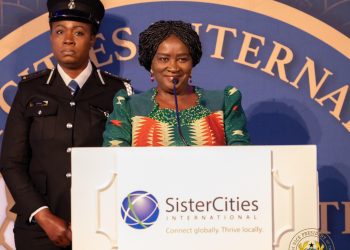
Speaking during a meeting with the European Union (EU) Ambassador to Ghana and other EU Heads of Mission accredited to Ghana, Foreign Affairs Minister, Shirley Ayorkor Botchwey underscored the need for a concerted effort to ensuring the security and safety along the Gulf of Guinea.
“Ghana welcomed initiatives by international partners such as the EU’s CMP to support Gulf of Guinea countries in their efforts to safeguard the safety and security of the maritime area, she stated”.
The discussions also centered on the EU’s Coordinated Maritime Presence (CMP) as well as other efforts by European countries to eradicate maritime insecurity in the Gulf of Guinea.
According to Madam Ayorkor Botchwey “the Gulf of Guinea connects maritime traffic of multiple continents with its export and import potential, making it an indispensable part of global trade and added that the discovery of offshore hydrocarbon deposits has increased the geostrategic importance of the Gulf of Guinea.”
She indicated, however, that the blue economy potential of the Gulf of Guinea was being undermined by a plethora of illicit activities and insecurities in the maritime domain and observed further that for over a decade piracy and other maritime crimes such as Illegal, Unreported and Unregulated (IUU) fishing have been on the rise and are posing serious threats to the safety and security of shipping.
Madam Ayorkor Botchweysaid Ghana was actively engaged in regional efforts to ensure maritime security through the Multinational Maritime Coordination Centre (MMCC) (Ghana falls within the maritime Zone ‘F’ of this Centre/architecture whilst other Member States fall within zones ranging from ‘A to G’), which was established by ECOWAS with the aim of developing a regional framework to counter piracy and armed robbery at sea.
According to the Minister, the MMCC Zone F, within which Ghana falls, undertook activities such as the monitoring of ports, fishing activities, oil and gas exploration and critical maritime installations (such as the West African Gas Pipeline).
Madam Ayorkor Botchwey explained that “Zone F conducts profiling of vessels of interest and vessels vulnerable to attack, and shares information with stakeholders and partners at the national, regional and international levels.”
The Minister pointed to the existence of regional and sub-regional frameworks in place at the level of the African Union (AU) and Regional Economic Communities (RECs) to tackle maritime insecurity in the Gulf of Guinea and urged the EU and European countries to help in strengthening them to be more efficient.
Madam Ayorkor Botchwey emphasized the need to hold broad consultations with key Ghanaian stakeholders in maritime security such as the Ghana Navy and Ghana Maritime Authority to receive more technical and informed inputs specific to Ghana’s maritime security needs.
She urged the EU to coordinate with Gulf of Guinea countries within the ambit of regional/multilateral organizations such as the Gulf of Guinea Commission (GGC), ECOWAS and ECCAS.
The Foreign Affairs Minister appealed to international partners to patrol the territorial waters of Gulf of Guinea Member States to do so with utmost respect for their sovereignty and territorial integrity.
She requested the EU’s provision of a document on the detailed implementation strategy of the CMP for Ghana’s information.
The Head of European Union Delegation to Ghana, Ambassador Diana Acconcia, on her part assured of EU’s continuous support for maritime security in the Gulf of Guinea.
Source: Henry George Martinson@radiogoldlive.com