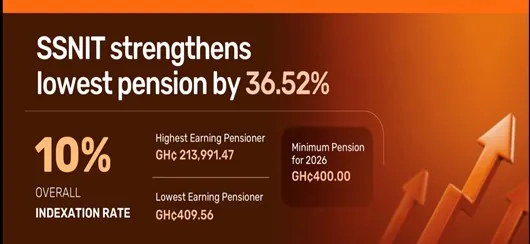
The Social Security and National Insurance Trust (SSNIT), in consultation with the National Pensions Regulatory Authority (NPRA), has announced a 10 per cent pension indexation for 2026, a move expected to deliver significant relief to low-income retirees, with the lowest pension band rising by more than 36% under a redistribution model designed to protect Ghana’s most vulnerable pensioners.
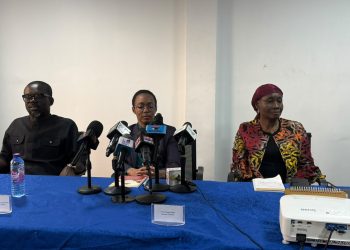
The announcement was made today at a press event at the Labadi Beach Hotel in Accra, where SSNIT outlined how the approved indexation will be applied across pension categories to preserve pensioners’ purchasing power while safeguarding the scheme’s long-term sustainability.
SSNIT said the indexation forms part of its statutory obligation under Section 80 of the National Pensions Act, 2008 (Act 766), which requires the Trust to periodically adjust pensions to help maintain their real value over time.
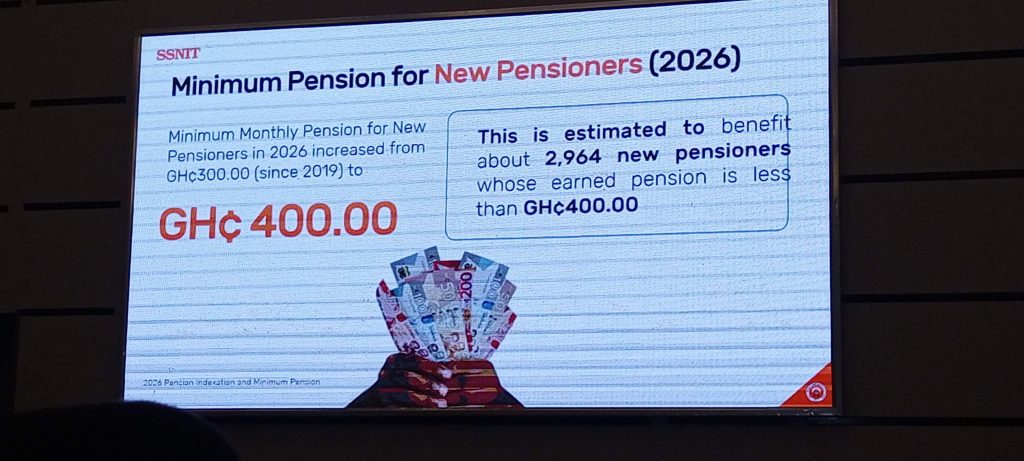
As part of the 2026 package, SSNIT announced that the minimum monthly pension for newly retired pensioners has been increased from GH¢300.00 to GH¢400.00, an improvement the Trust describes as a major step toward strengthening social protection for pensioners at the lower end of the scheme.
SSNIT explained that the adjustment was informed by prevailing economic and actuarial factors, including salary growth among active contributors, projected inflation, and the need to balance pension adequacy with sustainability.
How the 10% Indexation will be applied
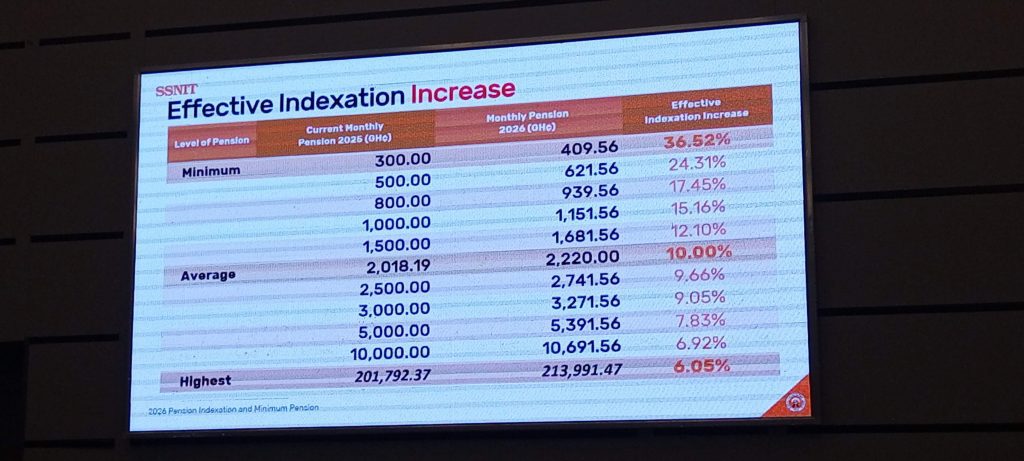
Rather than applying the 10% as a uniform increase across all pensioners, SSNIT said the 2026 adjustment will be implemented through a blended structure: a fixed 6 per cent across the board, plus a flat redistributed amount of GH¢91.56 drawn from the remaining 4 per cent component of the indexation.
The Trust said the approach is intentional, to ensure pensioners on lower pensions feel a more meaningful uplift than those at the top end of the scale.
Under the redistribution model, pensioners who were previously receiving the minimum pension of GH¢300.00 will now receive GH¢409.56, representing an effective increase of 36.52%, one of the strongest improvements for the lowest pension category under SSNIT’s indexation framework.
SSNIT said the mechanism is aimed at narrowing disparities within the scheme and ensuring that the indexation offers real protection, particularly for pensioners who are most vulnerable to rising living costs.
“The redistribution of benefits is intended to narrow the gap between the low and high-earning pensioners,” SSNIT stated, explaining that pensions in defined benefit schemes are based on salaries on which contributions were paid, naturally creating differences across pension bands.
“This demonstrates the solidarity concept that underpins social security,” the Trust added.
SSNIT also disclosed how the adjustment affects high earners. The Trust said the highest pensioner, who earned GH¢201,792.37 as of 31 December 2025, will receive GH¢213,991.47 after indexation in 2026, reflecting the same overall structure but with less dramatic percentage impact compared to the lowest pension group.
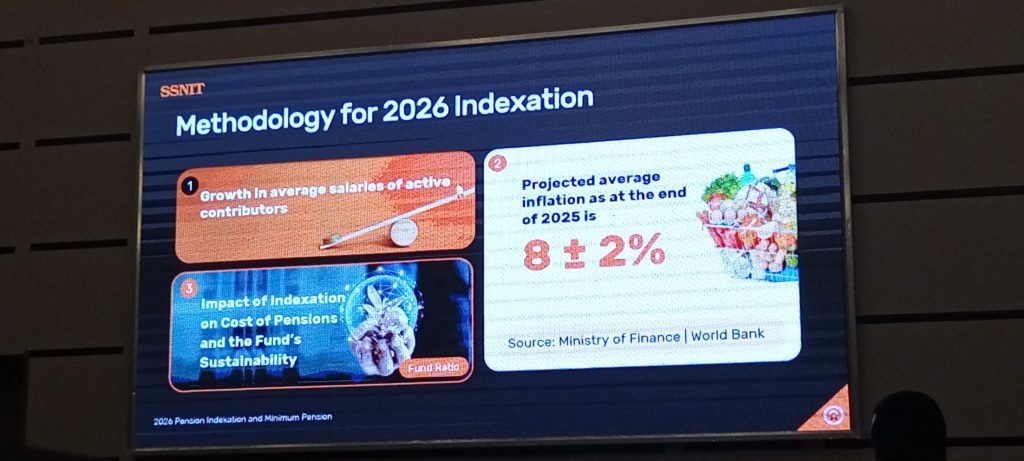
SSNIT stressed that the 2026 indexation is designed to protect retirees while also ensuring the pension scheme remains sustainable over time: “The indexation reflects prevailing economic conditions and is designed to ensure pensions remain responsive while maintaining sustainability for future generations.”
The Trust said the 2026 pension indexation highlights SSNIT’s commitment to strengthening pension adequacy, improving equity within the scheme, and reinforcing confidence in Ghana’s national social security system.