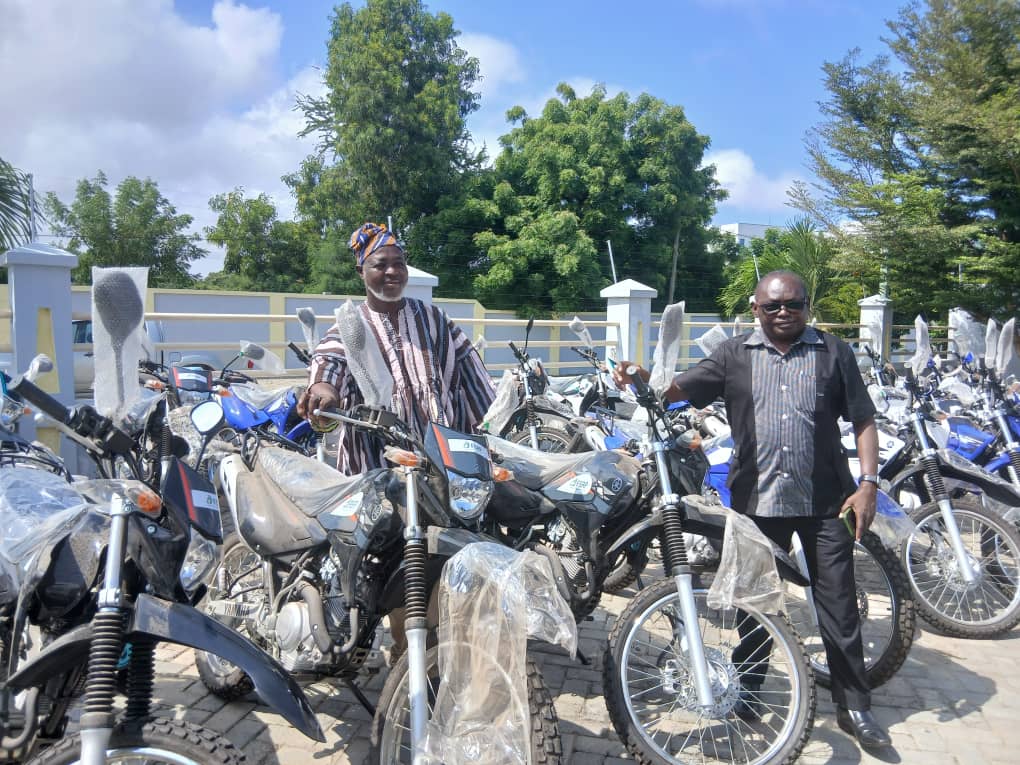
As part of efforts to improve mobility and field outreach, the Ministry of Food and Agriculture has procured 500 motorbikes for agricultural extension officers and Feed Ghana coordinators.
The first batch of 150 motorbikes—30 of which are gender-friendly to support female officers—was officially handed over to the Project Coordinator of the Food Systems Resilience Project (FSRP) for onward distribution.
Speaking at the handover ceremony, the Minister for Food and Agriculture, Hon. Eric Opoku, emphasized that transforming agriculture requires building a strong foundation—starting with effective soil management, improved seed and fertilizer use, enhanced extension service delivery, and the formation of farmer cooperatives.
The Minister described the current farmer-to-extension-officer ratio—approximately 1:1500—as a serious bottleneck that undermines productivity. To bridge the gap, the Ministry is recruiting additional personnel under the “Feed Ghana” initiative to work with district directors in supporting farmers across the country.
“Extension officers are the critical link between agricultural research and farmers. Without them, all our research breakthroughs will never reach the people who need them most,” he noted.
Hon. Eric Opoku also announced a comprehensive set of reforms aimed at revitalizing Ghana’s agricultural sector to address rising food insecurity and widespread poverty. According to him, despite Ghana’s immense agricultural potential, the country remains trapped in a paradox of food scarcity, with many citizens being pushed into abject poverty due to a weak and underperforming food system.
With support from the Food and Agriculture Organization (FAO) and AGRA, he revealed plans to procure modern equipment to support district-level soil testing. This move, according to Hon. Opoku, aims to end the blanket application of fertilizers that has failed to yield the desired productivity gains. Additionally, equipment for testing fertilizer efficacy and seed viability has been provided to ensure that only high-performing inputs are used in Ghana’s agricultural zones.
“We are laying a solid foundation upon which sustainable food production can be built. Testing soil and seeds before application is now a necessity, not an option,” the Minister stated.
In a major policy shift, the Ministry has also pushed for the formation of Community Commodity Farmer Cooperatives to promote group farming, improve education and technology transfer, and simplify access to agricultural financing.
“As of today, we have successfully registered 42,822 farmer cooperatives across the country,” Hon. Opoku announced. “These cooperatives will make it easier for farmers to access loans, receive training, and connect directly with buyers—ultimately boosting food production and reducing post-harvest losses.”
The Project Coordinator for FSRP, Mr. Osei Owusu Agyeman, highlighted Ghana’s strategic approach to the project, which is anchored on three core principles: sustainability, ownership, and public-private engagement.
He acknowledged that the country’s food systems remain vulnerable to climate variability, especially given the ecological significance of the Volta River Basin—which accounts for 25% of Ghana’s land mass and originates from Burkina Faso.
He said the motorbikes would be used for their intended purpose: improving the effectiveness of extension work.
Earlier in the morning, the Agric Minister officially inaugurated the newly revitalized board of PBC Shea Ltd at the Ministry. The board is expected to oversee the operations and strategic direction of the shea industry. It will play a key role in ensuring value addition, job creation, and enhanced market opportunities for producers, particularly women in northern Ghana.
Story by Osman Issah