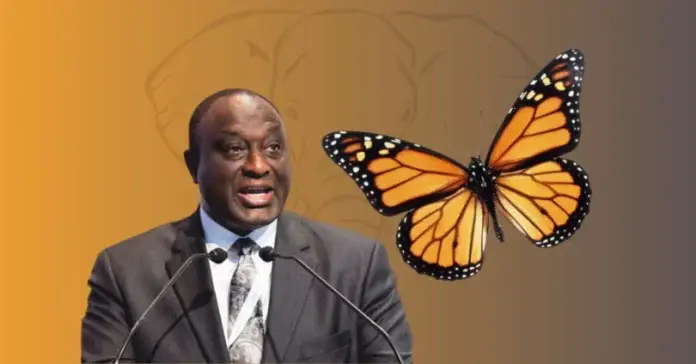
The launch of the United Party Plus (UP Plus) by Alan John Kwadwo Kyerematen marks yet another attempt to disrupt Ghana’s entrenched two-party system Emerging from the rebranded Movement for Change (MfC), UP Plus enters the political arena with historical resonance and renewed ambition. Yet, its prospects must be assessed against the structural realities of Ghana’s Fourth Republic, where the New Patriotic Party (NPP) and the National Democratic Congress (NDC) have maintained a near-monopoly on electoral outcomes since 1992.
Since the return to constitutional rule, Ghana’s political landscape has been defined by the dominance of the NPP and NDC, who together have consistently secured more than 90 per cent of the national vote. In the 2020 elections, their combined share reached an extraordinary 99.2 per cent, leaving less than one per cent for all other parties and independents combined. This duopoly has proven remarkably resilient, absorbing or neutralizing breakaway movements that have emerged at various points in the electoral cycle. From the splinter parties of the late 1990s and early 2000s, through the Progressive People’s Party (PPP) and the Ghana Union Movement (GUM), to the MfC and the New Force in 2024, the story has been one of limited impact and eventual dissipation.
The MfC, however, has managed to remain visible beyond the 2024 elections through sustained media engagement and now through its rebranding as UP Plus. This continuity distinguishes it from many of its predecessors, which often faded into obscurity after a single electoral cycle. Yet visibility alone does not translate into political traction. The real test lies in whether UP Plus can build durable grassroots structures across the country’s more than 40,000 polling stations. Without such organizational depth, the party risks becoming another personality-driven project, dependent on the charisma of its founder rather than on institutional resilience.
History offers sobering lessons. Smaller parties that have attempted to anchor themselves in specific regions or constituencies have struggled to sustain momentum. The Great Consolidated Popular Party (GCPP) concentrated efforts in Greater Accra, the Convention People’s Party (CPP) once held sway in Ellembelle and Jomoro, and the PPP targeted Komenda-Edina-Eguafo-Abirem (KEEA). Yet these footholds proved fleeting, as electoral results failed to justify the investment of resources. The Ghanaian voter, accustomed to the binary contest between NPP and NDC, has often interpreted such inconsistency as a lack of seriousness or readiness to govern.
The constitutional framework further complicates the prospects of third forces. Under the 1992 Constitution, the president must appoint a majority of ministers from Parliament. This requirement makes parliamentary representation indispensable for any party aspiring to govern. Yet, smaller parties have consistently failed to win seats. The PPP, once promising, contested 211 constituencies in 2012, 163 in 2016, and only 21 in 2020—without securing a single seat. The GUM contested 80 seats in 2020 but also failed to win any. Such patterns reinforce the perception that these parties are electoral vehicles rather than viable institutions of governance.
For UP Plus, the challenge is, therefore, twofold. First, it must resist the gravitational pull of co-optation, whereby leading figures of smaller parties are absorbed into the NPP or NDC, often in exchange for ministerial appointments or political survival. Second, it must demonstrate consistency in contesting parliamentary seats, targeting winnable constituencies, and sustaining grassroots activity between elections. Without this, the party risks being remembered as another fleeting experiment in Ghana’s long history of third-force politics.
Alan Kyerematen’s personal performance in the 2024 elections underscores the scale of the challenge. Running as an independent candidate, he secured only 0.26 per cent of the vote, trailing behind Nana Kwame Bediako’s 0.73 per cent. Both men appeared on the ballot without the full weight of their movements, highlighting the difficulty of translating media visibility into electoral success. For UP Plus to move beyond symbolism, it must, therefore, prioritize parliamentary strategy. By calculation, a party would need at least six seats in Parliament to form a government if it were to win the presidency. This should be the minimum target for any aspiring third force.
The launch of UP Plus could have sent a stronger grassroots signal had it been strategically anchored in constituencies or regions where Alan’s appeal is strongest, such as the Ashanti Region. Instead, the national unveiling risks being interpreted as another top-down initiative without clear territorial grounding. To break the cycle, UP Plus must adopt a “beachhead strategy,” concentrating resources in a handful of constituencies, building polling station branches, and cultivating shadow MPs who remain active between elections. Only then can it begin to erode the perception that Ghana’s politics is permanently locked into a two-party system.
In the end, the relevance of UP Plus will not be determined by the fanfare of its launch but by its ability to endure, organize, and win. Ghana’s political history is littered with the remnants of once-promising third forces. To avoid this fate, UP Plus must transform itself from a rebranded movement into a rooted institution, capable of contesting power not only at the presidential level but also in Parliament and at the grassroots. Anything less will leave the NPP and NDC’s three-decade duopoly unshaken.
Source: IMANI