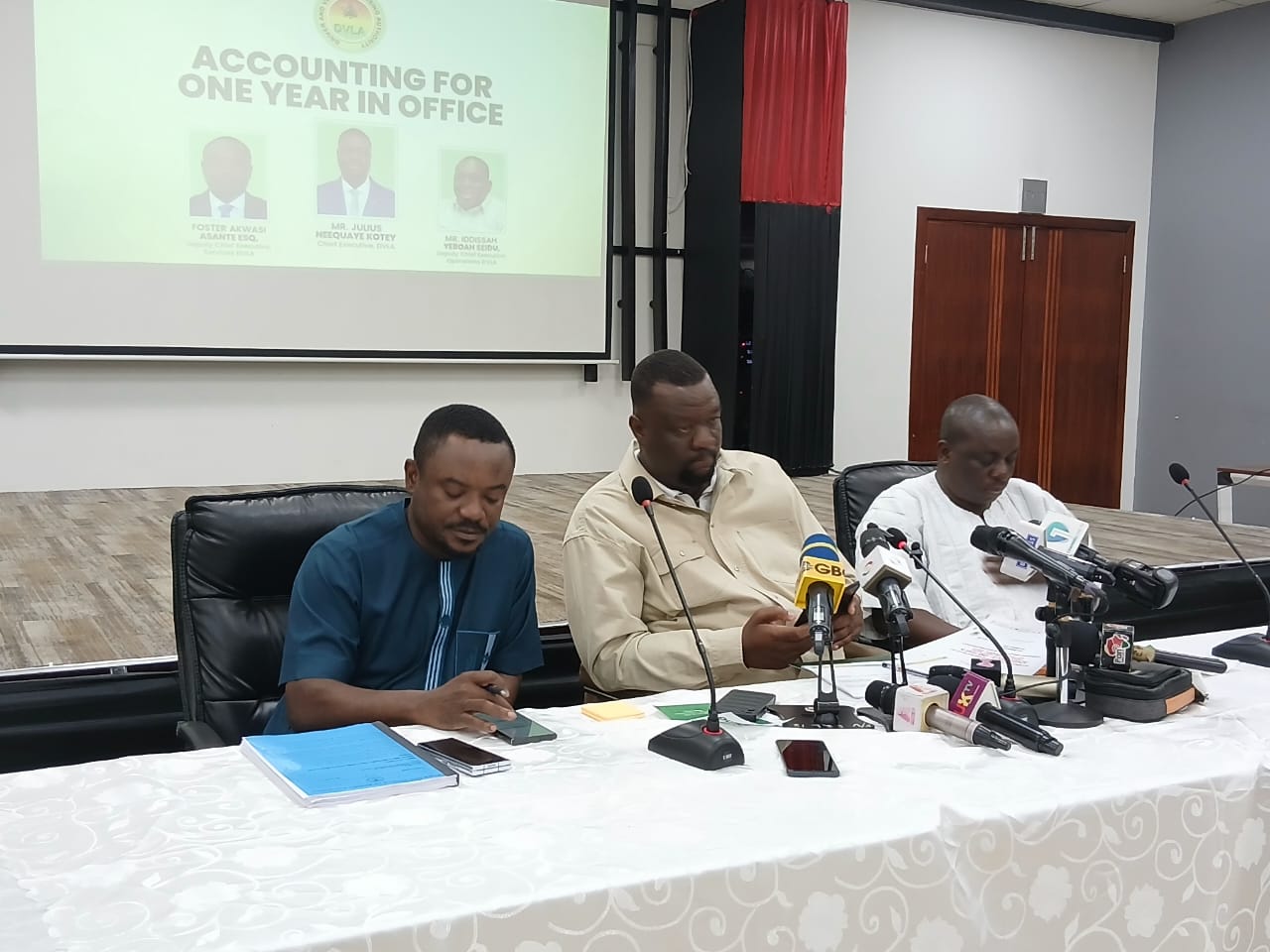
The Chief Executive Officer of the Driver and Vehicle Licensing Authority (DVLA), Mr. Julius Neequaye Kotey, has outlined major reforms and achievements chalked up by the Authority within his first year in office, emphasizing transparency, innovation, and public accountability.
Speaking at a press conference to mark one year since assuming office, Mr. Kotey said the current administration has aligned DVLA operations with government policy direction and board-approved budgets while undertaking far-reaching reforms to meet stakeholder expectations.
“One of our first major achievements was the registration of earth-moving equipment at the ports of entry,” he disclosed. “When we came into office, we realized that most of the equipment seized by the police were not registered with the DVLA. We therefore took the initiative to register these machines at the point of entry into the country.”
According to him, more than 3,000 earth-moving equipment were registered last year alone, bringing the total number of registered excavators and agricultural equipment to about 9,240 nationwide.
Mr. Kotey also announced the introduction of a new vehicle registration and number plate system, uniquely designed and produced entirely in-house without the use of external consultants.
“Everything was done internally by our own staff. We did not engage any consultancy,” he stressed. “Every design is affiliated with a particular vehicle, depending on the car type and ownership.”

On revenue reforms, the DVLA CEO said the Authority introduced a new sticker policy after securing Cabinet approval. He noted that when the administration took office, sticker issuance was as low as 1,000 per month.
However, since August last year, the Authority has recorded between 10,000 and 16,000 sticker issuances monthly, with December recording the highest figures.
He further outlined improvements in licensing operations, including the clearing of license backlogs, enhanced insurance processing, and the initiation of a project to tie license expiry dates to holders’ dates of birth to ensure continuous and predictable renewals.
To improve service delivery, Mr. Kotey said the DVLA has established and commissioned multiple regional offices, including 24-hour service centers, and extended services to additional regions.
The Authority has also opened branch offices at bus terminals and other strategic locations to bring services closer to communities.
He highlighted partnerships with key stakeholders such as SIC Insurance and collaboration with the National Identification Authority (NIA) to provide integrated services at selected stations.
In the area of digital communication, the DVLA has introduced SMS notifications to alert motorists of upcoming license expirations.
The Authority has also deployed gadgets and service buses to support 24-hour operations and boost the operational capacity of its stations.
Mr. Kotey disclosed plans to strengthen staff capacity through training and the establishment of a school development sector, alongside public education and outreach campaigns to raise awareness on DVLA services and reforms.
“Our administration is working on a project to ensure continuous services and improve public convenience,” he said, adding that innovation and public accountability remain central to achieving the institution’s goals.
He reaffirmed the DVLA’s commitment to modernizing its operations and delivering efficient, transparent, and accessible services to the Ghanaian public.
Story by Osman Issah Abadoo