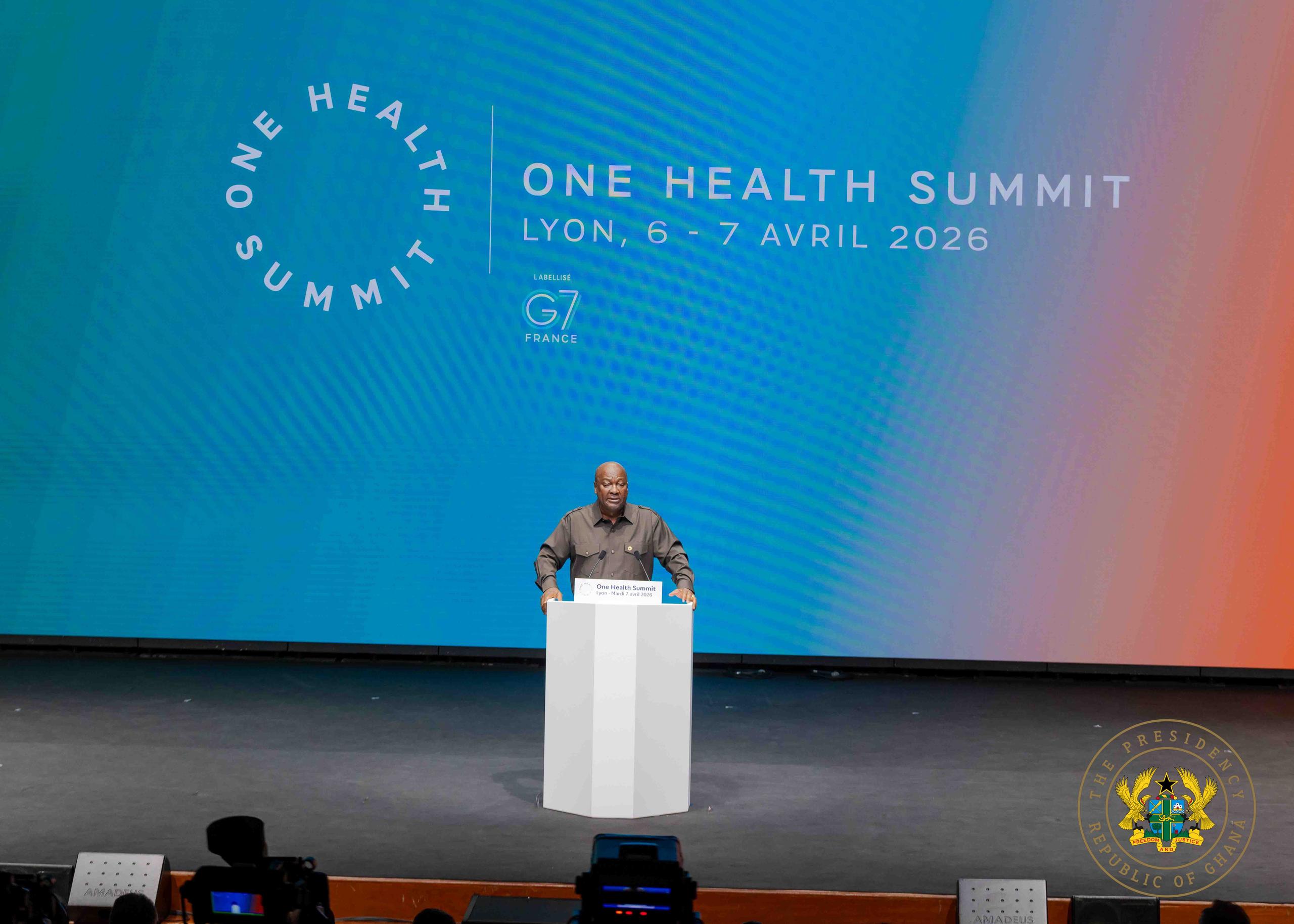
President John Dramani Mahama has issued three urgent calls to action to world leaders at the One Health Summit 2026, warning of a dangerous convergence of climate change, disease, and global inequality.
Addressing the high-level gathering on Tuesday in Lyon, the President stressed that global leaders must move beyond commitments and deliver tangible results.
“The period of declarations must come to an end. The moment for coordinated effort is here, and let us start from Lyon,” he declared.
From Commitments to Action
President Mahama’s first call centred on shifting from promises to implementation, urging leaders to prioritise concrete outcomes over repeated pledges.
He emphasised that the One Health approach must be fully integrated into national development strategies and aligned with a broader global public health framework.
“Let us connect our One Health strategies for our national development agendas to a new global framework for public health,” he urged, adding that international security systems must also adopt the approach.
Building Preventive Systems
His third key call focused on prevention, highlighting the importance of early detection and rapid response systems.
“Let us concentrate on building a new preventive shield and an intelligent radar system at its source,” he said.
He explained that community-level early warning mechanisms remain the strongest defence against future pandemics, stressing that such systems must be:
“smart, dynamic, agile and interoperable” to ensure efficiency and avoid unnecessary bureaucracy.
Climate Change Driving Global Health Threats
Beyond the calls to action, President Mahama warned that the world is facing an unprecedented surge in cross-border health threats affecting humans, animals, and plants.
“Around the world, we are facing an overwhelming surge of health threats across borders. Every species is in the crosshairs—animals, humans and plants,” he stated.
He identified climate change as the central driver of these risks.
“At the foundation of all these crises is the phenomenon of climate change; everything is interconnected,” he said, pointing to links between infectious diseases, antimicrobial resistance, and food system disruptions.
Ghana’s Experience and Environmental Concerns
Drawing from Ghana’s experience, the President highlighted the impact of environmental degradation on livelihoods.
“Diseases and pests are affecting smallholder cocoa farmers,” he noted, adding that illegal mining continues to damage ecosystems.
“Illegal gold mining leads to forest degradation and pollution of our water bodies, threatening the survival of precious populations of birds and insects.”
He also raised alarm over plastic pollution:
“Plastic pollution is poisoning all our ecosystems. We must advance international action in dealing with plastic pollution.”
Addressing Global Inequality
President Mahama described global health inequality as unacceptable, noting that the most vulnerable countries often lack the resources to respond.
“The countries that are most at risk have the least resources to cope. This must change,” he stressed.
He called for equitable access to financing, technology, data, and innovation, adding that a stronger Africa would benefit the world.
“A healthy and thriving Africa is no threat to anyone. It will be a positive force for global progress.”
Prevention Over Cure
Making a case for prevention-led systems, the President emphasised cost-effectiveness and sustainability.
“Prevention is not only more effective, but also much more cost-effective than cure,” he said, citing Ghana’s rollout of the Ghana Medical Trust Fund and strengthened primary healthcare.
Africa’s Knowledge Systems and Lessons from Pandemics
President Mahama also highlighted Africa’s traditional knowledge systems as foundational to the One Health concept.
“In Africa, our lived experience leads us to accept without question that human survival, animal well-being, and environmental care form a single interconnected system,” he said.
Referencing past outbreaks, including COVID-19, Mpox, Lassa fever, and Marburg, he noted that global systems remain slow to adapt.
“Each crisis has highlighted the importance of the One Health approach,” he said.
A Call for Political Will
He urged leaders to demonstrate stronger political will in addressing fragmented global systems.
“Let Lyon be the turning point,” he declared.
Shaping the Future of Global Health
Concluding his address, President Mahama underscored the significance of decisions taken at the summit.
“The decisions we make at this summit will shape the future of global health security let us ensure that they result in tangible, measurable outcomes for our people and our planet.”
The summit, hosted by France under its G7 Presidency, has brought together global leaders and experts to advances coordinated action on the interconnected health of humans, animals, and ecosystems.
Story: Patrick Asford Boadu