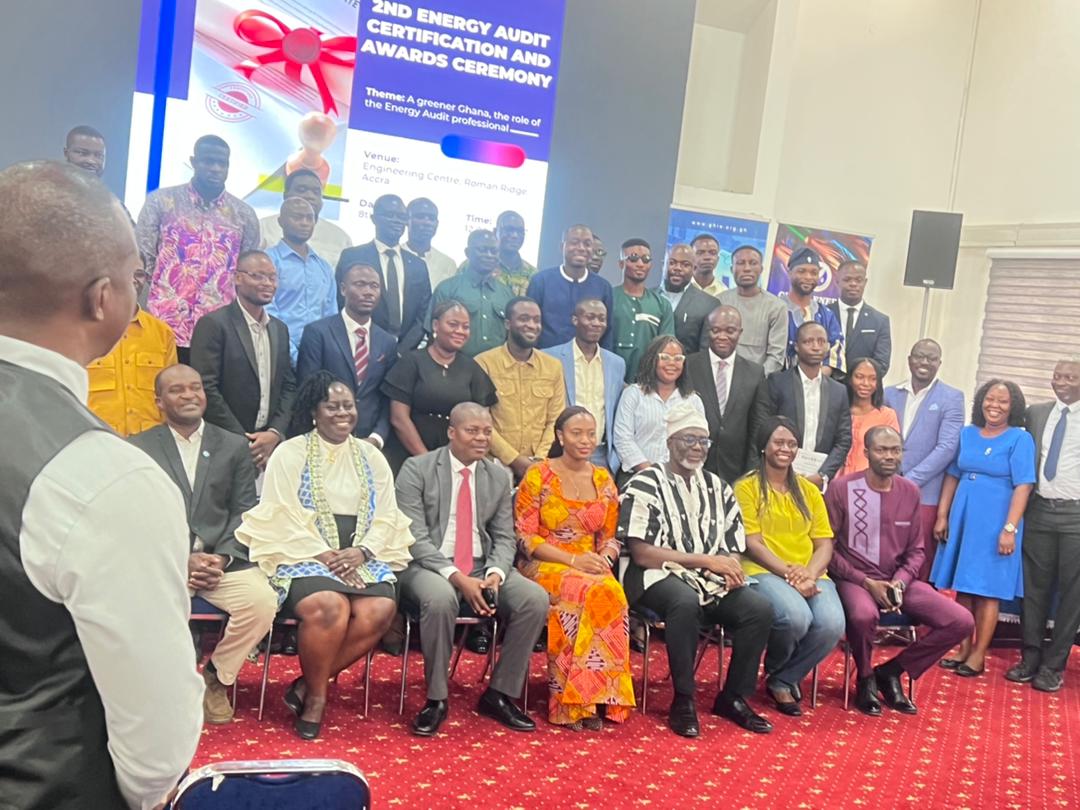
The Energy Commission has inducted a new cohort of certified Energy Audit Professionals, marking a significant step toward strengthening energy efficiency and sustainability efforts across the country
The ceremony, held at the Ghana Institute of Engineering (GhIE), Accra, served as a rallying cry for “wiser power” consumption amidst a strategic national shift toward sustainability and green transition. It brought together government officials, industry stakeholders, and energy experts to celebrate the successful completion of training by the newly certified professionals. The programme forms part of the Commission’s ongoing efforts to promote prudent energy use and build local capacity in energy management.
The event featured keynote addresses from the leadership of the GhIE and the Energy Commission, both highlighting the critical role of energy auditing in stabilizing the national grid and curbing economic waste.
The Chairperson of the event and immediate past President of the GhIE, Kwabena Bempong, characterized the induction not merely as a graduation, but as a “blueprint for national transformation.” He noted that the strategic redesignation of the Ministry of Energy to the Ministry of Energy and Green Transition in January 2025 signaled a definitive shift toward climate action.
Bempong challenged the new inductees to act as “detectives of inefficiency,” identifying energy leaks in factories, hotels, and government offices. He revealed that recent audits of metropolitan buildings in Accra identified air conditioning and lighting as the primary sources of energy waste.
”You are now going to be the detectives of inefficiency, the calculators of savings, and the trusted advisors who turn data into decisive action,” Bempong stated.
He further advocated for making energy audits mandatory for all public and private buildings to ensure consistent efficiency standards across the country.
Addressing the global energy landscape, he highlighted the volatility of fossil fuel markets, noting that Brent crude prices had fluctuated wildly from $107 to $94 per barrel in a single 24-hour period. He warned that with global reserves depleting, Ghana must accelerate its transition to renewables under the Renewable Energy Act, 2011 (Act 832).
Citing the famous observation of Sheikh Ahmed Zaki Zamani, Bempong reminded the audience that “the stone age came to an end, not for lack of stones, and the oil age will end, but not for the lack of oil.” He urged the professionals to reduce national energy waste, noting that Ghana loses millions of cedis annually to oversized motors, leaky compressed air systems, and inefficient HVAC units.
The Acting Executive Secretary of the Energy Commission, Adwoa Serwaa Bondzie, described energy efficiency as the nation’s “first fuel”, the fastest and cleanest way to meet rising demand.
Under the Energy Commission Act 1997 (Act 541), the Commission is moving toward implementing energy performance certifications for all buildings. Bondzie emphasized that the work of these professionals is vital to the Integrated Power System Master Plan (IPSMP), which coordinates national energy planning.
”An Energy Audit Professional is not merely a technician. You are the bridge between energy consumption and energy conservation,” Bondzie remarked.
Both leaders stressed the importance of ethical conduct. Bempong warned inductees to resist pressure from clients to inflate savings reports or overlook non-compliance, stating that “a greener Ghana cannot be built on false reports.”
She echoed this sentiment, urging the graduates to uphold the highest standards of practice as they support the government’s agenda for fiscal sustainability. She acknowledged the partnership of the Ghana Institute of Engineering, the Millennium Development Authority (MiDA), and the Sustainable Energy Service Centres in making the certification program a success.
”A greener Ghana is not a distant dream,” she concluded. “It is a practical and achievable goal, but it requires deliberate action, collaboration, and commitment.”
Story By: Eugenia Ewoenam Osei