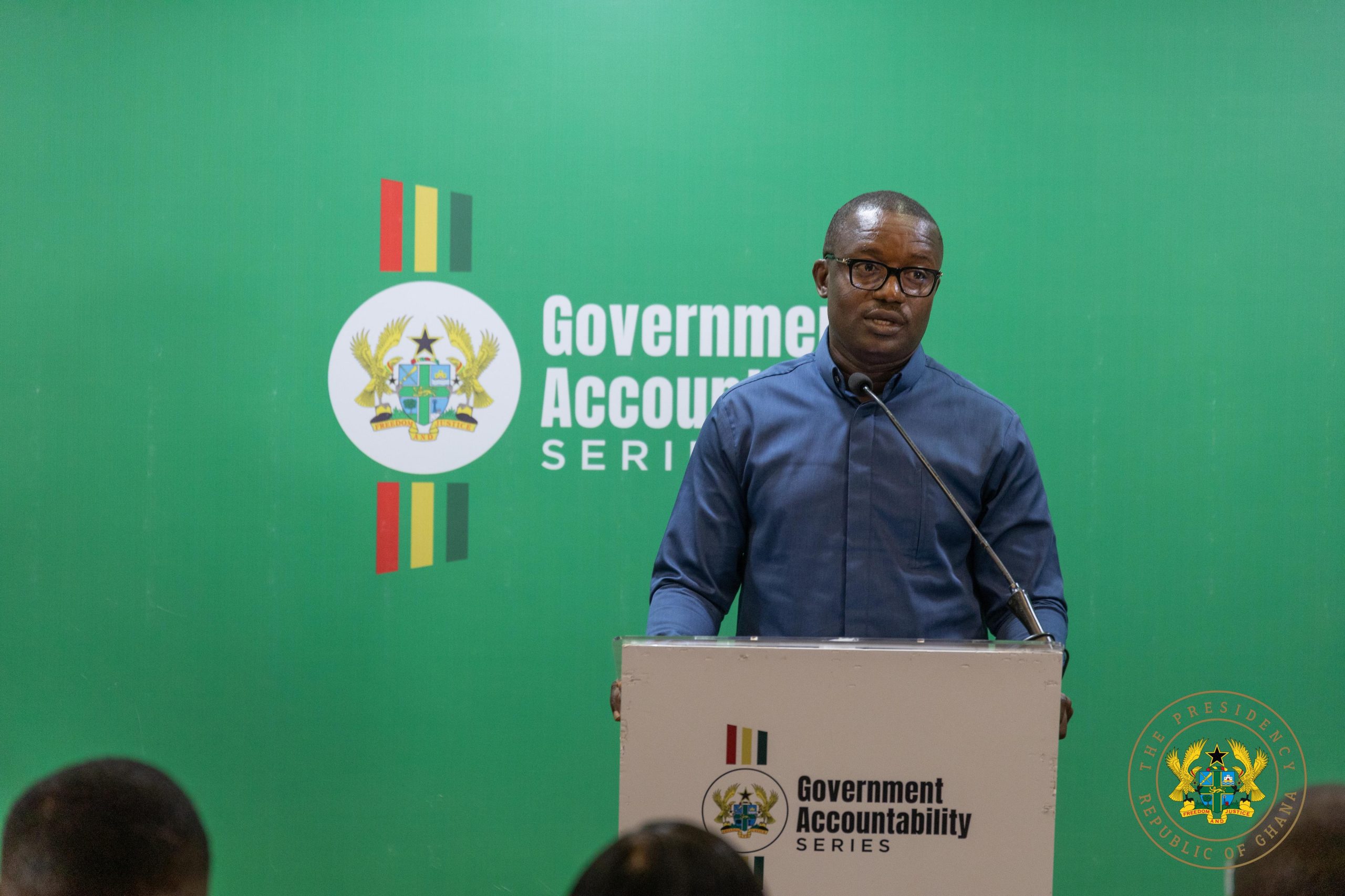
Ghana’s Minister for Energy and Green Transition, John Abdulai Jinapor, has assured the public that government is taking urgent steps to restore stability to the power sector following a major fire incident at the Akosombo Dam substation.
Speaking at the Government Accountability Series, the Minister described the incident as “one of the most serious and unprecedented disruptions” in Ghana’s energy sector, revealing that the fire severely damaged the control room responsible for power evacuation, leaving over 1,000 megawatts of electricity stranded.
Sector Gains Before the Setback
Mr. Jinapor emphasized that the disruption comes after a period of significant progress in stabilizing Ghana’s power supply.
“Over the past 15 months, we have worked with focus and discipline to stabilize the sector,” he said, noting that a 700-megawatt deficit inherited in 2024 had posed a major threat to national productivity.
He outlined key reforms across the energy value chain, including improvements in power generation, transmission, and distribution, as well as enhanced gas supply from Jubilee, TEN, and eNGAS fields.
The Minister also cited increased financial discipline within the Electricity Company of Ghana and the Northern Electricity Distribution Company, alongside the payment of over $1.4 billion in energy sector debts and restoration of a $500 million World Bank-backed partial risk guarantee.
Impact of the Akosombo Incident
Detailing the outage, Mr. Jinapor explained that although power generation at Akosombo continued, the destruction of the control room prevented transmission of electricity into the national grid.
“When you lose the control room, you cannot evacuate power. It cripples a critical component of the transmission system,” he said.
The resulting disruption has led to outages across parts of the country, with the Minister acknowledging the inconvenience caused to households and businesses.
Emergency Response and Restoration Efforts
Government, he said, has responded with urgency. Engineers have been working continuously under difficult conditions, with initial success already recorded.
“I am pleased to inform you that the first generation unit has been restored, and a second unit is now operational,” he announced, adding that work is ongoing to bring additional units online.
He expressed strong appreciation to engineers and technical teams from the Volta River Authority and the Ghana Grid Company for their dedication.
Load Management and Public Communication
Mr. Jinapor indicated that due to the fluid nature of the situation, power outage schedules will be issued in short intervals rather than fixed weekly timetables.
“We will be honest with Ghanaians. When we face challenges, we will tell you,” he said, stressing transparency in government communication.
Investigation Underway
To determine the cause of the fire, the Minister has constituted an independent technical committee chaired by Ing. William Amuna. Security agencies are also conducting parallel investigations into possible negligence or criminality. A report is expected within two weeks.
Long-Term Reforms and Infrastructure Upgrades
Beyond the immediate crisis, the Minister outlined broader structural challenges, including aging transformers and rising electricity demand, which has more than doubled over the past decade.
Government has launched a nationwide programme to deploy 2,500 new transformers, with nearly 200 already installed and 140 more expected within the week. Key areas such as Adenta, Lashibi, and Teshie-Nungua have already benefited.
Additionally, the Ghana Grid Company is set to begin major transmission reinforcement works in Kumasi, while Cenit Energy Limited is airlifting critical equipment to support power generation in the Ashanti Region.
Commitment to Stability
Despite the setback, Mr. Jinapor maintained that Ghana’s power sector remains resilient and on a positive trajectory.
“This experience is transient and temporary,” he assured. “We are restoring what has been disrupted and building a stronger, more resilient power system for the future.”
Story: Patrick Asford Boadu