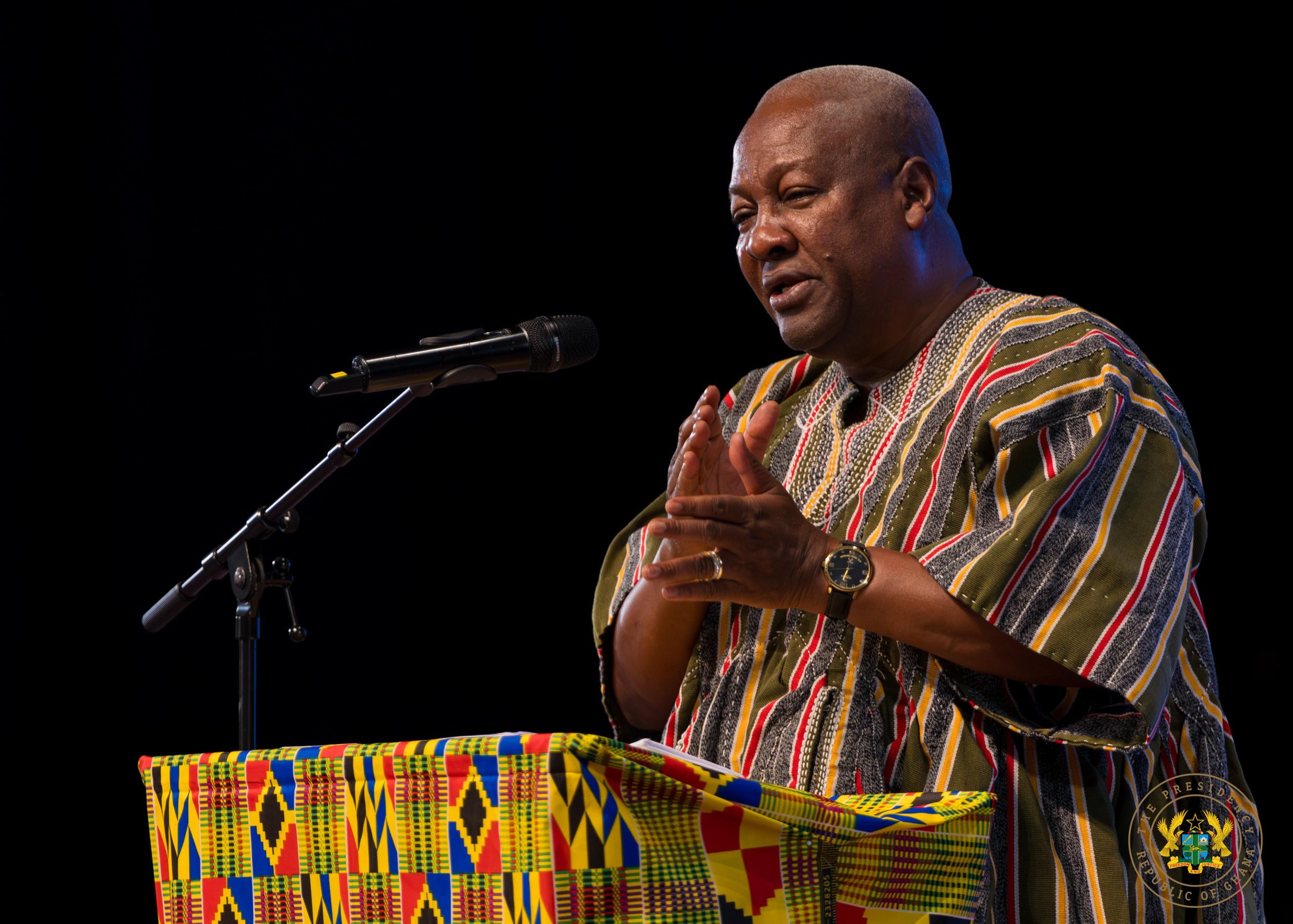
President John Dramani Mahama has reaffirmed his administration’s commitment to expanding opportunities for Ghanaians in the diaspora to participate in national development and governance, while outlining reforms aimed at improving accountability in state-owned enterprises and maintaining fiscal discipline.
Responding to questions during a town hall meeting with the Ghanaian diaspora in London, President Mahama highlighted the contributions of Ghanaians who had returned home from abroad to serve in key positions in government.
“I am proud to say that my Roads Minister, Kwame Agbodza, was Vice-Chair of the East London Chapter, while Ato Forson was also a member of the same chapter,” he said. “This reflects the growing evidence of many of our people in the diaspora returning home and being reintegrated into national systems.”
The President noted that his administration is pursuing constitutional reforms to ensure broader participation of citizens living abroad.
“That is precisely why we are pursuing reforms, including constitutional amendments, to allow greater participation of citizens at every level of governance in Ghana,” he stated.
According to President Mahama, the government’s vision of Ghana as the country’s “17th Region” is intended to strengthen ties with citizens abroad and remove barriers to their involvement in national affairs.
“In the past, dual citizenship or non-residency sometimes limited one’s ability to participate fully in aspects of Ghanaian life. But with the vision of Ghana as the ‘17th Region,’ we believe citizens abroad should be free to return and actively contribute to national development and governance,” he said.
Addressing concerns about brain drain, the President urged Ghanaians abroad to carefully plan any decision to return home.
“I often say that we should not simply tell people to come back home and work without preparation. Relocating without proper planning can be very difficult,” he explained.
“That is why I advise that people take their time, identify what they want to do upon returning, and ensure they are properly grounded before relocating. In this way, we can turn brain drain into brain gain.”
President Mahama described migration as a natural and historic human phenomenon that has shaped societies across the world.
“Migration itself, I believe, is a natural human phenomenon. From time immemorial, people have moved across borders in search of opportunity, exploration, and better living conditions,” he said.
“As our elders say, visitors sometimes bring not only investments but also new ideas that we may not have previously considered. In this sense, migration can result in both brain drain and brain gain, ultimately benefiting everyone.”
Turning to the performance of state-owned enterprises (SOEs), President Mahama revealed that several institutions inherited by his administration were struggling financially and lacked basic accountability mechanisms.
“When we came into office, several state-owned enterprises were struggling. These institutions had become a major obstacle to economic progress,” he said.
The President disclosed that some SOEs had failed to submit audited accounts and annual reports for as long as seven years.
“For instance, we found that some state-owned enterprises had not submitted annual reports or audited accounts for up to seven years. No organisation can be properly run under such conditions,” he stated.
To address the situation, he said compliance with annual reporting requirements has now been incorporated into the performance assessment of chief executives.
“We have therefore made compliance with audited accounts and annual reports part of their key performance indicators.
The deadline has been set by SIGA for the middle of the year, and any CEO who fails to comply will be relieved of their post,” President Mahama warned. He reported that the reforms were already yielding positive results.
“We are restoring discipline and accountability. I am glad to report that several state-owned enterprises have moved from loss-making positions to profitability,” he said.
Citing an example, the President noted that the National Buffer Stock Company had recorded a profit of GH¢60 million for the first time in years.
“For example, the National Buffer Stock Company has recorded a profit of 60 million Ghana Cedis for the first time in years, and others are also beginning to show improved financial performance,” he added.
On preparations for the Black Stars’ participation in the upcoming FIFA World Cup, President Mahama stressed that the government would not compromise fiscal discipline by sponsoring large numbers of supporters to travel from Ghana.
“It will be difficult to transport our supporters from Ghana due to logistical and financial constraints,” he said.
The President explained that Ghana’s group-stage matches would be played across Canada and the United States, significantly increasing travel and accommodation costs.
“The estimated cost per supporter, including tickets, accommodation, transport and feeding, is nearly $11,000,” he revealed. “We are committed to fiscal discipline and therefore cannot justify spending at that scale.”
Instead, the government plans to work closely with organised Ghanaian communities and supporters’ groups already based abroad.
“We will mainly rely on registered supporters’ unions, who have a tradition of following the team internationally and have been part of previous tournaments,” he said.
President Mahama also announced plans to facilitate access to match tickets for members of the Ghanaian diaspora.
“Ghanaian communities in Boston, Philadelphia and Canada have been organised, and tickets purchased will be distributed among them to enable attendance at the games,” he said.
“For those who are able to travel independently, we will facilitate access to tickets so they can attend and support the team.”
Story: Patrick Asford Boadu