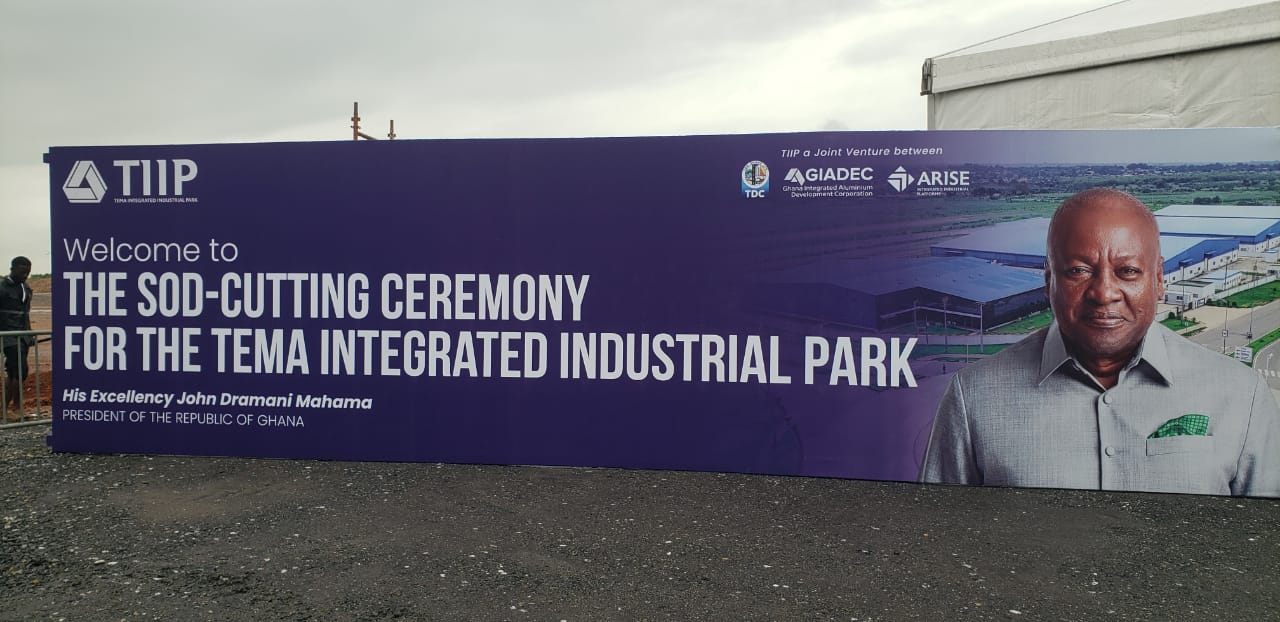
President John Dramani Mahama today cut the sod for the construction of the Tema Integrated Industrial Park (TIIP), a landmark industrial project expected to strengthen Ghana’s manufacturing sector, create thousands of jobs, and accelerate value addition to the country’s natural resources.
The 100-to-120-hectare industrial enclave, located in the Tema Heavy Industrial Area, is being developed to position Ghana as a regional manufacturing hub, with a strong focus on local processing, industrial production, and export-oriented manufacturing.
The project is being undertaken by the Tema Integrated Industrial Parks Company Limited (TIIPco), a special purpose vehicle established through a partnership between TDC Ghana Ltd, the Ghana Integrated Aluminium Development Corporation (GIADEC), and ARISE Integrated Industrial Platforms (ARISE IIP).
Under the partnership, ARISE IIP will provide technical expertise in infrastructure design, construction, operations, and management, drawing on its extensive experience in developing integrated industrial platforms across Africa.
Strategically situated adjacent to the Volta Aluminium Company (VALCO) smelter, the park enjoys direct access to key transport infrastructure, including the Tema Port, while leveraging existing industrial facilities to support efficient manufacturing and logistics.
A major anchor investment within the park is the €300 million (approximately US$341.7 million) aluminium foil rolling mill and Centre of Excellence, which GIADEC signed with Italian industrial firm Danieli in June 2026.
The state-of-the-art facility is expected to process locally sourced aluminium into between 40,000 and 45,000 metric tonnes of aluminium foil annually, supplying pharmaceutical, packaging, food processing, and other industrial markets.
Beyond aluminium processing, the Tema Integrated Industrial Park is projected to create more than 4,000 direct jobs while stimulating significant upstream and downstream industrial activities across the Tema industrial enclave.
The project forms part of the Mahama administration’s broader industrialisation agenda aimed at increasing local value addition, reducing the export of raw materials, strengthening domestic manufacturing, and boosting foreign exchange earnings through the production and export of finished and semi-finished products.
Story: Patrick Asford Boadu