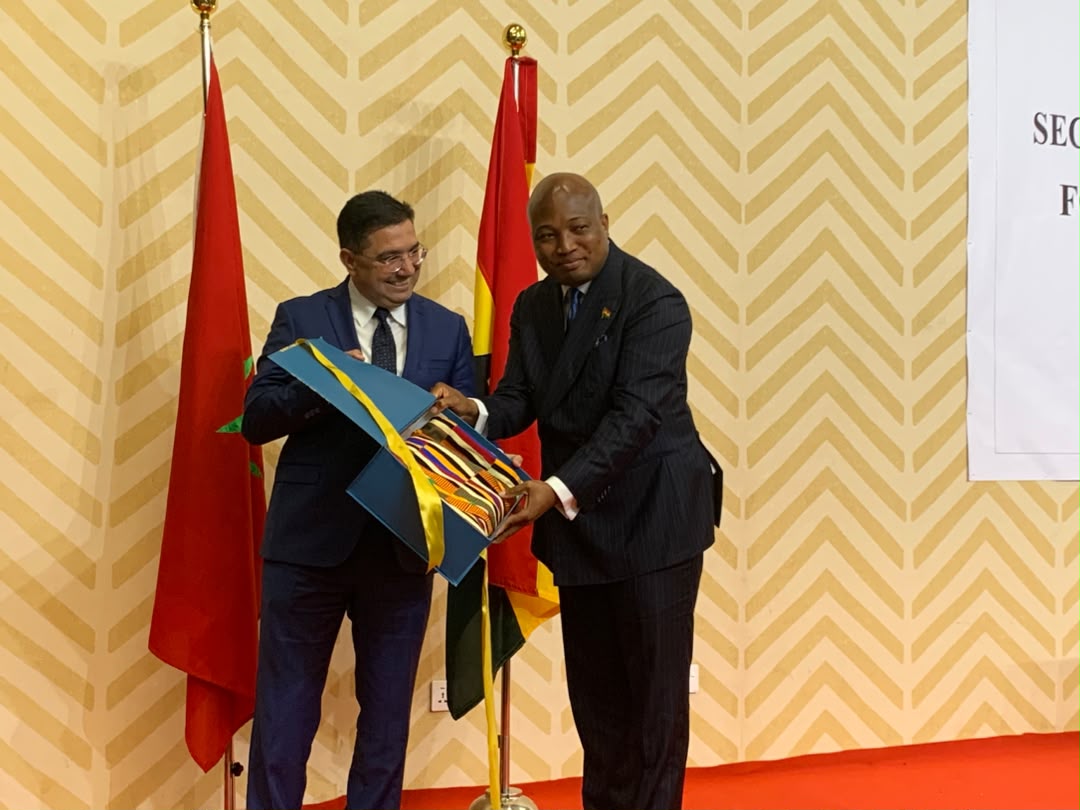
Ghana and Morocco have signed seven bilateral agreements aimed at strengthening cooperation in trade, education, mining and diplomacy, while outlining an ambitious agenda focused on expanding solar energy, advancing the Trans-African Gas Pipeline and achieving pharmaceutical self-sufficiency in Africa.
The agreements were concluded at the Ministerial Session of the Ghana-Morocco Permanent Joint Commission for Cooperation, marking the revival of the commission after an 11-year break since its last meeting in 2015.
Addressing the session, Minister for Foreign Affairs Samuel Okudzeto Ablakwa praised the technical teams from both countries for successfully concluding negotiations, describing the outcome as a significant milestone in Ghana-Morocco relations.
The Ghanaian delegation was led by Ambassador Arola Djimon, Coordinating Director for Political and Economic Affairs, while Morocco’s team was headed by Ambassador Abdelkader BouKhriss, Director of African Affairs at the Moroccan Ministry of Foreign Affairs, African Cooperation and Moroccan Expatriates.
The two countries signed agreements covering mutual administrative assistance in customs matters, standardisation, higher education, vocational training, academic scholarship exchanges and diplomatic training.
A landmark geosciences agreement was also reached between Morocco’s National Office of Hydrocarbons and Mines, Ghana’s Minerals Commission and the Ghana Geological Survey Authority to strengthen collaboration in mineral exploration and geological research.
Beyond the signed agreements, Ghana and Morocco also explored opportunities for cooperation in tourism, defence, maritime security, airport management, petroleum exploration and investment promotion.
Looking ahead, Mr Ablakwa outlined three strategic priorities President John Dramani Mahama has directed the government to pursue in partnership with Morocco.
The first is a major expansion of Ghana’s solar energy sector. With solar currently contributing only about two percent of the country’s energy mix, the government aims to increase that figure to at least 10 percent in the near term. According to the Minister, the move will allow more domestic natural gas to be channelled into value-added industries such as fertiliser production and pharmaceutical manufacturing instead of electricity generation.
The second priority is for Ghana to take a leading role in advancing the Trans-African Gas Pipeline project following recent decisions taken at the ECOWAS Summit.
The third focuses on strengthening Africa’s pharmaceutical sovereignty under the Accra Research Agenda. Mr Ablakwa highlighted Morocco’s US$300 million investment in vaccine manufacturing and called for an African Union-backed regulatory system that would enable African countries to certify vaccines and medicines on the continent rather than relying on external institutions.
He noted that President Mahama intends to champion the initiative as Ghana prepares for upcoming leadership responsibilities within the African Union.
Mr Ablakwa stressed that the real success of the agreements would be measured not by their signing, but by their effective implementation.
He urged both countries to move swiftly in translating the agreements into tangible benefits for citizens, businesses and young people, reaffirming Ghana’s commitment to deepening its partnership with Morocco in the spirit of mutual respect, shared prosperity and African integration.
Story By: Eugenia Ewoenam Osei