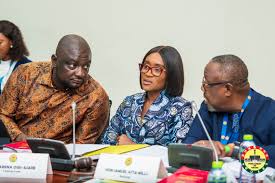
The Chairperson of the Public Accounts Committee, Abena Osei Asare, has identified “gross negligence” in record-keeping and the underutilization of the Ghana Integrated Financial Management Information System (GIFMIS) as the primary drivers of massive financial leakages within state institutions.
Speaking following a committee hearing on the Auditor General’s report, the Chairperson revealed that poor documentation has led to instances where ministries have resubmitted invoices for billions of Ghana Cedis that had already been settled.
The Record-Keeping Crisis
The Chairperson emphasized that while the technical infrastructure to prevent fraud and errors exists, officials responsible for data entry are failing to perform their duties.
”The technical people, the people who are responsible to feed the system with this information, are not doing what is expected of them. If we are able to keep proper documents and records, we will go a long way to block the huge leakages that we see in there,” she stated.
The scale of the oversight is particularly evident in the energy and roads sectors. According to the Chairperson, audit reports have confirmed that “huge sums of monies have already been paid under Ministry of Energy and Ministry of Roads, in the billions of Ghana Cedis,” yet these departments frequently resubmit the same claims because they lack the records to show the debt has been cleared.
Enforcing GIFMIS Compliance
The Committee is now calling on the Minister for Finance to enforce strict adherence to the GIFMIS platform across all Ministries, Departments, and Agencies (MDAs). The Chairperson noted that proper use of the system would “take away more than half of the issues” currently plaguing public accounts.
Responding to concerns that some officials avoid appearing before the committee to answer for infractions, the Chairperson argued that a robust digital record would make individuals irrelevant to the truth-finding process.
”It is not about right people answering questions. If the data is in the system, you shouldn’t have problems speaking to it,” she remarked, citing a recent instance where a representative from the Ministry of Environment successfully defended their accounts solely because they had consistently input data into GIFMIS.
Accountability and Sanctions
The Committee also addressed the issue of perjury, following allegations that some officials may have lied under oath during the hearings. While maintaining that the committee’s primary goal is “to find solutions” rather than “vilify any political party,” the Chairperson warned that legal consequences are on the table.
”When you fall foul of the law in terms of perjury… what ought to happen to you will happen to you. There are sanctions, and the sanctions that are in there will be prescribed accordingly when we put it in our recommendations.”
Path Forward
The Chairperson concluded that solving the documentation crisis would resolve approximately 70% of the infractions cited in the Auditor General’s report. The Public Accounts Committee is expected to present its full report and recommendations to Parliament when the house resumes sitting.
The objective, she stressed, remains the restoration of public confidence: “It is in our interest that we manage the public finance well to know that when you expect anything from government, you also get your fair share in the form of roads, schools, and hospitals.”
Story by: Eugenia Ewoenam Osei