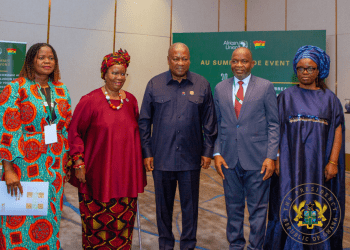
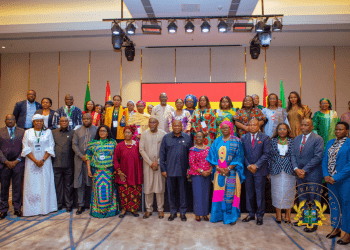
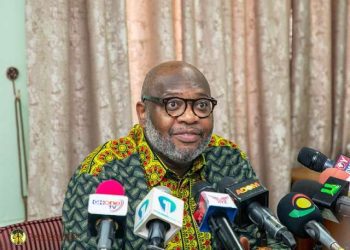
President John Dramani Mahama has declared that Africa has reached a decisive turning point and must move beyond reflection to action, as he officially opened the Accra Reset, Addis Reckoning high-level event on the sidelines of the African Union Summit.
“We are not here to add another side event to a crowded summit calendar,” President Mahama said.
“We are here because Africa has reached a turning point we cannot afford to ignore.”
Addressing fellow heads of state, senior policymakers, and global partners, the President noted that the global environment confronting Africa has fundamentally changed, citing fractured supply chains, cautious global finance, rapid technological advances, and shifting international power dynamics.
“Old assumptions no longer hold,” he stressed. “The familiar mantras of development cooperation have lost their flavour, and there are tectonic shifts in the global rules that have shaped our world for more than eight decades.”
President Mahama traced the evolution of the Accra Reset initiative from the Health Sovereignty Summit in Accra, through engagements at the United Nations General Assembly and the World Economic Forum in Davos, to its current phase in Addis Ababa.
“Today, here in Addis Ababa, we move into action,” he declared.
He paid tribute to members of the Interim Presidential Council of the Accra Reset, describing them as leaders who had shown courage by committing political capital to an idea still under development.
“Leadership is often exercised before certainty arrives,” President Mahama said, as he acknowledged Presidents William Ruto, Abdel Fattah El-Sisi, Bola Ahmed Tinubu, Hakainde Hichilema, Félix Tshisekedi, Faure Gnassingbé, Luiz Inácio Lula da Silva, and Prime Minister Mia Mottley for their support.
Clarifying the purpose of the initiative, President Mahama dismissed suggestions that the Accra Reset was merely another declaration. “The Accra Reset is an architecture,” he explained.
“It is a framework through which Africa and its partners align finance, health, trade, skills, and technology into a single direction of travel.”
On global health, the President argued that Africa must abandon the perception of health systems as fiscal liabilities and instead recognise them as economic assets.
“For too long, our health systems have been seen as budget drains,” he said.
“Every finance minister must now understand that health is the foundation of productivity, stability, and growth.”
In that regard, he announced the establishment of a High-Level Panel on the Reform of Global Health Architecture, which he said would draw lessons from past failures while preparing Africa for future shocks.
President Mahama also revealed that technical work had begun on a Sovereign Negotiators Certification Programme aimed at strengthening Africa’s bargaining power in areas such as technology agreements, critical minerals, and complex financing arrangements.
“Sovereignty depends on who mans the gates,” he noted.
On trade and labour mobility, the President said initiatives under the African Continental Free Trade Area were giving new meaning to free movement, adding that a Global Digital Skills Passport would help ensure that African qualifications are recognised across borders and digital platforms.
Touching on Africa’s global partnerships, President Mahama said a “New Bandung Spirit” was emerging, with growing exchanges involving countries such as South Korea, Singapore, India, and Indonesia, and with artificial intelligence increasingly embedded in Africa’s industrial and governance planning.
In a reflective moment, the President challenged what he described as a long-standing false dilemma confronting African leadership.
“For years, Africa’s leaders have been asked to choose between ambition and realism,” he said. “The Accra Reset rejects that false choice.”
He concluded with a call for firm commitments, urging leaders to take definitive decisions on deal-making, health financing, critical minerals supply chains, repatriation of African sovereign foreign exchange reserves, and digital skills recognition.
“We have reflected enough over the years,” President Mahama said. “It is time to commit. It is time to interlock our Sovereign Prosperity Spheres. It is time to transform.”
Story: Patrick Asford Boadu