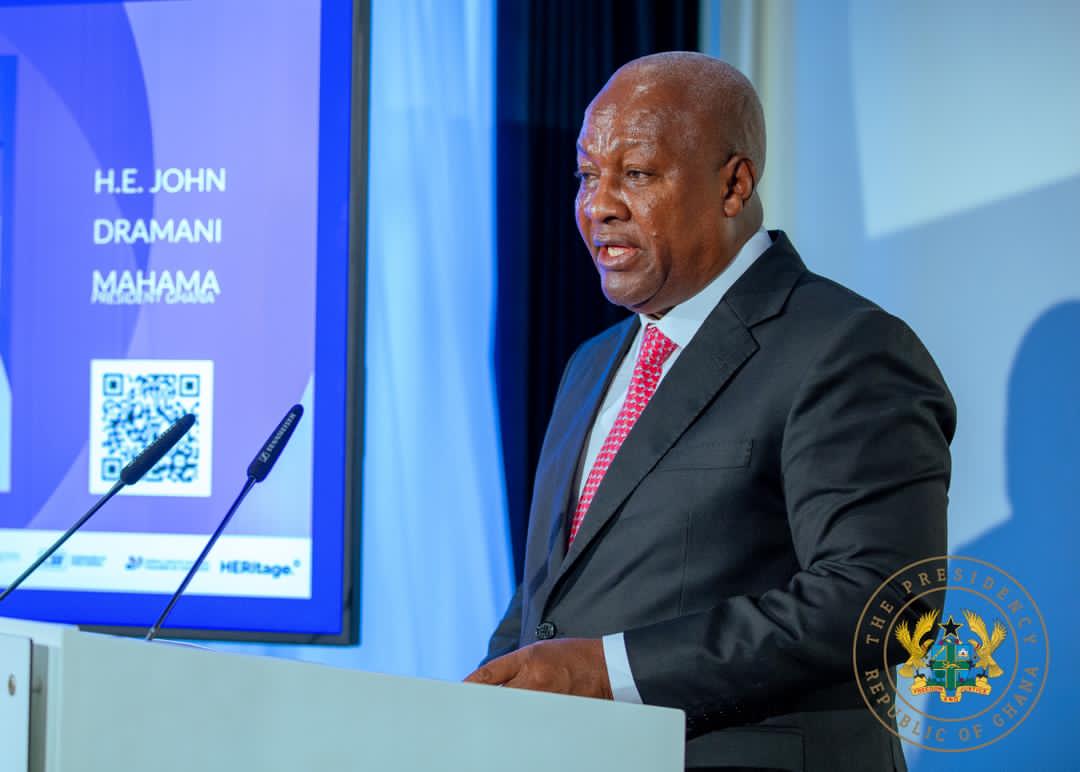
President John Dramani Mahama has called for a fundamental shift in Africa’s development trajectory, urging global leaders to move beyond aid dependency toward a new partnership model driven by African leadership, regional cooperation, and shared prosperity.
Speaking at the World Economic Forum in Davos during a high-level convening of the Accra Reset Initiative, President Mahama said the global order is at a breaking point and Africa must take responsibility for shaping what comes next.
“Our world as we know it is at an inflection point,” President Mahama told the gathering. “The multilateral governance system created after the Second World War is breaking down, and Africa intends to be at the table in determining what the new global order will look like.”
The session, held at the Steigenberger Icon Grandhotel Belvédère, brought together former Nigerian President Olusegun Obasanjo, development partners, multilateral institutions, and private-sector leaders.
Strategic partners of the Accra Reset include the African Development Bank, the Global Fund, AfroChampions, Georgetown University, and the Rockefeller Foundation.
President Mahama described Africa as being trapped in what he termed a “triple dependency”—reliance on external actors for security, donor funding for social services, and the export of critical minerals without capturing value.
“This is not sovereignty. It is a trap—and it is getting worse,” he said.
From Aid Dependency to Self-Reliance
The Ghanaian leader noted that shrinking humanitarian assistance, rising geopolitical tensions, and cuts to Official Development Assistance in Europe and North America make Africa’s dependence on aid increasingly unsustainable.
“The COVID-19 pandemic exposed the fragility of the global system,” President Mahama said. “Africa was the last continent to receive vaccines.
But for the resilience of African populations, millions more would have died.”
He stressed that the Accra Reset Initiative, first unveiled at the United Nations General Assembly in September 2025, is not another declaration but a practical framework for action.
“It is a direct response to a question millions of young Africans are asking,” he said. “‘What should Africa’s response be in a changing global order?’”
Ghana’s Turnaround as Proof of Concept
President Mahama pointed to Ghana’s recent economic recovery as evidence that reform-focused leadership can deliver results. He said the country has moved from a debt-distressed crisis to macroeconomic stability within a year of his return to office.
“From a crisis-ridden economy, we have achieved an impressive turnaround with single-digit inflation, a strengthened currency, and renewed business confidence,” he stated.
However, he cautioned against isolated success.
“Ghana cannot be a jewel in the dirt,” President Mahama said. “Africa must move forward together. We must knit together the patchwork of success stories across the continent.”
A Continental Call to Action
Outlining the pillars of the Accra Reset, President Mahama called for African countries to pool their negotiating power on critical minerals, build regional manufacturing hubs, and invest heavily in skills development.
“What if we negotiated as one?” he asked. “What if we captured value from our minerals instead of exporting raw ore? What if we produced our own vaccines, medicines, and technology?”
He argued that industrial policy remains essential for survival in an increasingly competitive global economy.
“Industrial policy isn’t old-fashioned,” he said. “It is what will allow us to survive.”
Youth, Jobs, and Accountability
President Mahama warned that Africa’s young population is running out of patience amid high unemployment and weak social systems.
“Our young people are brilliant, ambitious, and watching closely,” he said.
“They want jobs, dignity, and opportunity—not excuses.”
He emphasised the need for accountability within African governments, noting that Ghana has reduced the size of its government, digitised public services to fight corruption, and redirected resources toward people-centred investments.
“Reset means reform, and reform means results,” he stressed.
A New Global Partnership
Concluding his address, President Mahama said the Accra Reset is seeking to build a coalition of willing partners—based on equality rather than charity.
“We did not come to Davos to ask for pity,” he said. “We came to propose a partnership of equals, built on mutual respect and shared prosperity.”
He added that the initiative will move next to the African Union summit in Addis Ababa, followed by the Oslo Dialogues, as momentum builds.
“The question is not whether the world needs this,” President Mahama said. “The question is whether we have the courage to build it.”
Story: Patrick Asford Boadu