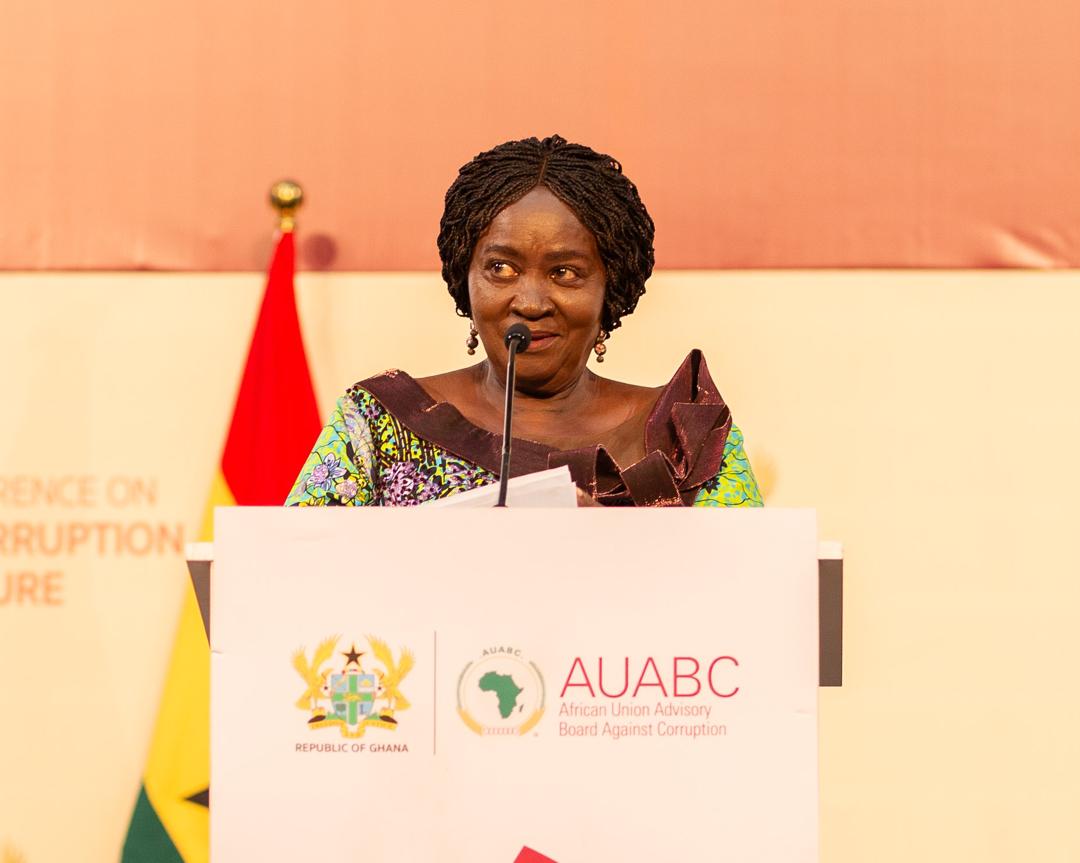
Vice President Professor Naana Jane Opoku-Agyemang has announced bold new measures to overhaul Ghana’s anti-corruption framework, acknowledging both the country’s early gains and recent setbacks in its fight against graft.
Speaking at the National Anti-Corruption Conference in Accra, the Vice President called for a “strategic revitalization” of institutions and systems tasked with combating corruption, stressing that Ghana cannot afford complacency in the face of evolving and increasingly complex forms of corruption.
“Despite our strong institutional foundations, recent reports show that public trust is waning and performance on key corruption indicators has either stagnated or declined,” she said, citing findings from the 2024 Corruption Perceptions Index and the Ghana Statistical Service, which estimated over GH¢5 billion lost to bribery in a single year.
Professor Opoku-Agyemang outlined a number of policy initiatives being pursued by the Mahama-led administration to restore integrity and accountability in governance. These include the launch of Operation Recover All Loot (ORAL), a presidential initiative aimed at retrieving stolen public funds, the introduction of a code of conduct for all presidential appointees, and a renewed push to strengthen existing laws and institutions.
She also announced that a revised Conduct of Public Officers Bill would soon be laid before Parliament, incorporating broad stakeholder input to ensure public buy in and long-term sustainability.
“We must legislate unexplained wealth orders, universalize their application, and anchor the reverse burden of proof in our constitution,” she said. “Our asset declaration regime must also move beyond mere formality.”
The Vice President emphasized that the government will ensure sustainable financing for anti-corruption bodies and introduce legislation to regulate political party and campaign financing.
Underscoring Ghana’s commitment to continental standards, she praised the African Union Advisory Board Against Corruption (AUABC) for its supportive, peer-learning approach and reaffirmed Ghana’s leadership role in continental accountability efforts.
“No anti-corruption system can succeed without the people. Citizen engagement especially youth involvement is essential. We must empower the public, not only to demand accountability but to participate in it,” she said.
While acknowledging the challenges of weak enforcement and political interference, the Vice President insisted that corruption is not inevitable, and that renewed political will and civic responsibility can reverse the trend.
“Corruption is a choice. So is integrity. We must recommit ourselves to build a Ghana and an Africa anchored in transparency, justice and shared prosperity.”
The conference brought together policymakers, civil society groups, media, academics and development partners to reflect on the theme”Revitalizing Africa’s Anti-Corruption Architecture.”
Story By: Nancy Obimpeh