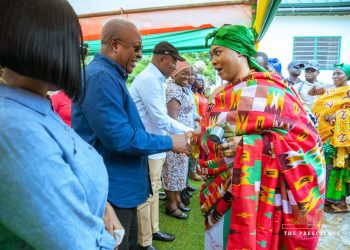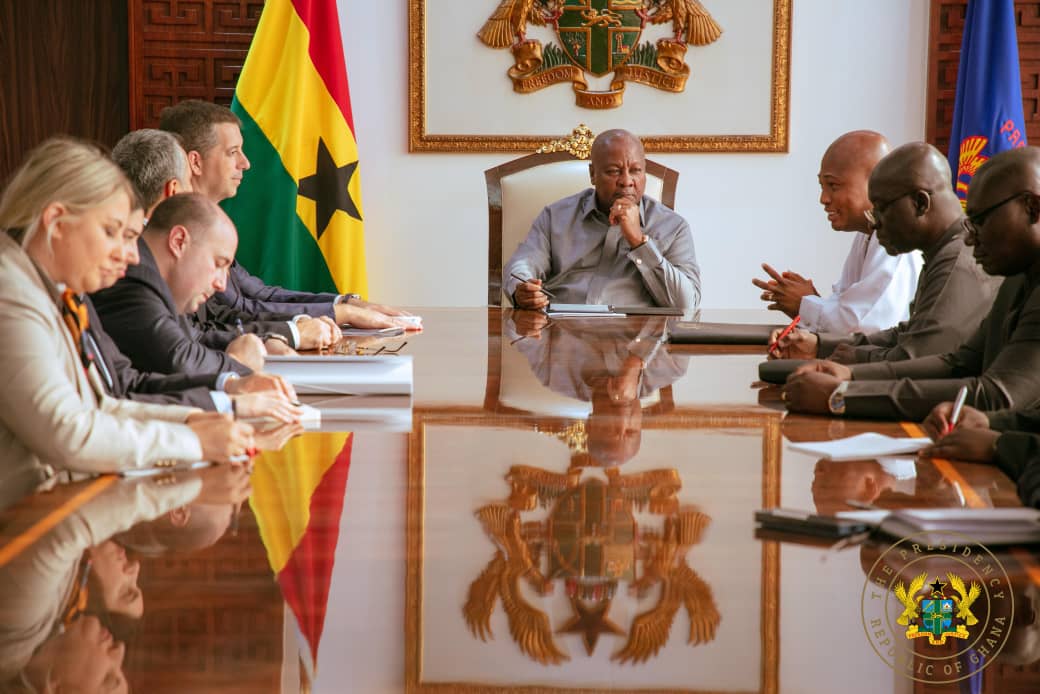
President John Dramani Mahama has reaffirmed Ghana’s commitment to democracy, economic transformation, and regional cooperation during a high-level engagement with American billionaire and philanthropist Alex Soros.
The meeting, which centered on shared values and global partnerships, also addressed Ghana’s historic role in Africa’s liberation struggle and its current leadership within ECOWAS.
“We’re happy to have Soros,” President Mahama said.
“There’s always a pleasant thing when you meet together and have shared values. Our values of democracy, respect for human rights, and freedoms for our people are the same—and that makes it easy for us to work together.”
Ghana’s Historic Leadership in Africa’s Liberation Struggle
Reflecting on Ghana’s legacy, President Mahama underscored the country’s pioneering role in Africa’s independence movement.
“Ghana was the first country south of the Sahara to liberate itself from colonialism. We became the headquarters for the anti-colonial struggle.
Liberation fighters from Zambia, South Africa, and other nations lived in Ghana and even held Ghanaian passports so they could travel freely. Ghana has always played that role.”
Ghana as a Beacon of Democracy
President Mahama highlighted Ghana’s stability since adopting the 1992 Constitution, following years of political turbulence.
“For 33 years, Ghana has enjoyed stable democracy. We’ve held nine successful elections, witnessed peaceful changes of government, and today we stand as a beacon of peace and democracy—not just in West Africa but across the continent.”
Restoring ECOWAS Unity Amid Regional Instability
On the challenges facing ECOWAS, President Mahama lamented the tensions caused by coups in Mali, Burkina Faso, and Niger, which led to sanctions and talk of military intervention.
“I’ve always said diplomacy must come first, sanctions last. The initial approach broke trust and pushed these countries to form their own confederation.
That was a sad development, given ECOWAS’ achievements in free movement and trade.”
Since taking office, President Mahama has engaged the Sahelian leaders directly, inviting them to his inauguration and visiting their capitals to re-establish dialogue.
“There is now appetite for rapprochement. Sanctions have been lifted, transit trade is resuming, and discussions are ongoing to reintegrate the Alliance of Sahel States into ECOWAS structures.”
Economic Reset and Recovery
President Mahama revealed the scale of Ghana’s economic challenges upon taking office in January.
“The previous administration borrowed nearly $13 billion on the Eurobond market in just four years, sending our debt-to-GDP ratio soaring and collapsing key indicators. Inflation hit 54%, our currency depreciated drastically, and the IMF had to step in with an Extended Credit Facility.”
Commending Finance Minister Dr. Cassiel Ato Forson, Mahama said: “He is implementing an austere fiscal program with strict expenditure discipline and revenue reforms. Inflation is falling fast, the cedi has appreciated 42% in six months, and our debt-to-GDP ratio is declining. We expect single-digit inflation by year’s end.”
Governance Reforms and Anti-Corruption Drive
Mahama outlined the Reset Agenda, aimed at restoring good governance and institutional strength.
“We inherited weakened institutions and rampant corruption. Through Operation Recover All the Loot, we are recovering stolen funds and holding both past and current officials accountable.
Anti-corruption agencies—the Special Prosecutor, EOCO, CHRAJ, and the CID—are working freely, and I have pledged not to interfere.”
Constitutional Review and Parliamentary Cooperation
Mahama announced the establishment of a National Constitutional Review Committee to modernize Ghana’s 33-year-old constitution.
“The Committee will present its report in August. With a two-thirds parliamentary majority and independent MPs backing us, we can pass needed reforms. But we won’t misuse our majority—we’ll seek consensus.”
Energy Transition and Green Growth
The President highlighted Ghana’s shift toward renewable energy: “We’ve renamed the Ministry of Energy to the Ministry of Energy and Green Transition.
We are using our natural gas for power to reduce liquid fuel use and expanding solar and wind capacity. With hydro included, renewables already exceed 10% of our energy mix.”
Regional Security and Climate Adaptation
Addressing threats from violent extremism in the Sahel, Mahama said: “We must reform the Accra Initiative or create a new platform with the Sahel states. Extremism is destabilizing trade routes and threatening lives. They can’t fight it alone, and we must cooperate.”
On climate change, he acknowledged its toll on agriculture: “Changing rainfall patterns have hurt cocoa production. We’re rolling out small irrigation schemes to help smallholder farmers sustain yields.”
Reparations and Pan-African Advocacy
Finally, President Mahama noted Ghana’s active role in global justice initiatives: “At the AU Summit in Malabo, the Union declared 2026–2036 as the Decade of Reparations. With CARICOM, we will push for reparations and restitution for Africa and its diaspora.”