President John Dramani Mahama has unveiled a raft of policy measures and achievements across multiple sectors, from mining oversight and energy security to constitutional reforms and local government financing.
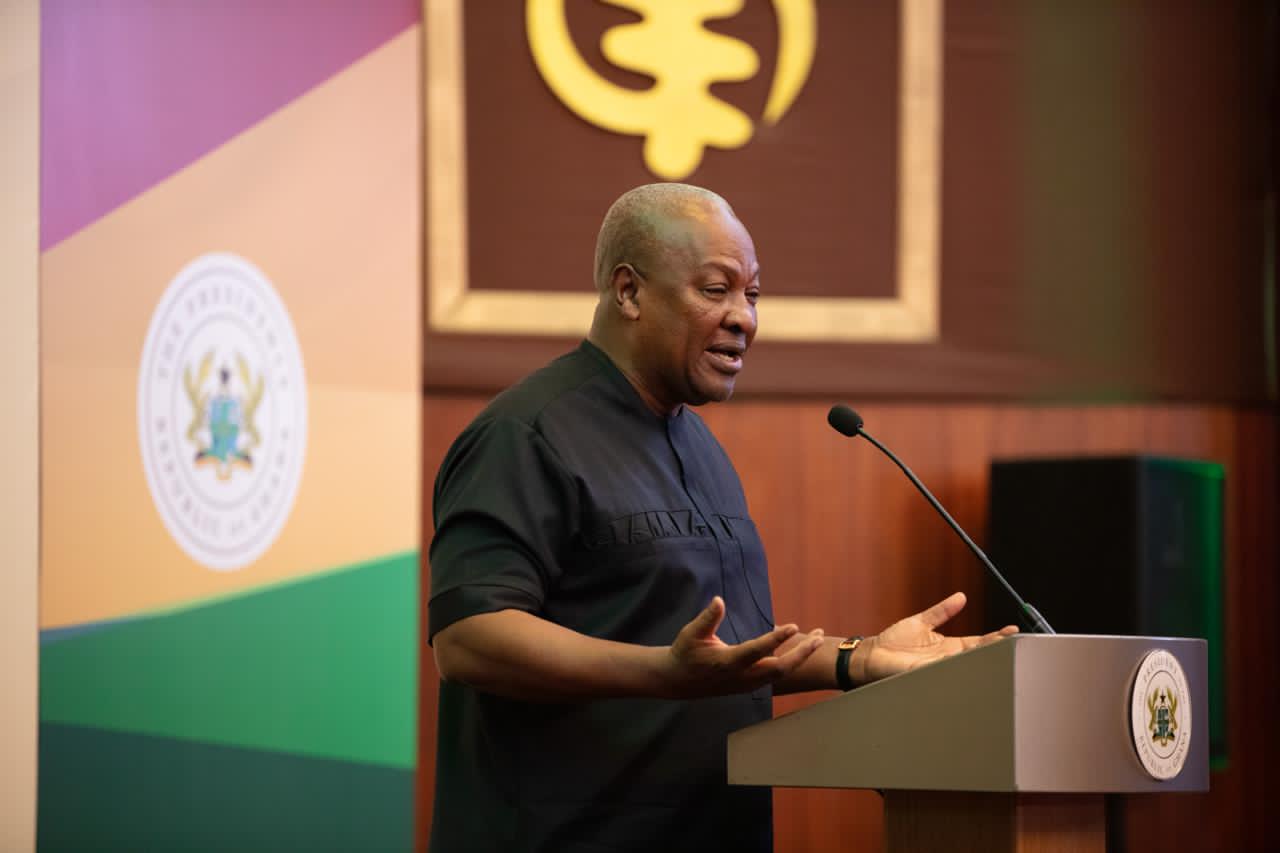
Speaking at the Jubilee House, the President said the measures were part of his administration’s broader agenda to “reset our institutions to reflect the demands of modern governance and enhance service delivery for every Ghanaian.”
Tracking Earth-Moving Equipment
In collaboration with the Ministry of Transport, Finance, Customs Division, and the Ports and Harbors Authority, government has introduced a new tracking system for excavators and earth-moving equipment to curb their diversion into illegal mining.
“So far, 1,015 pieces of equipment have been registered, with 647 fitted with tracking devices. Another 600 are awaiting clearance at the ports, and 350 more tracking devices will be available by September 12, 2025,” Mahama disclosed.
Security and Constitutional Review
The President emphasized the importance of internal security to economic progress, announcing a 1 billion Ghana Cedi package to retool security agencies.
At the same time, the Constitutional Review Commission is consulting widely on potential reforms.
“This inclusive process ensures that the voices of citizens, civil society, and institutions are reflected in the evolving constitutional order,” he said.
Energy and Oil Discoveries
Mahama confirmed the commercial viability of the Eban Akuma oil and gas discoveries in Cape Three Points Block 4. The project, led by joint venture partners E&I Vitor Woodfields and GNPC, will move into full development.
He also announced approval for a second gas processing plant (GPP-2) to double processing capacity.
“This project alone will save the country close to 500 million U.S. dollars every two years by cutting reliance on imported liquid fuel. Beyond savings, it will create over 1,000 jobs and secure cleaner, more reliable power,” Mahama said, adding that the looming threat of dumsor inherited in January had been averted.
Fiscal Decentralization Restored
The President highlighted reforms in local governance financing, noting that District Assemblies are now receiving 80% of their common fund allocations directly, compared to the historical 40–50%.
Of the 7.57 billion Cedis allocated to the DACF this year, about 6.1 billion Cedis has gone directly to MMDAs, with a minimum of 25 million Cedis to each.
“We have also released in full 2.03 billion to the National Health Insurance Fund and 2.71 billion to GetFund. This underscores our commitment to service delivery and local empowerment,” he said.
Cabinet-approved expenditure guidelines earmark 25% of DACF for 24-hour economy model markets, 10% for health (including at least two CHPS compounds per district), and 20% for completing legacy projects.
The Big Push Program
Mahama announced that he will next week cut sod in three locations to launch the Big Push program, which prioritizes infrastructure renewal.
“Almost 14 billion Cedis of oil and gold revenues have been earmarked for this year alone,” he said. “Projects like the Ofanko and Sawambu roads, which had been chronically underfunded, now have almost 1 billion Cedis released to ensure speedy completion.”
A Call to Shared Vision
Closing his address, the President reaffirmed his commitment to integrity, accountability, and national progress.
“I am resolute in laying foundations for economic recovery, and I am determined to see the dreams of our forebears for an economically independent and self-reliant Ghana realized in our lifetime,” Mahama declared.
“With your trust and support, we will build a nation that serves the hopes of this generation and the aspirations of those yet unborn.”