The Government of Ghana has declared a decisive shift from raw agricultural exports to value-added industrial processing, positioning tree crops as a central pillar of the country’s economic transformation agenda.
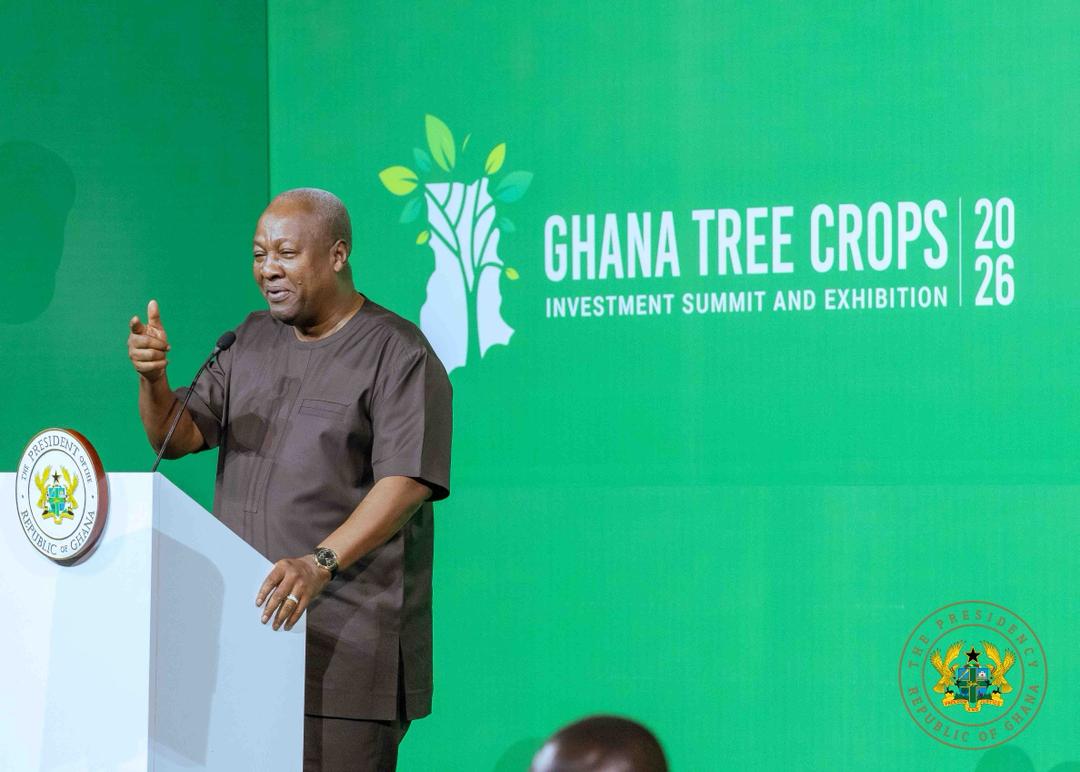
Speaking at the inaugural Ghana Tree Crops Investment Summit and Exhibition 2026, President John Dramani Mahama said the summit was “not merely ceremonial, but strategic,” describing it as a practical demonstration of the NDC government’s 2024 manifesto commitment to reset Ghana’s economy.
“This summit reflects our resolve to strengthen productive sectors, expand exports, create decent jobs, and position agriculture as a driver of industrial transformation,” the President stated.
He invoked an Akan proverb to underscore the government’s confidence in the sector. “There is an Akan saying that when you climb a good tree, that is when you are supported.
Today, Ghana is climbing a good tree’ the tree crop sector,” he said, inviting investors, development partners, and Ghanaians to “climb this tree with us.”
Diversifying Beyond Cocoa
While cocoa remains a key foreign exchange earner, contributing about $2 billion annually, President Mahama said overreliance on a single commodity exposes the economy to climate shocks and global price volatility.
“Our 2024 manifesto is clear Ghana must move from dependence to diversification,” he said. “Economic resilience requires that we reduce our over-reliance on single-commodity exports.”
He identified six priority tree crops—cashew, coconut, oil palm, rubber, mango, and shea as the backbone of Ghana’s diversification strategy, noting that together they employ over 1.6 million people and contribute about 2 percent of GDP.
“These are not secondary crops,” the President stressed. “They are engines of transformation.”
According to him, shea alone supports more than 500,000 households, mostly women, while cashew employs nearly 890,000 people nationwide.
End to Raw Exports
President Mahama announced a firm policy shift to end the export of unprocessed tree crop produce.
“We will no longer export raw cashew, raw shea, or unprocessed rubber, only to import the same products at higher prices,” he declared. “I want to travel and buy cashew labelled ‘Produce of Ghana,’ not produce of some third-party country.”
He urged international and local investors to establish processing facilities in Ghana, aligning with the government’s proposed 24-hour economy model, where production, processing, logistics, and exports operate continuously.
The government, he said, is targeting 50 to 60 percent local processing annually, supported by agro-industrial parks, private sector incentives, and enhanced oversight by the Tree Crops Development Authority.
Oil Palm and Job Creation
Under the National Policy on Integrated Oil Palm Development, dubbed “Red Gold,” President Mahama announced a $500 million investment to develop 100,000 hectares of oil palm.
“This will create 250,000 direct jobs and eliminate the 40 percent oil palm imports Ghana currently relies on,” he said, adding that the initiative would make Ghana a net exporter of oil palm products.
Empowering Women and Youth
The President emphasized that tree crops align strongly with the government’s inclusive growth agenda.
“Women dominate the shea industry, while cashew and mango offer strong opportunities for young people in agribusiness,” he noted. “Coconut and oil palm also create jobs across processing and logistics.”
He said government interventions would include improved seedlings, farmer service hubs, access to finance, and matching grants for small and medium-sized enterprises to make agriculture modern, profitable, and attractive to the youth.
$200 Million Diversification Drive
President Mahama used the occasion to officially relaunch the Ghana Tree Crop Diversification Project, a $200 million programme supported by the World Bank.
Under the project, more than 13 million seedlings—including cashew, rubber, and coconut will be distributed to over 30,000 farmers, directly benefiting 52,775 households. In addition, 185 small and medium enterprises will receive matching grants.
“Our farmers must see results, not paperwork,” the President said, directing the Tree Crops Development Authority and Ghana Cocoa Board to fast-track implementation.
Export Ambitions and AfCFTA
Looking ahead, President Mahama reaffirmed Ghana’s ambition to reach $12 billion in annual agricultural exports by 2035, targeting $2 billion in export earnings per major crop.
“My administration is committed to expanding Ghana’s export base and leveraging the African Continental Free Trade Area,” he said. “Tree crops will position Ghana to supply regional and global markets while reducing foreign exchange vulnerabilities.”
Declaring the summit officially open, the President said the event should mark a national turning point.
“Let this summit be remembered as the moment Ghana shifted from raw exports to industrial processing, from vulnerability to resilience, and from promise to performance,” he said.
Story: Patrick Asford Boadu