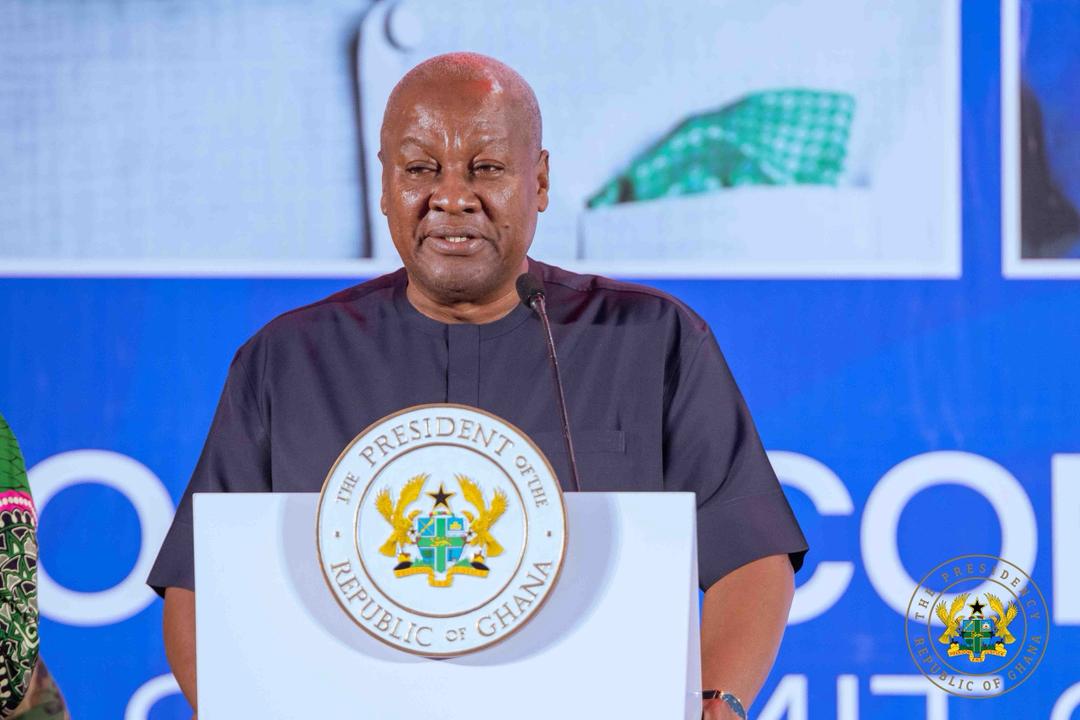
President John Dramani Mahama has outlined five strategic pillars that will guide Ghana’s renewed approach to local content in the mining sector, aimed at transforming the country from a raw mineral exporter into a hub of value-added industrial activity.
Speaking at the Mining Local Content Summit, organized by the Minerals Commission on the theme “Strengthening Local Content and Indigenization: Building a Resilient Mining Sector in Ghana'”‘President Mahama said Ghana’s long history of mineral production has not yet translated into full participation in the high-value segments of the extractive value chain.
“We have been prolific producers, but we are not yet full participants in the extractive value chain,” the President stated. “This summit is about closing that gap.”
Ghana, Africa’s leading gold producer and among the top six globally, earned nearly US$6.6 billion in export revenues from the extractive sector in 2023.
However, President Mahama noted that advanced processing, equipment manufacturing, engineering, and refining largely occur outside the country.
Rethinking the Legacy of Mineral Wealth
President Mahama challenged policymakers, investors, and industry players to reflect on the long-term impact of Ghana’s mineral endowment.
“What will be the true legacy of Ghana’s mineral wealth 100 years from now?” he asked. “Will it be recorded only in export statistics and royalty payments, or will it be remembered as the foundation for world-class industries, thriving Ghanaian enterprises, and resilient mining communities?”
He said global experience shows that strong local content frameworks can coexist with investor confidence.“Smart, enforceable, and forward-looking local content policies do not deter investment,” he said. “They create sustainable competitiveness.”
The Five Strategic Pillars
President Mahama explained that Ghana’s local content agenda will be anchored on five core pillars.
The first pillar focuses on moving local content from transactional procurement to transformational partnerships.
“Local content must go beyond buying consumables locally,” he said. “Equity participation, technology transfer, and knowledge sharing must become standard practice.”
He revealed that government is reviewing mining legislation and regulatory frameworks to help Ghanaian firms climb the value chain from service providers to manufacturers and innovators.
The second pillar targets value addition and the end of raw mineral exports.
“It is no longer acceptable for Ghana to export raw ores and import finished products,”President Mahama declared. “We must decisively reduce, and ultimately eliminate, raw mineral exports.”
He said government will support refineries, bullion infrastructure, mineral-based industrial clusters, and downstream processing of bauxite, manganese, and lithium, aligned with the global green energy transition.
The third pillar centres on human capital and skills development.
“No mining sector can be competitive without a skilled workforce,” he said. “We must train not only miners, but mining technologists, engineers, and innovators.”
Plans include strengthening institutions such as UMaT and technical universities, expanding apprenticeship programmes, and prioritising skills in automation, robotics, data analytics, modern exploration technologies, and environmental sustainability.
The fourth pillar emphasises technology, innovation, and digital transformation.“The future of mining is digital, sustainable, and technology-driven,” the President said.
He announced plans to explore the establishment of a National Mining Innovation and Research Hub to promote AI-assisted exploration, IoT-enabled asset management, blockchain-based supply chain transparency, and Ghana-focused research and development.
The fifth pillar focuses on strengthening indigenous Ghanaian participation and ownership in mining.“The Ghanaian private sector must move from subcontracting to full ownership of world-class mining operations,” President Mahama stated.
He cited the Black Volta Gold Project being developed by Engineers and Planners Limited as a landmark example of indigenous capacity, noting that it is expected to produce about 70,000 ounces of gold annually over a mine life of more than 15 years.
Call for a National Commitment
President Mahama stressed that local content cannot be separated from responsible and community-centred mining.
“Mining must leave our communities better than it found them,” he said, pledging continued action against illegal mining, land reclamation, and the restoration of polluted water bodies.
He concluded by urging stakeholders to treat the summit as the start of a binding national pact.
“If we get this right, our greatest export will not be raw gold or raw bauxite,” the President said. “It will be Ghanaian talent, Ghanaian technology, Ghanaian enterprise, and a resilient and competitive mining economy.”
He added that the success of the new local content agenda will depend on collective effort from government, industry, regulators, and communities alike.
Story: Patrick Asford Boadu