In a policy shift aimed at ending Ghana’s historical reliance on expensive short-term borrowing, the Minister for Finance, Dr. Cassiel Ato Forson, has unveiled the Ghana Accelerated National Reserve Accumulation Policy (GANRAP).
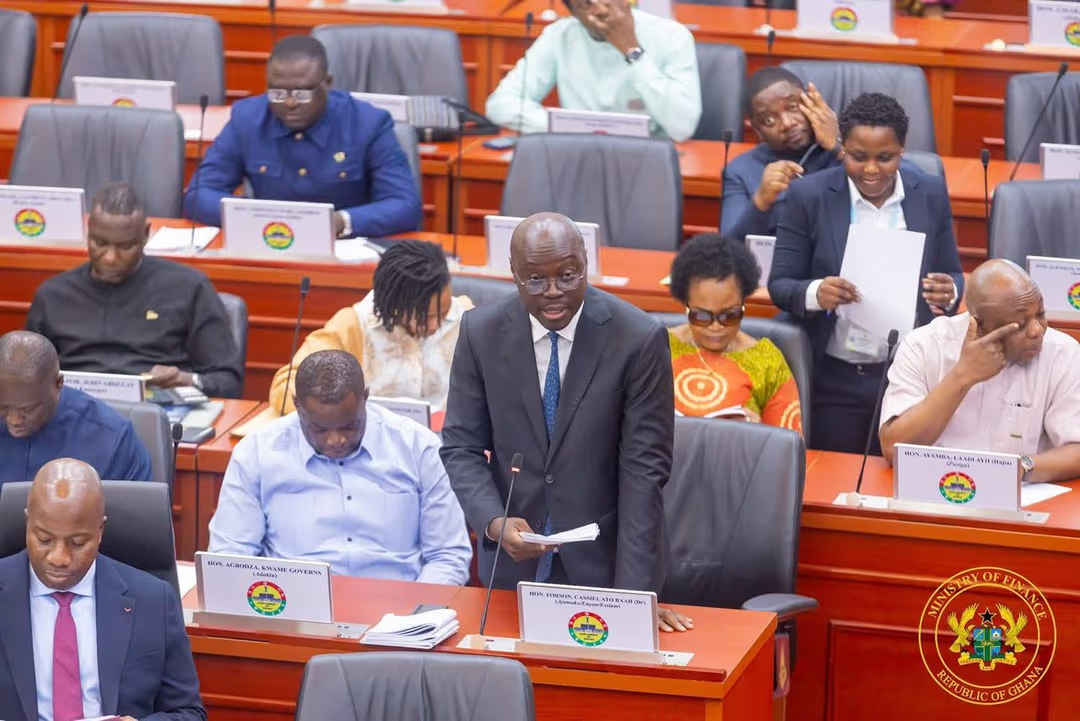
Presenting the strategy to Parliament, February 25, 2026, Dr. Forson detailed a roadmap to bolster the nation’s financial “first line of defense.” The policy seeks to leverage record-high gold prices to build a massive strategic buffer, moving away from the “leaky bucket” of debt-driven reserve building that characterized the previous decade.
Rapid Macroeconomic Recovery Sets the Stage
The Minister opened by highlighting a dramatic shift in Ghana’s fiscal health following the 2022–2023 crisis, noting that the country entered 2026 on a much stronger footing. He reported that:
”Ghana achieved a decisive macroeconomic turnaround in 2025 following the 2022–2023 economic crisis. By the end of 2025 real GDP growth averaged 6.1% in first three quarters of the 2025 and inflation declined sharply from 23.8% in 2024 to 5.4% and further down to 3.8% in January 2026.”
The Shift from “Traditional” to “Strategic” Reserves
While Ghana’s reserves currently meet international benchmarks, Dr. Forson argued that the standard “three-month” rule is no longer enough to protect the cedi from volatile global markets. He emphasized the need for a more aggressive buffer.
”The conventional threshold of three months of import cover is no longer adequate. Government therefore seeks to accumulate a strategic buffer beyond the conventional reserve adequacy levels and build an economic war‑chest of 15 months of import cover by end-2028.”
Gold to Replace Debt as the Engine of Stability
A central pillar of the GANRAP is the move away from Eurobonds and high-interest swaps, which the Minister claimed cost the taxpayer billions in interest payments. Instead, the state will focus on domestic gold procurement as a sustainable alternative:
”Gold has emerged as the most reliable and immediate instrument for accelerating reserve accumulation without increasing public debt or introducing distortions in domestic markets.”
Mandatory 20% Off-take from Large-Scale Miners
To ensure a steady flow of gold into the central bank’s vaults, the government plans to invoke preemption rights. Dr. Forson underscored that this gold will remain a physical asset protected by law:
”The Minister of Lands and Natural Resources shall invoke the preemption right under section 3(d) of the Ghana Gold Board Act, 2025 (Act 1140) and section 7 of the Minerals and Mining Act, 2006 (Act 703) to purchase a minimum of 20% of large-scale gold output, which translates to a minimum of 0.57 tonnes of gold per week. This gold shall only be sold by the central bank subject to prior approval of Cabinet and Parliament.”
Aggressive “Mop-Up” of Small-Scale Gold
The Ghana Gold Board is tasked with a massive operational goal: acquiring over 2.4 tonnes of gold weekly from the artisanal sector to generate billions in foreign exchange and curb smuggling:
”The Ghana Gold Board will put in place strategies to efficiently mop adequate volumes of ASM gold output, minimum of 2.45 tonnes weekly, through official channels to generate adequate foreign exchange for the country. Over the next three years, the Ghana Gold Board will aim to mop up about 127 tonnes of ASM gold per annum. This, at current price levels, will generate over US$20 billion in foreign exchange for the country annually.”
Reforming the Energy Sector “Leaky Bucket”
Addressing the structural drain on the nation’s dollars, Dr. Forson pointed to the “Gas-to-Power” policy as a means to stop the annual multi-billion dollar hemorrhage caused by energy sector shortfalls:
”Historically, Ghana has spent approximately $3.0 billion annually to cover energy sector shortfalls and IPP payments. This continuous drain acted as a leaky bucket for foreign exchange, forcing the Bank of Ghana to divert liquid reserves to meet fuel and power obligations.”
Moving Away from “Traumatic” IMF Reliance
Drawing parallels to the 1997 Asian Financial Crisis, the Minister stated that Ghana’s aggressive accumulation is a bid for true economic sovereignty and a departure from the cycle of bailouts:
”This was driven primarily by a desire for self-insurance against future sudden capital reversals and crises following the traumatic experience of relying on IMF bailouts, which came with strict conditions.”
Story By: Eugenia Ewoenam Osei