It began as a semantic debate on the definition of “dechemicalisation” and evolved into a high-stakes environmental and fiscal controversy. Following a contentious exchange on The Probe between the Executive Director of the Environmental Protection Authority (EPA), Prof. Nana Ama Klutse, and Dr. Ekpor, a critical question has emerged after a successful demonstration: Can Ghana’s polluted arterial rivers be restored through chemical intervention, and at what cost to the taxpayer?
The “dechemicalisation” hypothesis
Prof. Klutse’s proposal to “dechemicalise” Ghana’s water bodies is predicated on laboratory successes involving “nano liquid particles.” While the EPA maintains that these treatments effectively settle suspended solids and neutralize pollutants, the transition from controlled laboratory environments to dynamic river ecosystems may be fraught with technical and logistical complexities.
The primary concern for analysts is not merely the chemistry, but the inevitable intersection of environmental policy and public procurement. With over a dozen major rivers stretching hundreds of kilometers toward the Gulf of Guinea, the scale of such an operation is unprecedented.
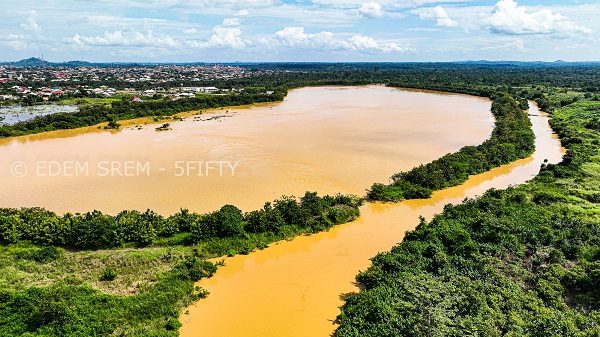
The Birim River—a vital tributary of the Pra—was selected as the site for a public demonstration of this technology. The choice was as symbolic as it was political. Originating in the Atewa Range near Kibi, the Birim flows through the heartland of former President Nana Akufo-Addo, who famously pledged to “put his presidency on the line” to end illegal mining (galamsey).
During the EPA’s demonstration, nano-liquid particles were introduced into a contained, non-flowing section of the river. The results were visually striking: within hours, sediments settled, and the water transitioned from a turbid ochre to relative clarity. To the casual observer, it was a “miracle.” To a prober, however, the “controlled” nature of the experiment failed to account for the velocity, sectional depth, and volume of a living, flowing river.
The fiscal burden of restoration
The exceptionality with which the “miracle” was performed was matched only by the staggering cost projections revealed in the aftermath. The EPA estimated the restoration cost at US$200,000 per kilometer.
When extrapolated across Ghana’s hydrological network, the financial implications are sobering:
River Estimated Length (km) Estimated Cost (USD)
Birim 175 $35,000,000
Tano 400 $80,000,000
Pra 240 $48,000,000
Ankobra 190 $38,000,000
Densu 120 $24,000,000
Offin 10 $2,000,000
For these six rivers alone, the cost exceeds US$227 million (approximately 2.4 billion Ghana Cedis). This raises a fundamental question of public choice: is this an investment in ecology, or the birth of a lucrative new industry for “restoration contractors”?
The necessity of due process
Ecological restoration cannot exist in a vacuum. It is being argued that pouring chemicals into rivers while illegal mining remains unchecked is an exercise in futility. Between 2025 and 2026 alone, the number of forest reserves decimated by illegal mining reportedly rose from 44 to 50.
For the “Miracle on the Birim” to be anything more than an expensive optical illusion, the government must adhere to a rigorous, three-stage restoration framework:
1. Enforcement and Cessation: The EPA must officially declare a river galamsey-free. Restoration is illogical if environmental terrorists continue to discharge effluent upstream.
2. Hydrological Correction: Diverted river sections must be reconnected to their natural channels.
3. Land Reclamation: Adjacent degraded lands must be reclaimed with vegetation cover to prevent immediate re-siltation during rainfall.
Without these prerequisites, dechemicalisation remains a drain of resources rather than a solution. Until the source of the pollution is neutralized, any chemical miracle will be washed away by the next tide of illegal activity.