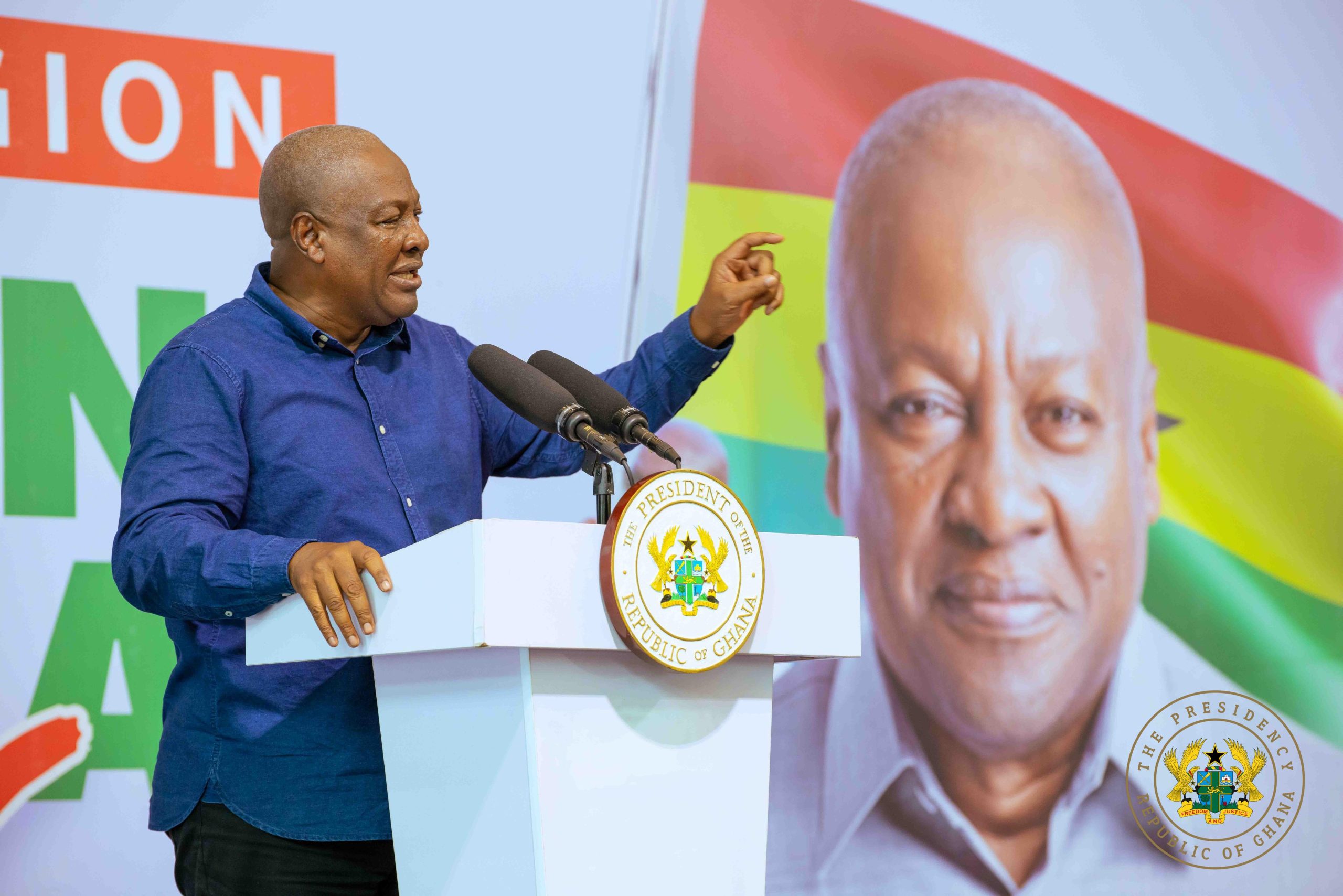
President John Dramani Mahama has outlined key policy directions on decentralisation, economic recovery, and infrastructure development during a citizens’ engagement in Koforidua as part of his Eastern Region “Resetting Tour.”
Addressing residents and stakeholders, the President began by commending the Eastern Regional leadership for ongoing development efforts in the region.
Renewed Focus on Decentralisation
President Mahama expressed concern that decentralisation had, over time, been weakened, noting that it had effectively become centralised in practice.
He traced the origins of decentralisation to the era of Jerry John Rawlings and highlighted provisions under the 1992 Constitution of Ghana, which mandate that a portion of national revenue be allocated to district assemblies through the District Assemblies Common Fund.
According to him, while his administration previously allocated 7.5 percent of national revenue to assemblies, subsequent reductions and the introduction of a capping policy significantly limited funds available for local development.
“As a result, assemblies at times received as low as 42 percent of what was due them,” he explained.
He announced a policy shift under his current administration, stating that 80 percent of the District Assemblies Common Fund is now being disbursed directly to assemblies to enhance local governance and development.
Economic Stabilisation and Growth
On the economy, President Mahama reported significant progress in stabilisation efforts, revealing that Ghana’s debt-to-GDP ratio had declined from 67 percent to 45 percent by the end of 2025.
He also noted improvements in currency stability and investor confidence, positioning Ghana among Africa’s leading economies with projected output exceeding $100 billion.
“Having achieved stability, the next phase is to move towards growth and opportunity,” he said, adding that a new economic policy will allocate one percent of GDP annually to sectors that generate employment.
Infrastructure and Roads
The President disclosed that government is undertaking approximately 2,000 kilometres of road construction nationwide, with contractors being paid promptly upon certification of work done.
He specifically mentioned the road project linking Ekyi Amanfrom to Adawso across the Afram River as part of ongoing infrastructure expansion.
Energy Sector Developments
Touching on energy, President Mahama commended engineers from the Volta River Authority and Ghana Grid Company for their swift response to the recent fire incident at the Akosombo power facility.
He noted that restoration efforts were largely driven by local expertise, including young engineers and national service personnel.
The President revealed that installed generation capacity has increased from about 3,500 megawatts to 4,300 megawatts, with plans to expand further through a 1,200-megawatt gas-powered plant.
He also highlighted renewed partnerships in the Jubilee oil fields and agreements with Eni to boost gas supply through the GPP II project.
Health and Social Interventions
On healthcare, President Mahama announced the rollout of the MahamaCares programme alongside Free Primary Healthcare to improve access to medical services.
He explained that while the National Health Insurance Scheme provides coverage, it does not address all conditions, particularly non-communicable diseases, which account for a significant portion of deaths.
The new initiatives, he said, will focus on preventive care through routine screenings and early detection.
Agriculture and Community Participation
The President also highlighted agricultural initiatives such as the Nkoko Nkitinkiti programme, encouraging traditional leaders to participate actively in boosting local food production.
He indicated plans to establish a register for chiefs willing to support the Feed Ghana programme.
Commitment to Inclusive Development
President Mahama concluded by reaffirming his administration’s commitment to inclusive governance and improved livelihoods.
“Together, through these efforts, we will continue working to improve livelihoods and expand opportunities for our people,” he said.
Story: Patrick Asford Boadu