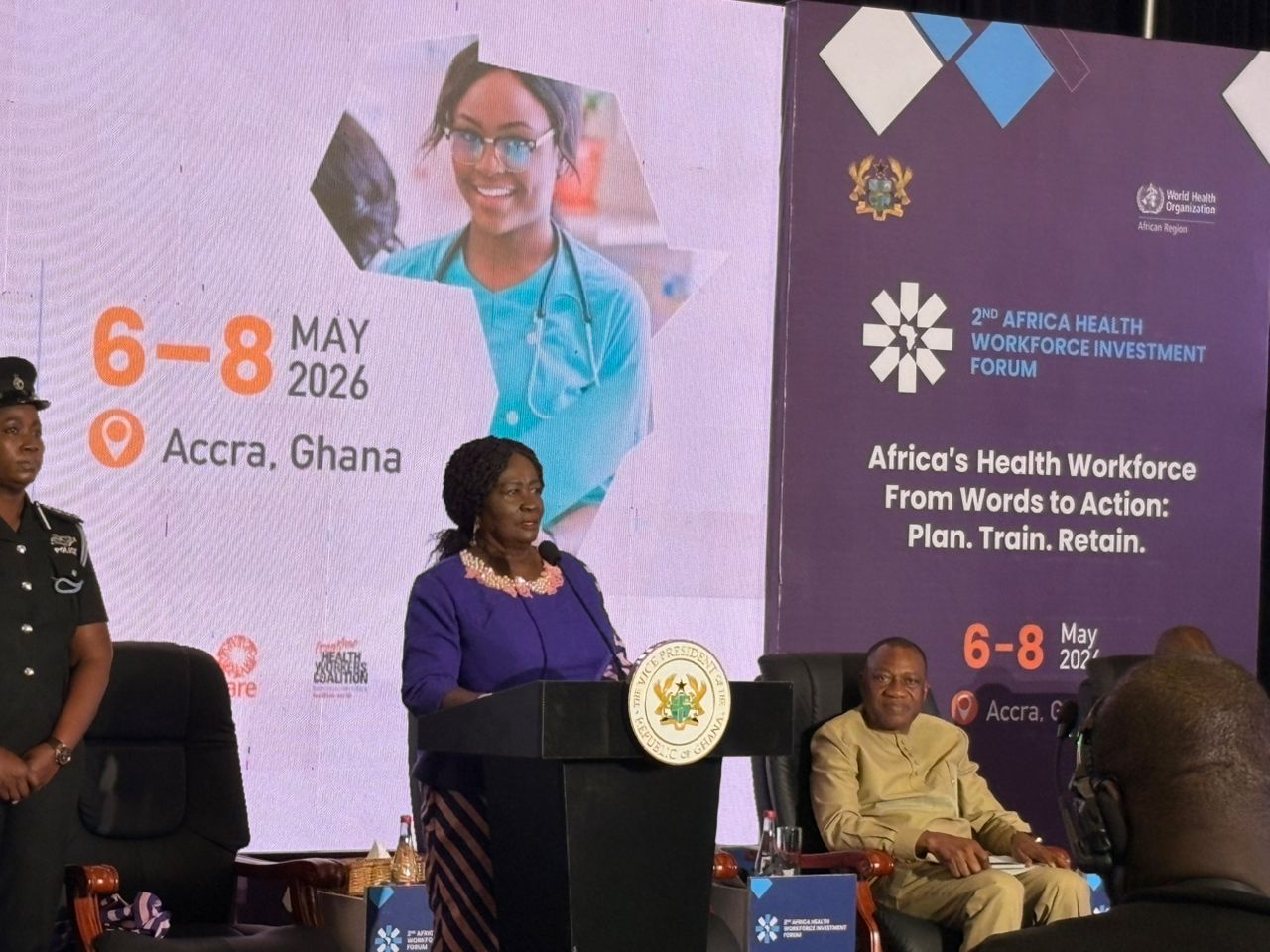
Vice President of Ghana, Jane Naana Opoku-Agyemang, has issued a strong call for African nations to address systemic challenges that hinder their ability to retain trained medical professionals. Speaking at the Second Africa Health Workforce Investment Forum in Accra, she urged leaders to move beyond rhetoric and build sustainable systems that ensure health workers are not only employed but retained with dignity.
Opening the forum, the Vice President combined economic urgency with a human rights perspective, questioning the persistent gaps between education and employment in the health sector. She acknowledged that while life expectancy across Africa has improved significantly in recent decades, access to quality healthcare remains out of reach for many due to high costs, long distances, and a shortage of skilled personnel—key barriers to achieving Universal Health Coverage.
“What makes it so easy for us to use scarce resources to train, and what makes it so difficult for us to retain the people we have trained?” she asked, calling for frank reflection and decisive action to fix the system.
Reaffirming the government’s commitment to reform, she highlighted the Accra Reset Agenda, which seeks to rebuild public trust and strengthen institutions. At the heart of this agenda is the concept of “health sovereignty,” emphasizing Africa’s ability to set its own priorities and design healthcare systems that reflect its unique realities. She stressed that international partnerships must be rooted in respect and aligned with the continent’s needs.
On the domestic front, the Vice President announced that Ghana has approved the recruitment of 16,000 health workers this year. About 8,000 have already received financial clearance, with the remainder expected soon. The initiative is designed to support key programs such as the Free Primary Health Care initiative and the Ghana Medical Trust Fund, popularly known as “Mahama Cares,” which focuses on providing specialized treatment for chronic illnesses.
She also drew attention to the critical role of women in healthcare delivery, noting that they make up the majority of the workforce across the continent. Ensuring that health systems work effectively for women, she said, must remain a top priority.
In her closing remarks, Vice President Opoku-Agyemang challenged participants to ensure that the forum leads to concrete reforms rather than symbolic commitments. She expressed hope that the Accra gathering would mark a turning point in Africa’s health sector—driven by strategic planning, targeted training, and sustainable job creation.
She concluded by emphasizing that investing in the health workforce is essential for long-term prosperity and for advancing the vision of African Union’s Agenda 2063.
Story By: .Eugenia Ewoenam Osei