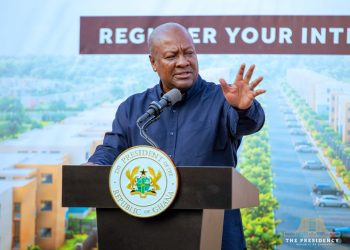
President John Dramani Mahama has called for stronger global cooperation, renewed investment in multilateral health institutions, and greater health sovereignty for developing nations, warning that the world cannot afford fragmentation in the face of future pandemics.
Speaking at the Accra Reset High-Level Geneva Convening on the sidelines of the World Health Organization meetings in Geneva, President Mahama said the world must recognize that “no country can live in isolation.”
“The global architecture is changing. Some people feel they can go on their own. But what we often forget is that we are passengers in the same bus, and that bus is this globe,” he said.
“There are things we cannot deal with alone. We need to come together as a world to do that.”
The President defended the importance of multilateral institutions, particularly in responding to health emergencies such as Ebola outbreaks and future pandemics.
“If you say you do not want a strong global health organization, or you withdraw funding, the reality is not a matter of if, but when the next pandemic will hit,” he stated. “Pandemics know no citizens. They do not know Ghanaians. They do not know Britons. They do not know Americans.”
President Mahama highlighted Ghana’s recent health sector reforms, including the expansion of the National Health Insurance Scheme coverage to 66 percent and the introduction of free primary healthcare funded domestically.
“It has been a joy to see healthcare workers, especially in rural areas, from CHPS compounds to health centers and polyclinics, providing care free of charge to every Ghanaian who presents an identity card,” he noted.
He also addressed criticism surrounding the government’s provision of tricycles for health outreach, clarifying that the vehicles were intended to improve access to care in hard-to-reach communities.
“In emergencies, if a pregnant woman is in distress and the only available means is a tricycle, then it becomes the ambulance available at that moment. We must be practical,” he stressed.
The President further announced increased investments in Ghana’s health sector, including the uncapping of health insurance funds and the allocation of approximately $300 million in exchange resources to support healthcare delivery.
Addressing the growing burden of non-communicable diseases, President Mahama warned that changing lifestyles and poor dietary habits were driving increases in diabetes, cardiovascular diseases, cancers, and kidney conditions.
“For this reason, we established the Ghana Medical Trust Fund, also referred to as Mahama Cares, with about 2.1 billion cedis allocated,” he said.
According to him, the initiative will not only finance treatment but also expand access to specialized medical facilities across the country.
“After setting up MahamaCares, we discovered that there is no cardiac center in the five northern regions,” he revealed. “We are therefore establishing a cardiac center with specialized equipment such as cath labs and other facilities.”
The President also announced plans to expand oncology centers to bring cancer treatment closer to patients nationwide.
On global health reform, President Mahama invoked the spirit of the historic 1955 Bandung Conference in Bandung, drawing parallels between political sovereignty and health sovereignty.
He cited Indonesia’s state-owned vaccine institute, Biopharma, as an example of how strategic investment in science and manufacturing can transform a nation into a global health leader.
“One of these Bandungs is the one in which beautiful speeches and exhortations were made,” he said. “And another is the story in which a little investment in vaccine science and research has built a global vaccine powerhouse.”
President Mahama explained that the Accra Reset initiative seeks to bridge the gap between rhetoric and implementation.
“We are here to break the distance between declarations we make at podiums and the factories and clinics we build on the ground,” he declared. “We are moving from speech to action.”
He outlined key pillars of the initiative, including the establishment of a high-level global health reform panel, the Reform Interlock Observatory (RIO), and the Sankuri Institute of Global Negotiators, aimed at strengthening developing countries’ negotiating power in areas such as technology transfer and pharmaceutical licensing.
The President also unveiled the Health Investment National Gateway and Mobilization Exchange System (HINGE), designed to create investment-ready health projects across Africa.
“It is a deal room, not a boardroom,” he said. “Our commitment is simple but aggressive. We will deliver bankable, co-financed deals within two years.”
President Mahama stressed the urgency of action, particularly in maternal healthcare across sub-Saharan Africa.
“We cannot afford a leisurely pace when 182,000 women in sub-Saharan Africa are going to die this year in childbirth,” he warned.
He concluded by calling on African governments and international partners to work together in transforming global health systems into more equitable and responsive structures.
“There is an Akan saying in Ghana that there’s nothing wrong with reaching back to fetch what you forgot,” he said. “What we forgot is our urgency.”
“And let our partners march along with us. After all, they said that if you want to go far, you go together. We want to go far, and so we will go together with our partners.”
Story: Patrick Asford Boadu