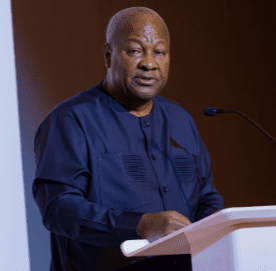
President John Dramani Mahama has called for a fundamental reset in the relationship between Africa and the rest of the world, urging global investors and development partners to embrace a new era of fair, strategic and mutually beneficial partnerships.
Delivering the keynote address at the 12th Africa Debate held at London’s historic Guildhall on Wednesday, President Mahama said Africa was no longer a passive observer in global affairs but an emerging force shaping the future of the world economy.
Speaking on the theme, “Redefining Partnerships: Navigating a World in Transition,” the President noted that global trade systems, geopolitical alliances and development financing structures were undergoing significant changes, creating new opportunities for Africa.
“Africa is rising not as a passive observer but as a decisive force in shaping the future global economy,” he told an audience of investors, policymakers and business leaders.
President Mahama argued that longstanding narratives portraying Africa through the lens of aid, crisis and dependency no longer reflected the continent’s realities.
“The Africa of today is youthful, dynamic, entrepreneurial, digitally connected, resource-rich and increasingly reform-oriented,” he said.
He highlighted Africa’s vast reserves of critical minerals essential for the global energy transition, including cobalt, lithium, manganese, copper and rare earth elements, while pointing to the African Continental Free Trade Area (AfCFTA) as a major catalyst for industrialization and intra-African trade.
“Africa does not seek sympathy. Africa seeks partnerships—fair partnerships, strategic partnerships and mutually beneficial partnerships,” he stressed.
The President emphasized that the era of exporting raw materials while importing expensive finished products must come to an end, advocating instead for investments that promote industrialization, technology transfer, infrastructure development and value addition across the continent.
Ghana’s Economic Recovery
Turning attention to Ghana, President Mahama said his administration inherited significant economic challenges upon assuming office in January 2025, including high inflation, currency depreciation, weakened investor confidence and rising public debt.
However, he said the government had implemented disciplined macroeconomic reforms that were already yielding results. “We refused to accept decline as our destiny,” he declared.
According to the President, inflation has fallen considerably, fiscal indicators have improved, international reserves have strengthened and investor confidence has begun to return.
“This recovery is not merely statistical; it is structural,” he said. “We are repositioning Ghana as a productive economy built on industrialization, agro-processing, exports, logistics, digital transformation and value addition.”
He cited the government’s flagship 24-hour economy initiative and accelerated export development programme as key pillars of a new growth strategy aimed at boosting production, creating jobs and increasing competitiveness.
“This initiative is not just about extending working hours. It is about reorganizing the Ghanaian economy to maximize productivity across manufacturing, logistics, transportation, agriculture, pharmaceuticals, digital services, tourism and the creative economy,” he explained.
‘Ghana Is Open for Business’
President Mahama used the platform to court international investors, assuring them that Ghana was committed to creating a transparent, predictable and investor-friendly business environment.
“The message I bring to investors today is simple: Ghana is open for business,” he stated.
He outlined ongoing reforms to improve the ease of doing business, alongside investments in roads, railways, ports, energy infrastructure, digital connectivity and skills development.
The President also highlighted the government’s “Big Push” infrastructure programme, which he said presents significant investment opportunities across sectors including transport, housing, energy, water and logistics.
“Ghana offers political stability, democratic continuity, strategic geographical access to the West African sub-region and a government committed to reform and private-sector growth,” he said.
Call for Global Financial Reform
President Mahama also called for reforms to the international financial architecture, arguing that African countries continue to face disproportionately high borrowing costs despite possessing strong growth potential.
He urged developed nations to honour climate finance commitments and advocated for faster and fairer debt restructuring mechanisms.
“Climate finance must be delivered. Africa contributes least to global emissions and yet bears a disproportionate burden of climate change,” he said.
The President further argued that global governance institutions must evolve to reflect Africa’s growing demographic and economic significance.
Deepening UK-Africa Relations
Addressing the future of UK-Africa relations, President Mahama said the United Kingdom had a unique opportunity to build a more strategic and economically driven partnership with the continent.
“This relationship must evolve from one primarily shaped by aid to one anchored in enterprise, innovation and investment,” he said.
He noted that stronger ties would benefit both sides by expanding trade, investment, technology transfer, infrastructure development and innovation.
‘Africa Is Not Waiting to Be Rescued’
In his concluding remarks, President Mahama challenged investors to view Africa not as a risk but as one of the world’s most promising growth frontiers.
“Africa is not a risk to be managed. Africa is an opportunity to be seized,” he declared.
He said Ghana was ready to serve as a gateway for investment, manufacturing, finance and regional trade expansion across West Africa and the continent at large.
“Africa is not waiting to be rescued. Africa is building, innovating and transforming,” he said.
“Ghana is preparing, Africa is preparing and together, through genuine partnership, we can build a more prosperous and equitable global future.”
Story: Patrick Asford Boadu