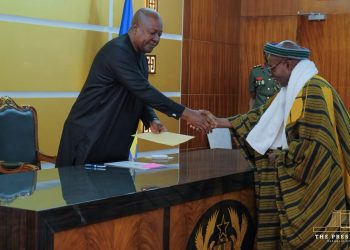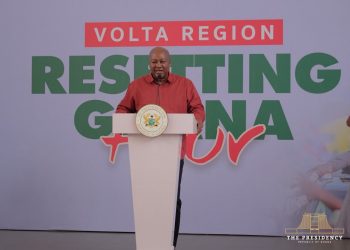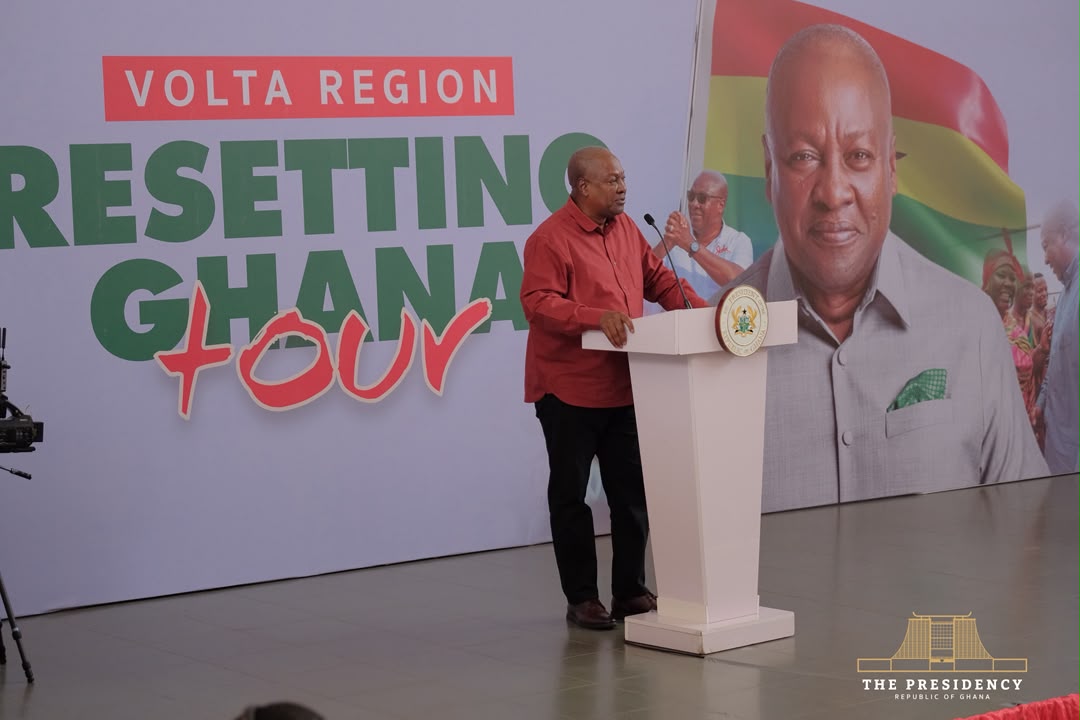
President John Dramani Mahama addressed a wide range of concerns raised by residents, traditional leaders, students, and persons with disabilities during the community engagement session of his two-day Resetting Ghana Tour in the Volta Region, outlining government’s plans for healthcare, education, infrastructure, transport, water supply, and social inclusion.
Responding to a request by Togbe Teprehodo for improved healthcare services, President Mahama announced that government intends to upgrade the Hohoe Municipal Hospital into the new Volta Regional Hospital while maintaining the Ho Teaching Hospital as the region’s teaching hospital.
“Our intention is to upgrade the Hohoe Hospital into the Volta Regional Hospital, while Ho Teaching Hospital continues to function as the region’s teaching hospital. In the coming months, you will begin to see the designs and feasibility studies for the construction of the new Volta Regional Hospital in Hohoe.”
He thanked the traditional ruler for his confidence in government and pledged to continue working harder to meet the expectations of the people.
On railway development, the President reaffirmed government’s commitment to implementing Ghana’s Railway Master Plan, describing the Eastern Corridor Railway as a critical national project.
“As resources become available, we will continue implementing the master plan step by step until the railway network effectively serves every part of Ghana.”
He explained that expanding rail transport would reduce the movement of heavy cargo on roads, preserve road infrastructure, lower maintenance costs, and improve the country’s transport efficiency.
Addressing concerns over political appointments, President Mahama defended government’s decision to reduce the number of appointees, saying it fulfilled a campaign promise to create a leaner and more efficient government.
“We deliberately decided to reduce the number of political appointees because that was a promise we made to the Ghanaian people.”
He assured party supporters that opportunities for public service would continue through future appointments and reshuffles.
On transport fares, the President acknowledged public frustration over the slow reduction of fares despite declining fuel prices.
He recalled that his previous administration introduced a trigger mechanism linking transport fares to fuel price movements and said government would continue engaging transport unions to ensure commuters benefit whenever operating costs decrease.
Responding to appeals from persons with disabilities, President Mahama announced that he had directed the Minister for Health to explore the engagement of sign language interpreters in regional and teaching hospitals.
“I have directed the Minister of Health to explore the engagement of sign language interpreters in regional and teaching hospitals so that hearing-impaired patients can receive quality healthcare without communication barriers.”
He also praised a student representative for presenting practical recommendations on inclusive education and directed the Volta Regional Minister to work with her to formally submit the proposals to the Minister for Education.
The President reiterated government’s commitment to free tertiary education for persons with disabilities in all public tertiary institutions and highlighted increased feeding grants and the removal of financial barriers for students with special needs.
“A nation’s true character is measured by how it treats its most vulnerable citizens, and we remain committed to protecting and supporting them.”
On preserving historical heritage, President Mahama tasked the Ghana Museums and Monuments Board with assessing concerns raised about a historical site to determine the best preservation strategy.
Regarding the ongoing extradition matter involving a Ghanaian abroad, he stressed that government would continue to follow international legal procedures and respect judicial processes.
“We believe strongly in the independence of Ghana’s judicial system and every accused person will have access to legal representation and a fair hearing.”
The President also announced that government had secured funding to continue constructing additional secondary schools in densely populated communities to reduce congestion and make day schooling more accessible.
He further reaffirmed government’s commitment to upgrading Ohawu Agricultural College into a fully-fledged agricultural university.
On water supply challenges in Ho, President Mahama directed the Environmental Protection Agency and the Ghana Water Company to investigate concerns about the city’s water source while confirming that government was reviving the Adidome Water Project to increase potable water supply to Ho and neighbouring communities.
He also reaffirmed government’s commitment to the GETFund tablet programme, which will provide students with electronic devices preloaded with core textbooks.
Commending Ho Technical University’s Fashion Department, the President praised the creativity and practical skills demonstrated during an exhibition he attended.
“The creativity, craftsmanship and quality of the designs on display demonstrate the practical skills being developed by the students.”
He also applauded research by the university into reducing the maturation period of the baobab tree, describing it as a breakthrough with significant agricultural and commercial potential.
On accommodation challenges facing tertiary institutions, President Mahama announced that government would partner private investors to construct affordable hostels on university lands.
“Government alone cannot solve this challenge, which is why we are partnering universities with the private sector to develop additional hostel facilities.”
Concluding his remarks, the President responded positively to a request from Ho Technical University for a bus.
“I can promise you that by next week, you will receive a brand-new bus.”
The community engagement formed part of President Mahama’s Resetting Ghana Tour, an initiative aimed at reporting on government’s performance, engaging citizens directly, and receiving feedback on national development priorities.
Story: Patrick Asford Boadu