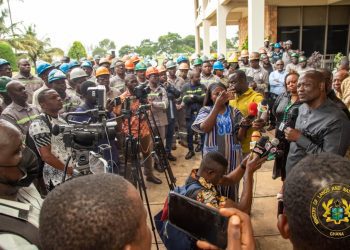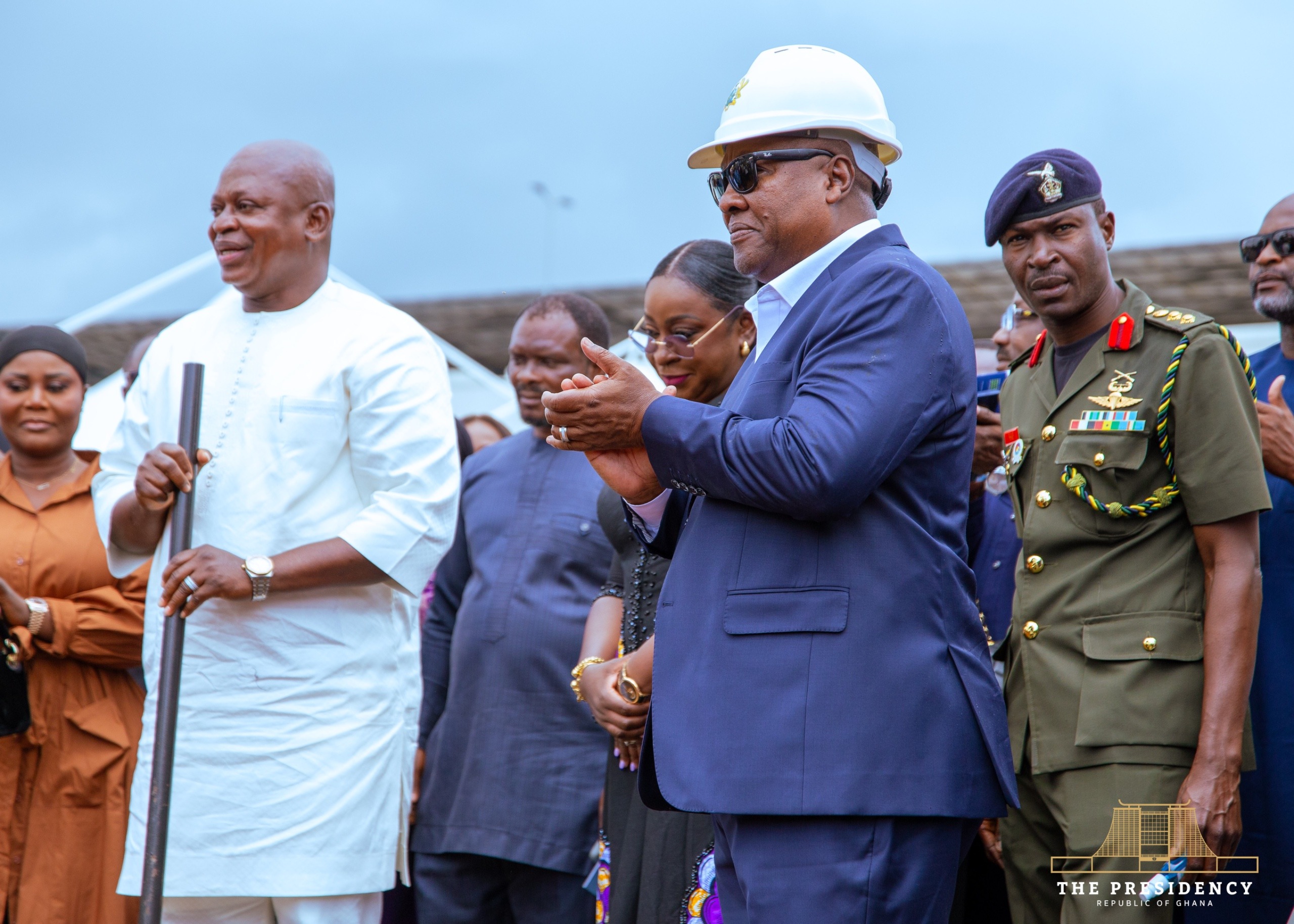
President John Dramani Mahama has cut sod for the construction of a multi-purpose, multi-tiered car park and airport hotels complex at the Accra International Airport, describing the project as a strategic investment to position Ghana’s principal international gateway for future growth.
The President said the development was not merely another construction project but a proactive response to increasing passenger traffic, vehicular congestion and the growing demands being placed on airport infrastructure.
“This is about preparing Ghana’s principal international gateway for the demands of the future,”
President Mahama said. “It is responding to growth with foresight, improving the experience of passengers and visitors, and ensuring that our airport infrastructure keeps pace with Ghana’s economic and development ambitions.”
He recalled that Ghana embarked on a transformative aviation infrastructure programme in 2014 with the construction of Terminal 3, following rising passenger traffic and capacity constraints at Terminal 2.
According to President Mahama, the completion of Terminal 3 significantly improved passenger facilitation and service delivery while strengthening Ghana’s position as an aviation hub in the West African sub-region.
He said the experience demonstrated the importance of investing ahead of demand rather than waiting for congestion and declining service standards to become unmanageable.
Passenger traffic drives new investment
President Mahama disclosed that passenger traffic through the Accra International Airport had increased from approximately 1.8 million passengers in 2022 to 2.5 million passengers in 2025.
He said the growth was encouraging and reflected Ghana’s expanding air connectivity as well as the country’s attractiveness for business, tourism, investment and family travel.
However, he noted that the increase in passenger numbers had also placed pressure on airport roads, parking facilities, passenger pick-up and drop-off areas, security operations and the overall efficiency of the airport enclave.
“The passenger experience begins long before you check in and it does not end after you have collected your baggage,” he said, stressing that access, parking, movement, safety, convenience and hospitality were all integral to the airport experience.
The seven-storey complex, when completed, is expected to provide approximately 2,030 covered parking bays, substantially increasing parking capacity around Terminal 3.
Two hotels and commercial facilities
President Mahama emphasised that the development would go beyond providing parking facilities, describing it as an integrated airport complex designed to serve passengers, business travellers, tourists, airlines and the wider public.
The facility will include a 120-room five-star premium hotel and a more affordable 250-room three-star hotel.
“That’s for the rich people. And for us ordinary people, there will be a 250-room, 3-star hotel that is more affordable for us,” the President remarked.
The complex will also feature retail and commercial facilities, restaurants, shopping areas, banking and traveller services, a food court and modern business facilities.
A covered pedestrian sky bridge will directly connect the development to Terminal 3, while a sky lounge and sky observatory will provide visitors with views of aircraft taking off and landing.
President Mahama said the combination of parking, accommodation, retail, dining and business facilities would transform the airport enclave into a more vibrant economic space and support longer transit stays.
Smart technology and electric vehicle infrastructure
The President said technology would play a central role in the development.
The parking facility is expected to incorporate automatic number plate recognition, cashless and ticketless parking, parking guidance systems, electric vehicle charging points and a centralised CCTV surveillance system.
He urged developers and operators to ensure that the technology was reliable, secure, user-friendly and capable of reducing rather than creating delays.
“Technology must serve people and no passenger should be left behind,” he said.
President Mahama also called for energy efficiency, responsible waste management, water conservation and environmentally responsible construction practices, noting that airport projects typically have long operating lives.
Safety and professionalism
Given the project’s location within a busy aviation environment, the President stressed that construction must be carefully coordinated with airport operations.
He said passenger movement, emergency access, traffic control and aviation security must remain protected throughout the construction period.
President Mahama further called for greater professionalism and discipline across Ghana’s aviation value chain, saying the conduct of workers and service providers directly influences the country’s image.
He commended the Ghana Airports Company Limited, the Ghana Civil Aviation Authority and other airport institutions for taking a firm position against soliciting and begging visitors for tips.
“It reflects very badly on our country,” he said.
Government expands regional aviation infrastructure
President Mahama also announced that government was pursuing a broader programme to expand aviation infrastructure beyond Accra.
He disclosed that during his recent visit to the Upper East Region, he inspected the site earmarked for the proposed Bolgatanga Airport and said preparations were well advanced for construction to begin.
He added that procurement processes were also underway for proposed regional airports at Wa in the Upper West Region and Nsuatre in the Bono Region.
In the Ashanti Region, he said work was advancing on the runway extension at Prempeh I International Airport in Kumasi, which is intended to accommodate heavier long-haul passenger aircraft capable of undertaking international routes.
“It is my hope that in the near future, passengers will be able to take off directly from Kumasi to other international destinations across the world,” President Mahama said.
He said expanding regional aviation would reduce travel times, connect producers to markets, support emergency services and open new tourism and investment corridors.
Airport projects funded without direct government financing
President Mahama made a significant disclosure regarding the financing of ongoing airport infrastructure projects.
He said projects including the Ghana Civil Aviation Authority’s new control tower, refurbishment of Terminal 2, the transfer concourse between Terminals 2 and 3, and the new multi-tiered car park and airport hotels complex were being funded entirely from the balance sheets of the Ghana Civil Aviation Authority and Ghana Airports Company Limited.
“The Government of Ghana has not given either of these two institutions one single cedi for these projects,” he stated.
He praised the Minister for Transport, the boards and management of the aviation institutions and other stakeholders for pursuing infrastructure development without relying on additional borrowing.
“This is what we want to see: develop our country, but don’t go to our creditors and ask for money,” he said.
New Customs Act removes duties on aircraft spare parts
President Mahama also announced a policy measure aimed at supporting Ghana’s domestic airline industry.
He said that following his assent to the new Ghana Customs Act, duties and taxes on aircraft spare parts imported by domestic airlines had been removed.
The measure, he explained, was intended to help domestic airlines maintain their aircraft more affordably and improve aviation safety.
“We want to make domestic airlines safer. If they bring in spare parts to maintain their aircraft, they will come in duty-free and tax-free,” he said, adding that the policy would be welcome news for domestic carriers including PassionAir and Africa World Airlines.
Contractors urged to deliver on time
As construction begins, President Mahama urged contractors and consultants to maintain high standards of quality, value for money and strict adherence to project specifications.
He called for rigorous cost controls, continuous supervision and early resolution of challenges that could threaten the project’s schedule or quality.
He also directed that airport users be adequately informed about major construction milestones, traffic diversions and other temporary disruptions.
“Let me emphasize that we’re not cutting the sod merely to begin construction,” President Mahama said. “We are cutting the sod with the expectation that the project will be completed, commissioned and put to productive use for the benefit of the people of Ghana.”
He reaffirmed government’s commitment to investing in aviation infrastructure, strengthening connectivity and building an aviation sector capable of competing at the highest level in Africa and beyond.
The President expressed hope that the project would create jobs and new economic opportunities, improve the passenger experience, strengthen Ghana’s position as a leading aviation hub and contribute to the government’s broader agenda to reset and transform the Ghanaian economy.
Story: Patrick Asford Boadu