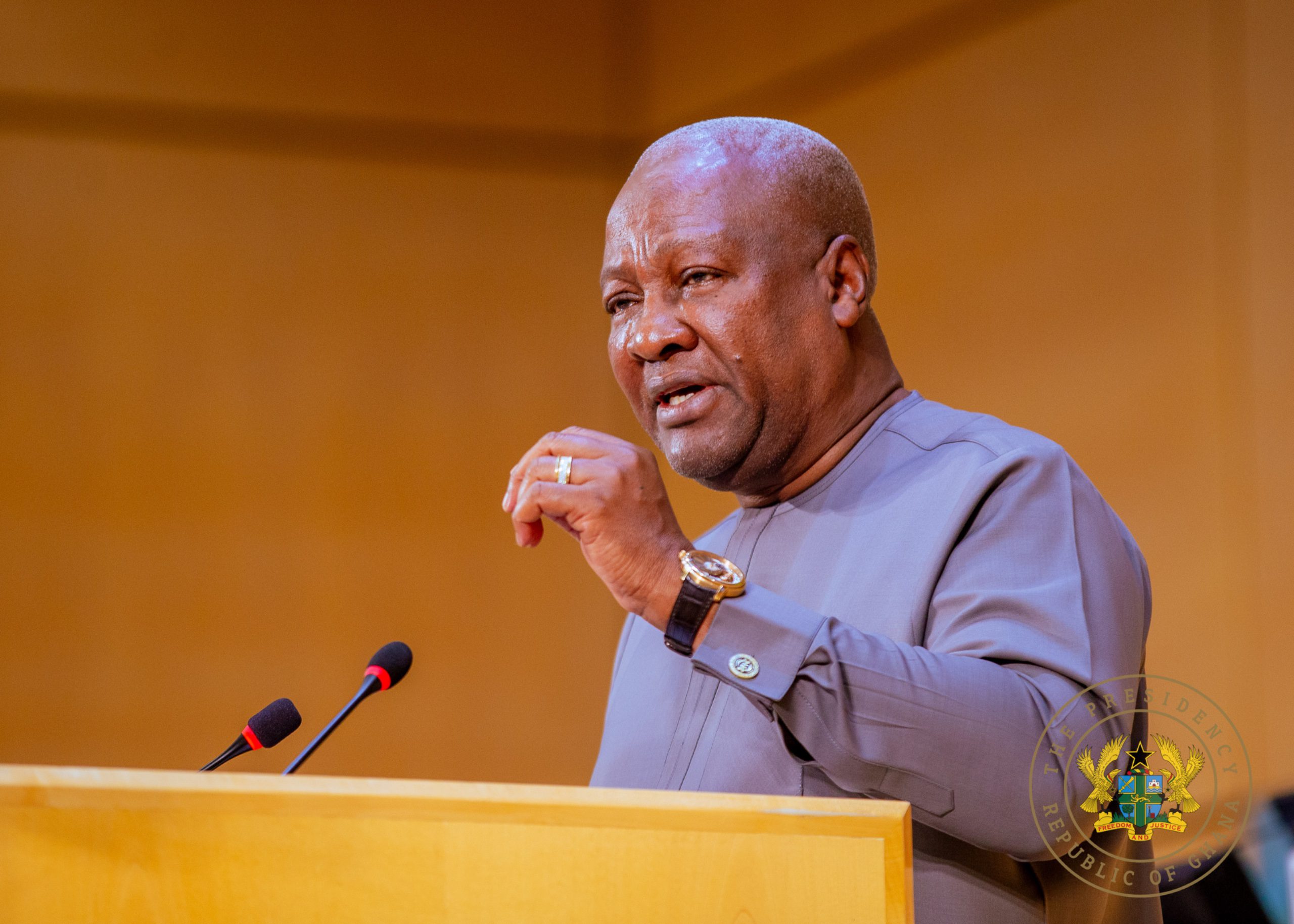
President John Dramani Mahama’s dissolution of the boards of several state institutions has reignited debate over deeper structural weaknesses in Ghana’s public-sector governance, with two governance experts warning that replacing board members alone will not resolve longstanding problems affecting State-Owned Enterprises (SOEs).
Speaking on Gold Morning Conversation, GIMPA law lecturer and governance expert Dr Kwaku Anane-Gyinde and Ghana’s former Ambassador to the Netherlands Dr Tony Aidoo examined the legal and governance implications of the board dissolutions, raising concerns about executive appointment powers, political patronage and accountability within state institutions.
Dr Anane-Gyinde defended the President’s authority to dissolve boards constituted through presidential appointments, citing Article 70 of the 1992 Constitution. He argued that while publicly explaining such decisions may constitute good governance practice, the President is not necessarily required to provide reasons for every revocation.
He also rejected attempts to separate the performance of SOEs entirely from the responsibilities of their boards, arguing that while chief executives oversee day-to-day operations, boards remain responsible for major strategic decisions.
“In other parts of the world, state-owned enterprises or corporations make profits and pay dividends to government. But in our part of the world, almost every year they make losses. So we are paying people to make losses,” he said.
“The day-to-day management is for the CEO and his people, but major, critical, strategic decisions are left to the board. So the performance of any state-owned enterprise is directly related to the efficiency and performance of the board.”
Addressing questions about entities such as the Bulk Oil Storage and Transportation Company (BOST), which has recently reported profits and paid dividends to the state, Dr Anane-Gyinde argued that profitability alone should not be the sole measure of a board’s effectiveness.
He said an entity could report a profit but still perform below its potential, while issues such as procurement breaches, conflicts of interest or other governance failures could provide grounds for questioning a board’s performance.
Dr Tony Aidoo, however, placed greater emphasis on what he described as a structural problem with Ghana’s governance architecture.
He argued that repeatedly dissolving and replacing boards would achieve little unless the system governing appointments and relationships between boards and chief executives is reformed.
According to him, allowing the President to appoint both board chairpersons and chief executives creates the potential for competing centres of authority within state institutions.
“Already, there’s an inbuilt structure of conflict. I don’t know how we are ever going to solve it. Where you have a board chairman who is appointed by the President, and a CEO who is appointed by the President, very often, there’s a clash of ideas or personalities,” Dr Aidoo said.
He further criticised the influence of political lobbying and patronage on appointments, arguing that some individuals secure positions through recommendations from political actors rather than through a system principally driven by competence and institutional needs.
“The President has too much power. The President, so far as the public services are concerned, appoints virtually everybody, from directors all the way to the top,” he said.
“Most of the board members are not personally known to the President. They are based on the recommendations and the lobbying of people. So by the time the President discovers that such a bad situation is the result of personality conflict, it is probably too late.”
Dr Aidoo consequently called for a reconsideration of the appointment architecture, including the possibility of giving sector ministers greater responsibility for constituting boards, as part of broader reforms aimed at reducing excessive concentration of appointment powers in the presidency.
The discussion also turned to the Presidency’s indication of possible changes involving chief executives of state institutions.
Dr Anane-Gyinde cautioned that removing chief executives raises different legal considerations from dissolving governing boards.
He referenced the Supreme Court’s decision in Theophilus Donkor v. Attorney-General, which dealt with provisions of the Presidential (Transition) Act concerning the tenure of chief executives of specified public bodies.
“The Supreme Court ruled that Section 14 of the Transition Act is unconstitutional, so the President cannot remove the CEOs or the MDs. But if he is not removing them and then he is reshuffling them, you cannot term it as a dismissal or removal. So that place we have to be very careful,” he said.
Both experts ultimately argued that improving the performance of Ghana’s state institutions would require more than changes in personnel. They advocated stronger performance benchmarks, clearer accountability mechanisms, reduced political interference and reforms to the appointment system governing boards and executives.
For Dr Aidoo in particular, the broader challenge remains the concentration of appointment powers in the presidency, a structural problem he believes requires deeper institutional and constitutional reform rather than periodic changes to the individuals occupying boardrooms.