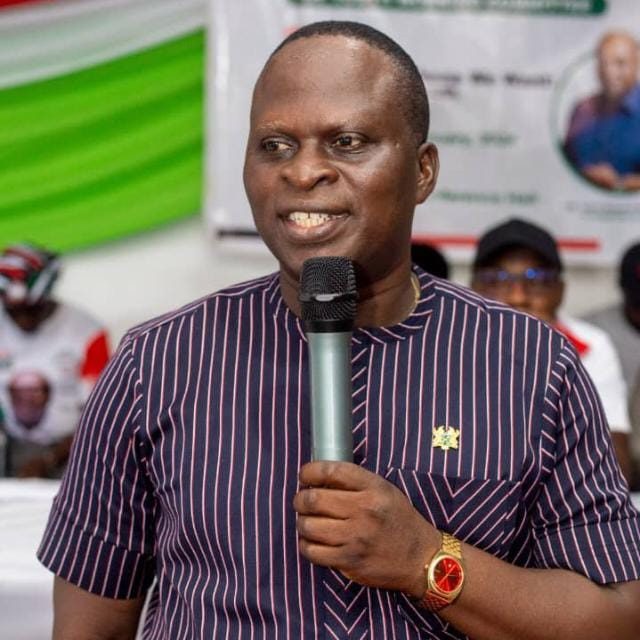
Member of Parliament for Krachi-Nchumuru, Solomon Kuyon, has thrown his full weight behind the 2027 Budget Statement and Economic Policy, arguing that the fiscal plan moves Ghana beyond macroeconomic recovery toward tangible job creation, reliable power, and targeted infrastructure for underserved regions like Oti.
Contributing to the parliamentary debate on the budget, Kuyon credited national resilience for steering the economy through global cocoa and crude oil volatility as well as the Akosombo fire, which knocked out 1,020 megawatts of power supply. With inflation easing to 5.5 percent in October and first-half economic growth reaching 6.2 percent, he said the central task now is converting stability into everyday opportunity.
Addressing education first, the lawmaker pointed to findings in the 2025 Auditor-General’s Report showing that more than 10,000 public basic schools serving over three million learners lack proper classroom blocks, while over 2,000 schools combine multiple classes in single spaces.
To close those gaps, he highlighted the Ministry of Education’s GH¢48 billion allocation, including GH¢11.2 billion routed through GETFund for infrastructure and GH¢1.37 billion earmarked to reform secondary education and phase out the double-track system.
He also underscored social intervention funding: GH¢537 million for the No Fees Stress policy for first-year tertiary students, GH¢169 million to cover BECE fees, GH¢292 million for free sanitary pads, and GH¢2.1 billion for the School Feeding Programme. Medium-term projections indicate No Fees Stress will expand to roughly GH¢806 million and school feeding to about GH¢2.6 billion by 2030.
On staffing, Kuyon noted that government has already deployed 7,000 teaching and support staff to understaffed schools, with further recruitment of teachers and TVET instructors slated for 2027, alongside a 20 percent special allowance for teachers serving in deprived communities.
Turning to youth employment, Kuyon welcomed the GH¢3.5 billion allocation to the Ministry of Youth Development and Empowerment, comprising GH¢2 billion for job creation and skills training and GH¢1 billion for National Service allowances. He added that amending the Earmarked Funds Capping and Realignment Act will lift ceilings on youth employment funding and unlock an extra GH¢1 billion.
According to the MP, the Youth Employment Agency has already reached 73,537 young people across 13 modules and aims to engage at least 100,000 in 2027, complemented by a US$300 million technology push to establish a National Artificial Intelligence Centre and upgrade rural 2G zones to 4G connectivity.
In sports, he cited a GH¢782 million allocation to the Ministry of Sports and Recreation, with GH¢600 million dedicated to initiating ten multipurpose regional stadia: seven 5,000-seat facilities in Western North, North East, Ahafo, Upper East, Upper West, Bono East, and Oti; two 10,000-seat venues in Savannah and Bono; and a 12,000-seat stadium in Volta. He added that Ghana’s hosting of 12 nations for next year’s CAF Under-20 Africa Cup of Nations will generate commercial spin-offs for local hotels, transport operators, and traders.
Reflecting on the energy sector, where shortfalls cost the economy roughly US$1.4 billion in 2025, Kuyon noted that GH¢13 billion has been set aside to cover 2027 shortfalls while long-term generation projects take shape.
He outlined major state-owned investments, including a 1,450-megawatt thermal plant at Kafodzidzi-Abrobeano breaking ground in December 2026 (with the first 600 megawatts expected by December 2028) and a 600-megawatt solar plant backed by 2,000 megawatt-hours of battery storage.
Coupled with a US$500 million transmission upgrade and the rollout of two million prepaid meters, government aims to cut power generation costs from roughly 16 US cents per unit to 8 cents or below and phase out emergency power by 2030. Meanwhile, GH¢3 billion under the Rural Electricity Acceleration and Urban Intensification Initiative (REIP) and the connection of 400 communities under the Self-Help Electrification Programme (SHEP) are projected to lift national electricity access from 89.13 percent to 89.65 percent.
Bringing the debate home to his constituents, Kuyon detailed a slate of projects slated for the Oti Region, including a 5,000-seat regional stadium, ongoing construction of a 160-bed regional hospital, upgrades to the Hohoe–Baika–Jasikan feeder roads, reinforcement of power supply via the Eastern Corridor Transmission Project, and the completion and occupation of Phase II of the Dambai military base by late 2027.
He added that 35 mini-grids are currently under construction to supply electricity to 47 lakeside and island communities across Oti, Bono East, and Savannah for commissioning in 2027, while the Krachi-Nchumuru District Assembly at Chinderi has been given a 2027 ceiling of approximately GH¢31.5 million, nearly GH¢26 million of it from the District Assemblies Common Fund.
Concluding his remarks, Kuyon urged colleagues across the aisle to approve the budget, noting its target of reducing national unemployment from 12.8 percent in 2025 to below 8 percent by 2030 through large-scale public works that will employ artisans, technicians, teachers, and coaches nationwide.
Eugenia Ewoenam Osei