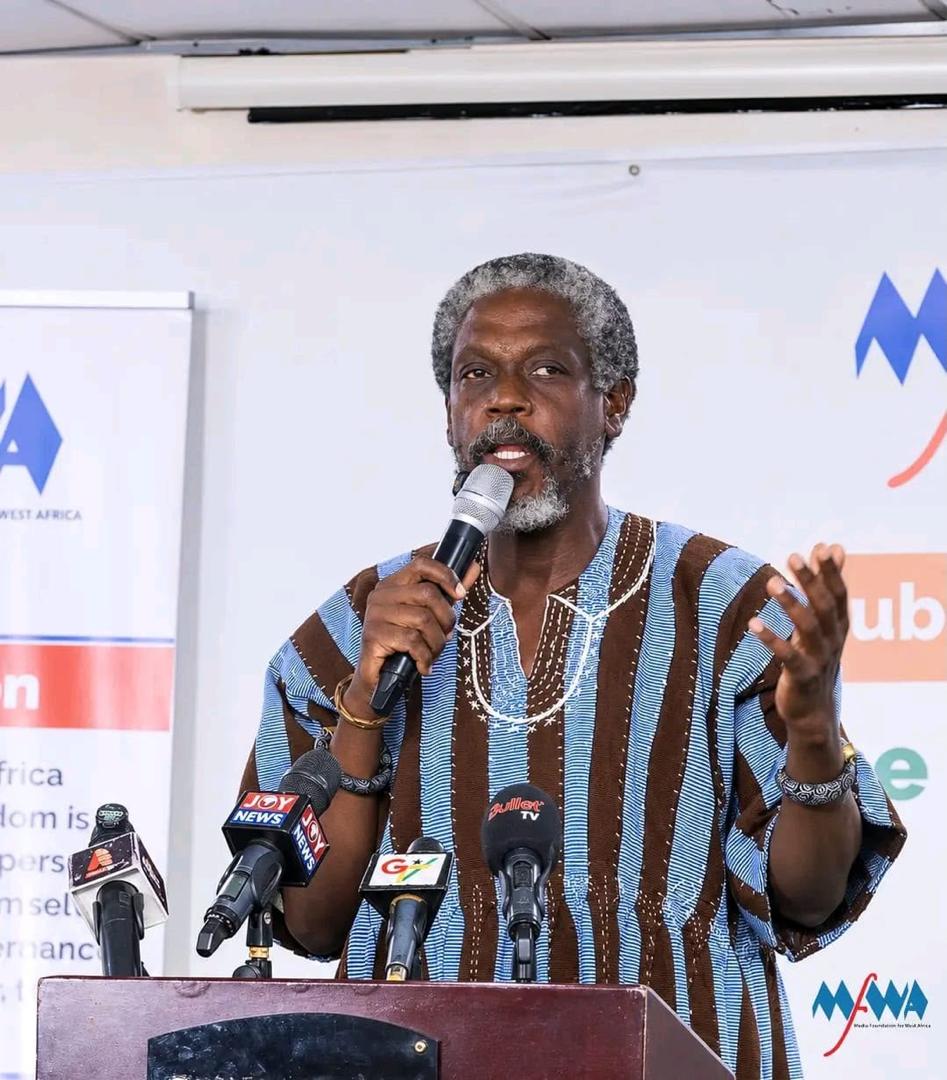
“Ghana stands at a critical crossroads and without urgent action to rethink how it produces, regulates, and values food, the country risks failing future generations, Communications Director of Food Sovereignty Ghana”, Edward Baffour, has warned.
Delivering the keynote address at a multi-stakeholder food systems forum, Baffour, who also serves as Public Relations and Advocacy Director of the Vegetarian Association of Ghana said Ghana is confronting an existential threat spanning environmental degradation, declining nutrition, and weakened food safety.
Anchoring his remarks on the African proverb, “We do not inherit the earth from our ancestors; we borrow it from our children,” he urged policymakers, researchers, farmers, and citizens to move beyond endless rhetoric and confront deep structural flaws in the nation’s agricultural model.
Citing Ghana News Agency reporting on the February 2026 Ghana Statistical Service food insecurity report,Baffour noted that 12.5 million Ghanaians representing 38.1 percent of the population experienced food insecurity between the first quarter of 2024 and the third quarter of 2025.
At the same time, he warned that ultra-processed fast foods such as pizzas and instant noodles are rapidly displacing nutritious traditional diets, fueling diet-related illnesses and placing a growing burden on public health.
He criticized trade and agricultural policy frameworks that allow imported poultry shipped from thousands of miles away to sell cheaper on local markets than chicken raised by Ghanaian farmers, arguing that such outcomes serve powerful commercial lobbies rather than the national interest. Combined with rising childhood obesity, increasing cancer cases, food additives, and mercury contamination in water bodies, he said, these trends should prick the nation’s conscience.
Baffour drew a sharp distinction between food security and food sovereignty. While food security focuses largely on food availability, food sovereignty encompasses affordability, cultural relevance, nutritional quality, safety, and ecological resilience.
For decades, he observed, agricultural progress has been measured primarily through crop yields, mechanization, synthetic fertilizers, pesticides, and commercialization. Yet that narrow focus has come at a steep ecological cost, evidenced by the disappearance of wild mushrooms, snails, frogs, agama lizards, and night-flying green fireflies that once signaled healthy ecosystems and supplemented rural livelihoods.
“Our challenge is not simply to produce more food,” he stressed. “It is to build a food system that nourishes people, protects the environment, strengthens our farmers, and safeguards biodiversity to secure the future.”
Tracing how pre-colonial communities sustained diverse crops through rainfall observation, intercropping, and seed saving, Baffour pointed to customary conservation norms such as traditional non-fishing days and sacred groves as proof of indigenous ecological accountability. He cited the dense green forest preserved around a shrine on the hill at Botianor, as a striking example of cultural values protecting biodiversity amid rapid urban sprawl.
Although colonialism sidelined traditional systems in favor of external models, he argued that modern laws and regulators alone cannot curb illegal mining (galamsey), deforestation, and chemical abuse without rebuilding a shared social ethic of environmental stewardship.
Baffour called on government to move agroecology from advocacy margins into the mainstream of Ghana’s agricultural transformation agenda. Defining agroecology as a holistic approach that unites modern science with local ecological and indigenous knowledge, he urged universities and research institutions to document and validate farmer-led innovations.
“A farmer who knows the behavior of birds on his land, when the frogs come out, and the patterns of ants has conducted experimentation and reviewed what his forebears taught him,” he said, urging extension officers to treat farmers, both men and women as co-equals rather than subordinates.
He also highlighted the erosion of resilient indigenous crops, noting that tuo zaafi, traditionally prepared from hardy, alkaline millet in northern communities such as Bongo and the Upper East and Upper West regions, increasingly made from maize, leaving diets and farms more vulnerable to climate shocks like El Niño.
While commending the Ministry of Food and Agriculture for establishing an agroecology unit and referencing agroecology within the Feed Ghana programme, Baffour emphasized that meaningful impact requires sustained funding, political will, and a coherent national agroecology framework developed alongside farmers, traditional authorities, and researchers.
Turning to food safety, Baffour warned against the widespread circulation and mishandling of hazardous agrochemicals, locally nicknamed “condemn” including substances banned in other jurisdictions. He cited unsafe practices such as farmers tasting chemical mixtures, reusing chemical containers, and harvesting sprayed vegetables like lettuce, carrots, and cabbage without observing pre-harvest intervals.
Effective enforcement of existing environmental legislation, farmer education on protective gear and chemical labels, and hygienic food transport across communities are urgently needed, he added.
On seed systems, Baffour cautioned against intellectual property regimes and commercial pressures that restrict farmers from saving, sharing, and exchanging indigenous seeds, as well as the lack of inclusive public engagement surrounding the commercial release of genetically modified crops such as Bt cowpea.
He challenged journalists to go beyond reactive reporting by building specialized expertise in agriculture and food safety, investigating policy gaps and chemical misuse while spotlighting farmers restoring soils and communities protecting seeds and water bodies.
Concluding his address, Edward Baffour urged collective responsibility across government, research institutions, media, and households to combine scientific rigor with ancestral wisdom innovating without destroying Ghana’s ecological inheritance.
Story: Eugenia Ewoenam Osei