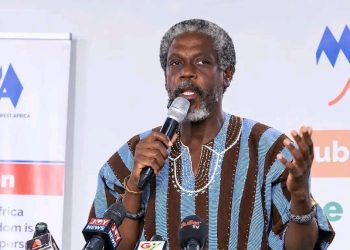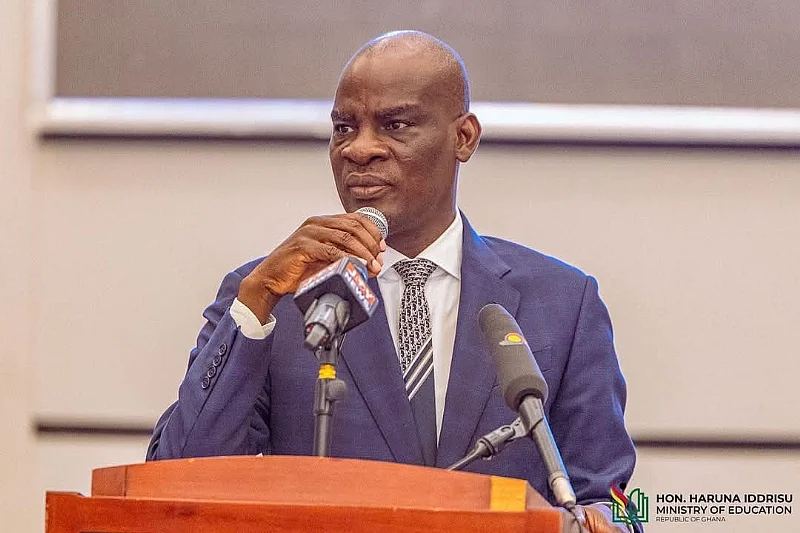
The Minister for Education, Haruna Iddrisu, has defended the government’s directive requiring students to complete all three years of Junior High School (JHS) before sitting for the Basic Education Certificate Examination (BECE), warning that skipping classes undermines the integrity of national assessments.
Responding to criticisms raised by the New Patriotic Party (NPP) at a press conference, Haruna explained that students must go through the complete JHS 1 to JHS 3 academic cycle so their performance can be properly evaluated.
Because continuous assessment forms a critical component of the BECE, he argued, allowing pupils to jump from JHS 1 or JHS 2 directly into the final year distorts the grading process.
He emphasized that education must go beyond exam preparation to prioritize character formation and holistic student development.
Maintaining that the rule is not a new invention, Haruna noted that it enforces a longstanding Ghana Education Service (GES) policy that was also upheld under the previous NPP administration. He pointed to similar policy positions articulated by former Education Minister Dr. Matthew Opoku Prempeh in 2017 and 2023 as proof of continuity.
The Minister accused the opposition party of political opportunism for organizing a press briefing addressed by Prince Amarfio to attack a policy it previously defended while in office, urging the NPP to base its critiques on sound educational principles rather than partisan politics.
Haruna also dismissed claims by the NPP that the government plans to make foreign languages compulsory in schools, insisting his earlier remarks were taken out of context. Challenging the opposition to release the full video of his statement, he clarified that foreign languages will only be introduced as optional subjects for students starting in Senior High School (SHS) Two.
Addressing debate over the use of local languages in classrooms, the Minister noted that the policy mandating mother-tongue instruction from Kindergarten to Primary Three was inherited from the previous NPP administration rather than initiated by the current government.
He clarified that the government has never proposed replacing English with Ghanaian languages. Instead, he said, promoting first-language instruction at the lower primary level is backed by evidence showing that young learners grasp foundational concepts far better when taught in a familiar language.
Haruna added that the Mahama administration is deliberately redirecting investment toward foundational and basic education after what he described as a decade of heavy focus on the secondary level.
Citing the 1992 Constitution’s guarantee of free, compulsory, and universal basic education for every Ghanaian child, he stressed that strengthening the base of the education system is essential to equipping learners for higher academic achievement.
He concluded by calling on the NPP to maintain consistency and speak with one voice when engaging on national education policies.
Story: Eugenia Ewoenam Osei