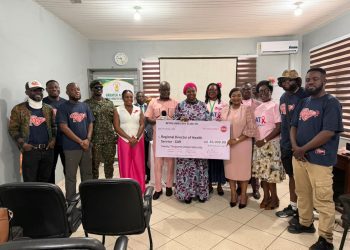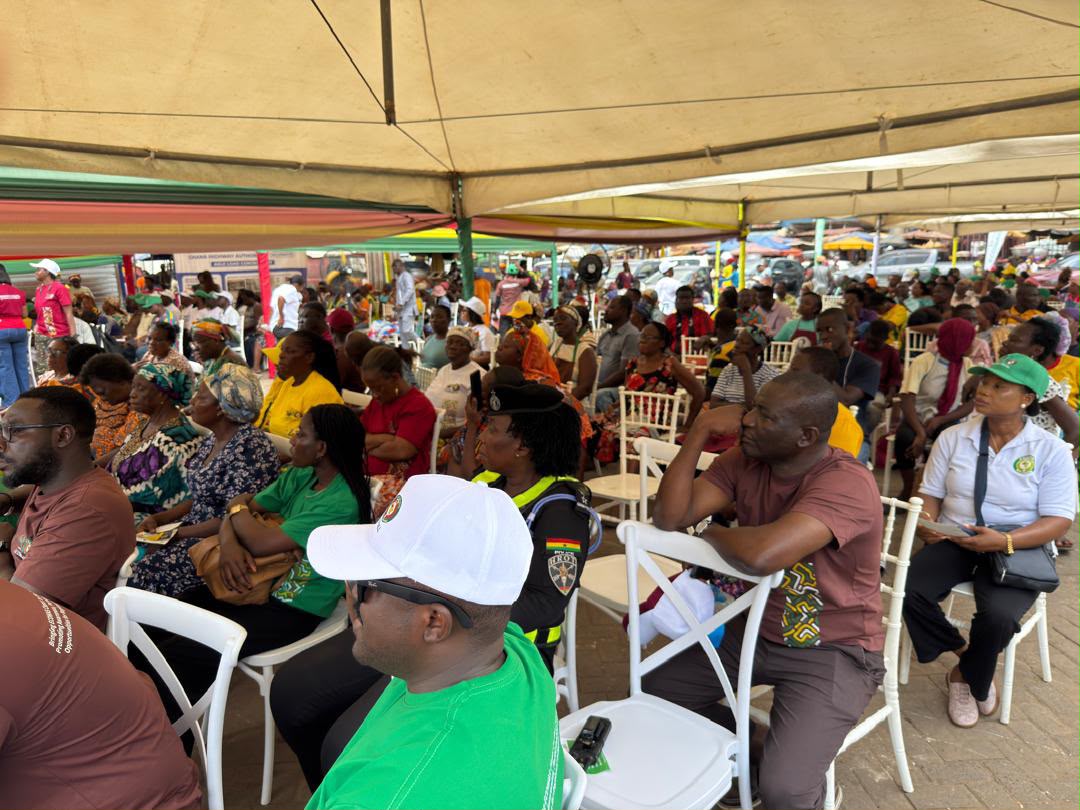
The Ministry of Foreign Affairs, in collaboration with the Economic Community of West African States (ECOWAS), recently brought regional diplomacy directly to the grassroots during the second ECOWAS National Citizen Engagement and Public Sensitization Campaign held at the bustling Madina Market in Accra.
Under the theme “ECOWAS for All: Bringing ECOWAS Closer to the Citizen,” the event served as a platform to demystify regional protocols, address cross-border trading challenges, and empower local traders, transport operators, and entrepreneurs.
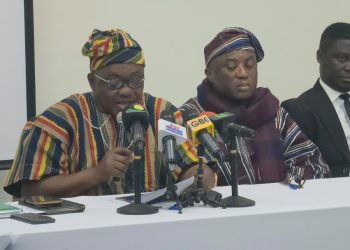
Delivering the keynote address on behalf of the Minister for Foreign Affairs, Samuel Okudzeto Ablakwa, the Coordinating Director for Multilateral and International Organisations at the Ministry, Ambassador Francis Danti Kotia, emphasized that the campaign was designed to engage rather than lecture citizens.
”We have come to your doorstep today, not to lecture you, but to engage with you and raise awareness of the rights, opportunities, and responsibilities that come with being a citizen of the ECOWAS community,” Kotia stated. He acknowledged the vital contributions of traders and transport operators to economic growth, job creation, and the regional integration agenda, particularly through cross-border commerce.
However, the Ministry also recognized persistent hurdles faced by traders, including border delays, unfamiliar procedures, and unofficial charges resulting from a lack of information. To combat these challenges, Kotia highlighted key community programs designed to facilitate trade and movement.
These include the ECOWAS Trade Liberalization Scheme (ETLS) for preferential tariff treatments on regional goods; the Protocol on Free Movement of Persons and the Right of Residence and Establishment, which guarantees seamless mobility; the ECOWAS Brown Card Insurance Scheme for third-party motor insurance coverage across member states; and the harmonization of axle load regulations to protect regional road infrastructure from premature deterioration while establishing a level playing field for transporters.
He urged participants to leverage the expertise of institutional stakeholders present at the event, including Customs, Immigration, the Ghana Export Promotion Authority, the Ghana Shippers’ Authority, and the ECOWAS Brown Card Scheme to resolve their operational difficulties.
He also underscored that rights must be balanced with responsibility, reminding traders to ensure their goods are properly documented, honestly declared, and transported through approved channels.
Highlighting the structural support available, Ambassador Kotia announced that the ECOWAS National Office has been officially established within the Ministry of Foreign Affairs, maintaining an open-door policy to ensure Ghanaians derive maximum benefits from the 400-million-strong West African market.
In his goodwill message, the Resident Representative of ECOWAS in Ghana, Ambassador Mohammed Lawan Gana, expressed profound gratitude to the government and people of Ghana for their unwavering support of regional integration policies.
Gana took the audience on an insightful historical retrospective, tracing the roots of West African cooperation back to ancient trans-Saharan trade networks that connected the region to the Mediterranean between the 8th and 17th centuries.
He highlighted that West Africa has long been a repository of rich cultural heritage and natural resources, challenging the historical misconception of an underdeveloped region.
Detailing the formation of the sub-regional bloc, Gana recalled how the unification ideal gained critical momentum in 1972 through a joint initiative spearheaded by Nigeria and Togo, supported by 15 founding member states, including Ghana, Senegal, Côte d’Ivoire, Liberia, Benin, Guinea, Guinea-Bissau, Sierra Leone, The Gambia, Burkina Faso, and Mali. These diplomatic efforts culminated in the signing of the historic Treaty of Lagos on May 28, 1975.
Reflecting on the milestone 50th anniversary of the regional body which officially kicked off its golden jubilee commemorations in April 2025, Ambassador Gana noted that the milestone served as a vital moment for introspection.
He stressed that evaluating the past 50 years allows the regional body to strategically reposition itself amid an evolving geopolitical landscape to achieve a peaceful, integrated, and prosperous West Africa.
Eugenia Ewoenam Osei