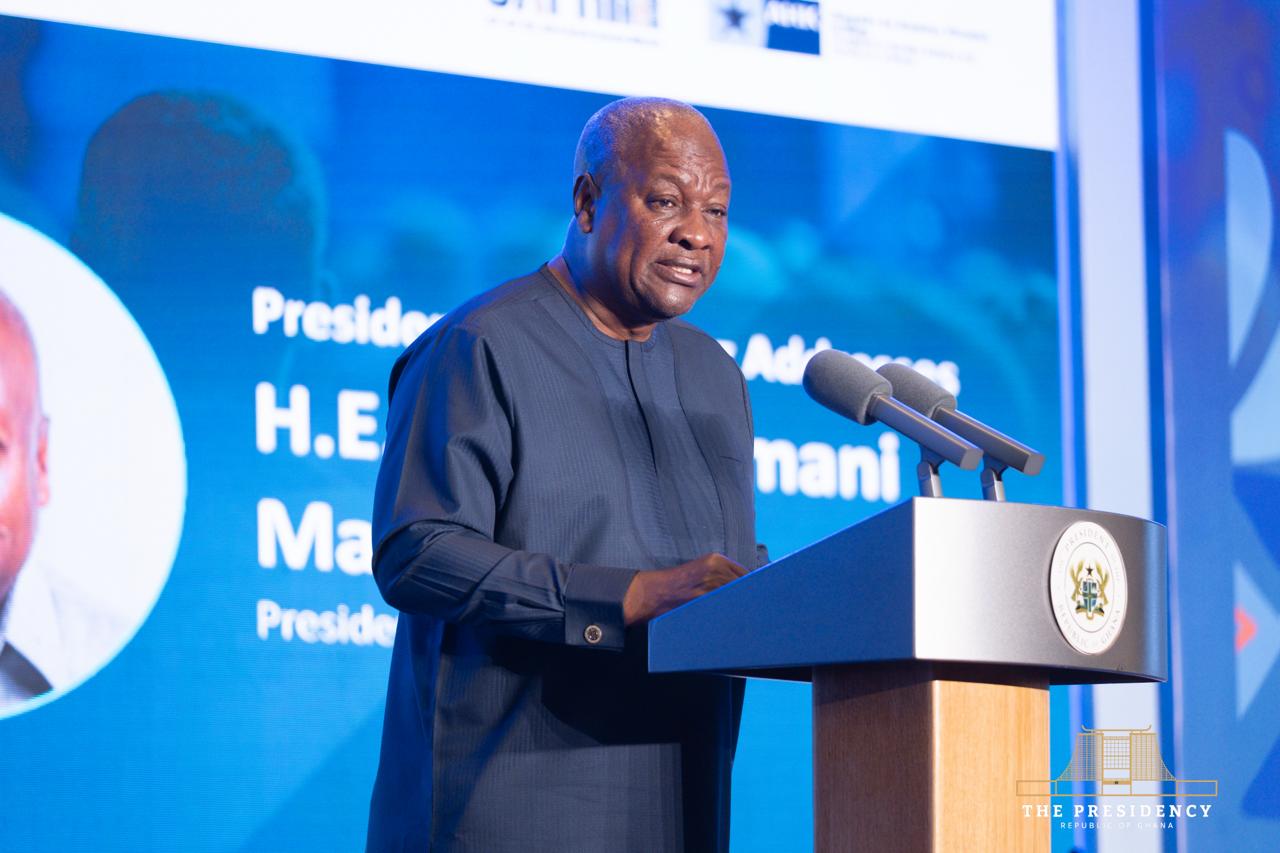
President John Dramani Mahama has announced that Ghana intends to invest US$10 billion over the next four years, from 2027 to 2030, in its New Economy programme as part of efforts to accelerate industrialisation, expand production and create employment opportunities.
He said the government was prepared to implement the programme in partnership with the private sector, including German businesses, and called on investors to take advantage of opportunities in Ghana’s agriculture, manufacturing, energy, pharmaceuticals, infrastructure and digital technology sectors.
President Mahama made the announcement when he addressed the opening of the sixth German-African Business Summit in Accra.
He said the programme was designed to transform Ghana’s economic structure by promoting local production, processing raw materials, expanding manufacturing and strengthening the country’s competitiveness in regional and international markets.
“Ghana intends to spend $10 billion over the next four years, from 2027 to 2030, in implementing the New Economy programme, and we will do this in partnership with the private sector, including our German counterparts,” he announced.
The President said Ghana was seeking a new form of economic partnership with Germany and other international partners, moving beyond traditional donor dependence towards trade, investment, industrial cooperation, technology transfer and value addition.
He said Germany’s expertise in engineering, advanced manufacturing, technological innovation and vocational training offered significant opportunities for Ghana’s industrial transformation.
President Mahama urged German businesses to consider Ghana as a strategic entry point into the African market, leveraging the opportunities provided by the African Continental Free Trade Area (AfCFTA).
He noted that the agreement sought to integrate a continental market of approximately 1.4 billion people, with a combined Gross Domestic Product estimated at more than US$3.5 trillion.
The President said the African market offered enormous opportunities for businesses willing to establish production facilities, develop local supply chains and expand their operations across the continent.
He cited World Bank projections that the comprehensive implementation of the AfCFTA, alongside complementary trade facilitation measures, could increase African incomes by approximately US$450 billion by 2035 and lift about 30 million people out of extreme poverty.
Ghana’s economic recovery
President Mahama also used the summit to highlight Ghana’s economic performance, arguing that the country had moved beyond economic stabilisation and was now focused on growth, resilience and structural transformation.
He said Ghana’s economy expanded by 6 per cent in 2025, while year-on-year growth reached 6 per cent in the second quarter of 2026.
He added that the International Monetary Fund (IMF) projected Ghana’s economic growth at 5.7 per cent for 2026.
On inflation, the President said the rate had declined from 23.8 per cent in December 2024 to 5.2 per cent in September 2026.
He further disclosed that Ghana’s international reserves had increased from US$8.9 billion in December 2024 to approximately US$12.94 billion in June 2026, providing about four months of import cover.
According to him, the cedi had regained strength, interest rates had moderated and government reforms had contributed to reducing the cost of doing business.
President Mahama also said Ghana’s Gross Domestic Product had crossed the US$100 billion mark, positioning the country as the eighth-largest economy in Africa and the second-largest in West Africa.
“These are not just statistics, they are clear evidence that Ghana has moved beyond stabilisation. We are now focused on growth, resilience and transformation,” he stated.
He assured potential investors that Ghana remained committed to creating a predictable and transparent business environment through sustained economic reforms, fiscal discipline and improved public sector efficiency.
“For investors, the message is simple: Ghana is stable, Ghana is growing, and Ghana is open for business,” he said.
German investment opportunities
The President identified agriculture and agro-processing, manufacturing, energy, infrastructure, pharmaceuticals, tourism, the creative industries, digital innovation and mineral beneficiation as priority areas under the New Economy programme.
He said Ghana was particularly interested in partnerships that would introduce advanced technologies, strengthen local supply chains, develop joint ventures and support the emergence of globally competitive Ghanaian enterprises.
In agriculture, he said the government was seeking investment to improve productivity, expand domestic processing and increase exports of higher-value products.
In manufacturing, the focus would be on deepening local production, industrial innovation and integrating Ghanaian businesses into regional and international value chains.
He also called for investments in reliable electricity infrastructure, renewable energy, energy efficiency, logistics, healthcare and technical education.
President Mahama stressed that Ghana wanted investments that went beyond financial commitments to deliver technology transfer, knowledge sharing, local enterprise development and sustainable employment.
“Our message is clear: Ghana welcomes investment that creates value, transfers knowledge, strengthens local enterprise and contributes to sustainable economic growth,” he said.
KfW-backed factory creates 2,000 jobs
To demonstrate the potential of German-Ghanaian investment partnerships, President Mahama highlighted the North Shore Apparel Factory in Savelugu in the Northern Region, which he said had benefited from financing support from Germany’s development bank, KfW, and the Ghana Export-Import Bank.
He disclosed that the factory was currently employing more than 2,000 young people, approximately 80 per cent of whom were female.
According to him, the investment had helped create employment opportunities in the northern part of the country, reducing the pressure on young people to migrate to major urban centres in search of menial jobs.
“But today that factory is employing more than 2,000 young people, 80% of whom are female girls,” he said.
“Today, 2,000 of them have remained at home because they can find opportunity in the northern part of our country,” he added.
The President described the factory as an example of how development financing and private-sector partnerships could support industrialisation, create jobs and promote balanced regional development.
He encouraged German financial institutions, development finance organisations, export credit agencies and commercial banks to explore financing arrangements for commercially viable projects in Ghana.
He specifically mentioned KfW, DEG and Germany’s export credit guarantee systems as important institutions within Germany’s financing ecosystem.
Ghana seeks to expand trade with Germany and EU
President Mahama also called for stronger trade relations between Ghana, Germany and the European Union, highlighting the potential to diversify the composition of goods traded between the two economies.
He disclosed that Ghana’s exports to the European Union increased by 23.2 per cent in 2025, resulting in a trade surplus of €418 million in Ghana’s favour.
He said the figures demonstrated the importance of the European market to Ghana and the opportunities available to deepen and diversify bilateral trade.
The President observed that Ghana’s exports to Germany had traditionally consisted largely of raw materials and agricultural products, while imports from Germany included machinery, chemicals and manufactured goods.
He said the government wanted to change that pattern by expanding local processing and exporting finished and value-added products.
President Mahama further commended Germany for its continued development cooperation with Ghana, recalling that during President Frank-Walter Steinmeier’s previous visit in November 2025, Germany announced approximately €65 million in development cooperation support.
He said Ghana valued the partnership and was looking forward to expanding cooperation in governance, energy, technical education and economic development.
Calls for stronger Africa-Europe partnership
President Mahama said the changing global economic environment, characterised by geopolitical uncertainty, technological transformation and the reorganisation of global supply chains, presented Africa with an opportunity to reposition itself as a competitive destination for investment and manufacturing.
He said Africa’s natural resources, youthful population, expanding consumer markets and opportunities in infrastructure, energy, agriculture and digital technology provided a strong foundation for industrial development.
However, he stressed that the continent must move beyond exporting raw materials and focus on processing what it produces and manufacturing what it consumes.
“Our future must be built at the edge of transformation. We must process what we produce, we must manufacture what we consume, and compete effectively in regional and global markets,” he stated.
He also commended the European Union’s Global Gateway Strategy, including its €150 billion Africa-Europe Investment Package, for providing a framework to address infrastructure, energy, transport and digital connectivity gaps across the continent.
The President urged African leaders to strengthen regional integration, policy consistency, institutional accountability, infrastructure development and democratic governance to attract sustainable investments.
He said the success of the German-African Business Summit should ultimately be measured by concrete investment commitments, partnerships established and jobs created rather than the quality of speeches and discussions alone.
“Let the success of this gathering be measured not only by the quality of our discussions or the length of our speeches, but by the partnerships concluded, investments that are mobilised, and enterprises that are established in the months and years ahead,” he said.
President Mahama expressed optimism that the summit would open a new chapter in German-African economic relations, built around industrial partnerships, technology transfer, infrastructure development and shared prosperity.
Story: Patrick Asford Boadu