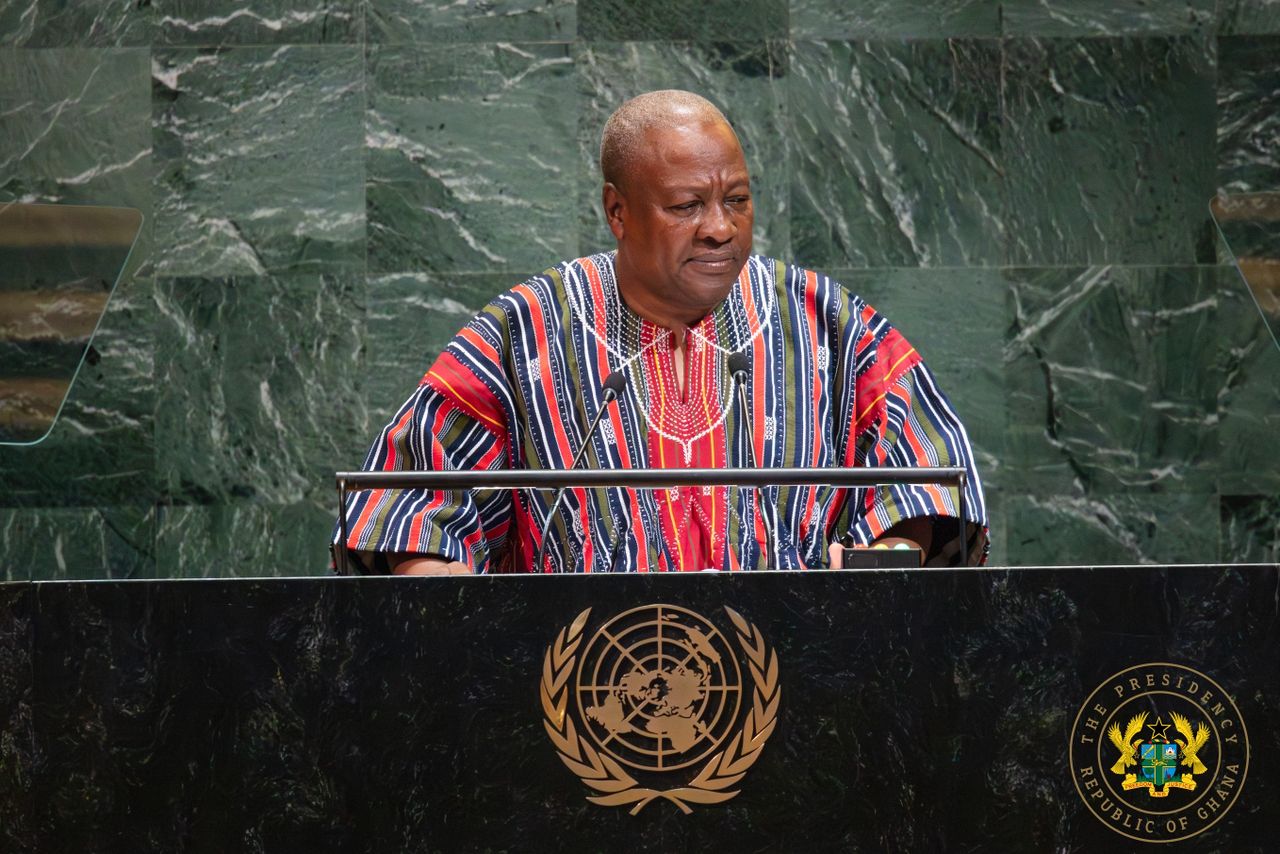
President John Dramani Mahama has urged African nations to assert greater sovereignty over their natural resources, declaring at the 80th United Nations General Assembly (UNGA) that the continent’s future must be built on self-determination, equity, and the fair use of its vast wealth.
“Africa is a catalyst for human potential, for economic reform, and for ecological stability,” Mahama said.
“But this potential will never be fully realized if our resources continue to enrich others more than they benefit our own people. Africa must exercise sovereignty over its natural resources.”
The Ghanaian leader reminded the Assembly of Africa’s historical exclusion from global decision-making. “At the founding of the UN in 1945, only four African nations had a seat at the table. The vast majority of the continent was under colonial domination,” he noted. “As fate would have it, the tables have turned.
Africa today holds the world’s youngest population and tomorrow’s biggest share of humanity. The future is African.”
Mahama stressed that Africa’s mineral, agricultural, and ecological assets were indispensable for the global green transition and sustainable development.
“From critical minerals for clean energy to fertile lands and forests that safeguard the climate, Africa is the engine of the world’s future,” he declared. “Yet, too often, contracts and agreements strip Africa of the value it deserves. This cannot continue.”
Drawing on Ghana’s recent economic reforms, Mahama argued that sovereignty over resources was the cornerstone of resilience.
“When I returned to office this January, Ghana faced spiraling inflation, a weakened currency, and low morale. Through our Reset Agenda, we stabilized the cedi, cut inflation from 23.8% to 11.5%, and restored investor confidence,” he explained.
“But real transformation will only be sustained if we ensure that Ghanaians, and Africans, are the primary beneficiaries of our resources.”
Calling for a broader reform of the UN system itself, Mahama urged the Assembly to recognize Africa’s rightful place. “The UN at 80 cannot continue to operate on structures built in 1945.
Just as Ghana is resetting its economy, the UN must embark on its own reset agenda, one that acknowledges Africa not as a footnote, but as a full author of the global order.”
He closed with a message of solidarity: “Yes, the future is African.
But it is also shared. Let us build it together, with fairness, with justice, and with the unshakable conviction that Africa’s resources must serve Africa’s people first.”
Story: Patrick Asford Boadu