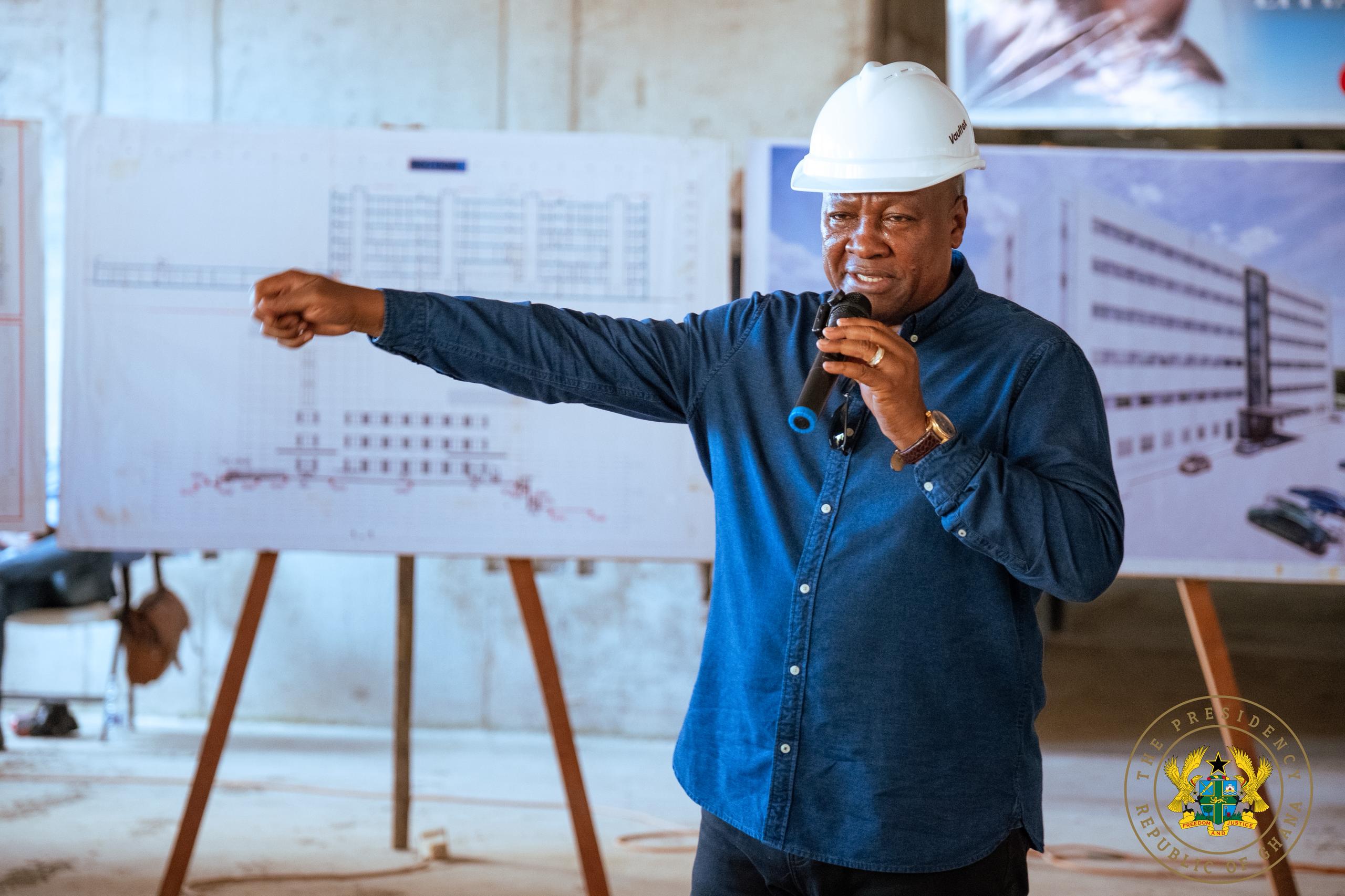
President John Dramani Mahama has reaffirmed his government’s commitment to modernizing Ghana’s major transport corridors, declaring that the dualisation of the Cape Coast–Takoradi Road marks an irreversible step in the country’s infrastructure renewal and economic transformation.
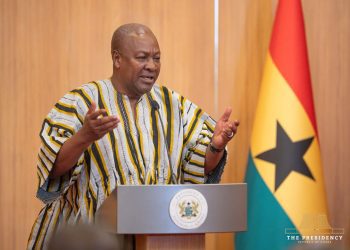
Addressing traditional and religious leaders including traders and professionals as well as residents of Shama at the sod-cutting ceremony, the President said the current single carriageway has long outlived its design life and no longer meets the growing transport and safety demands of the region.
“The current single carriageway has long outlived its design life. It has become congested, it has become accident-prone and inefficient, leading to the loss of lives and productivity,” he stated. “This must change and today, we’re making that change irreversible.”
President Mahama explained that the dualisation project covers 73.6 kilometres from Cape Coast to Takoradi and has been divided into three contiguous lots to ensure rapid and efficient implementation.
“In the past, the whole road would have been awarded to one contractor, and it would take a long time to complete,” he said. “Today, the 73.6 kilometres has been divided into three lots and given to three different contractors so that the work can progress rapidly.”
Under the new arrangement, Lot Four will deliver three interchanges, four bridges, and two pedestrian facilities. Lot Five will include two interchanges, three major bridges, and four pedestrian crossings, while Lot Six will feature four interchanges, three major bridges, seven footbridges, and about 20 kilometres of service roads with a rest stop and an axleway station.
The President noted that the design includes two-lane dual carriageways engineered for speeds between 80 and 100 kilometres per hour, with paved shoulders, improved drainage, LED lighting, and polymer-modified asphalt surfaces to enhance durability and safety.
Each lot is expected to be completed within 24 months, though the President expressed confidence that the contractors could deliver earlier than scheduled.
When completed, the project will cut travel time between Cape Coast and Takoradi by 50 percent, improve safety, and facilitate easier access to the Takoradi Port, industrial enclaves in the Western Region, and key tourism destinations across the Central and Western Regions.
“It will stimulate trade, tourism, and investment across the two regions and will create more than 8,000 jobs, 2,000 direct and 6,000 indirect, during construction,” President Mahama revealed. “And as the Minister said, I appeal to the contractors: if you have to hire labour, please look within the local communities first.”
The President named SNL Construction and Engineering Limited as the contractor for Lots Four and Six, while Alicro Jewelers Limited is responsible for Lot Five.
He urged the contractors to uphold the highest standards of professionalism, quality, and environmental responsibility, and directed the Ghana Highway Authority to ensure rigorous supervision and compliance with performance standards.
“We expect you to use quality materials and maintain the highest standards in executing these jobs,” President Mahama emphasized.
The President described the project as a cornerstone of the 24-Hour Economy and the Big Push agenda, aimed at building a more connected and productive Ghana.
“This project will enable faster, safer, round-the-clock transport and logistics operations. It will reduce fuel consumption and vehicle maintenance costs for transporters, strengthen connectivity to export processing zones, port terminals, and industrial corridors, and boost regional competitiveness and tourism along Ghana’s Atlantic Coast,” he said.
President Mahama added that the dualisation complements other ongoing Big Push projects, including the Takoradi Port Expansion, the Western Rail Revival, and the Atimpoku–Hua Flower Road reconstruction, all designed to create a more integrated and resilient national economy.
He also appealed to contractors and local authorities to respect environmental standards, ensure proper drainage and waste management, and minimize any adverse impact on nearby communities.
“Government will honour all legitimate compensation claims associated with right-of-way acquisition,” he assured. “We will not repeat the mistakes of the past where infrastructure came at the cost of our people’s livelihoods.”
Story: Patrick Asford Boadu