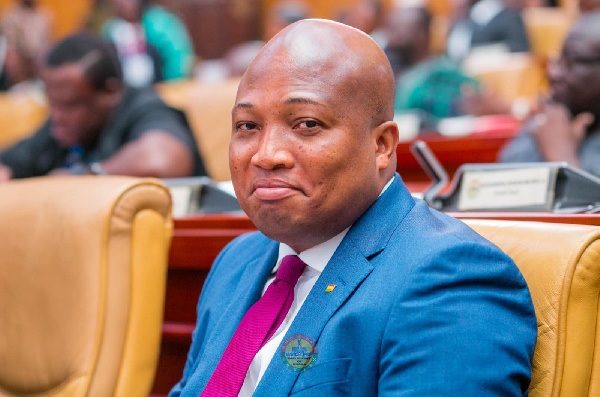
Inusah Fuseini has questioned the Minority’s ability to initiate a vote of censure against Foreign Affairs Minister Samuel Okudzeto Ablakwa, citing the strict constitutional requirements governing the removal of ministers through Parliament.
According to him, the opposition cannot invoke the parliamentary censure process without first securing the support of at least one-third of all Members of Parliament.
Mr Fuseini explained that the requirement is mandatory and cannot be bypassed, regardless of the seriousness of the allegations against a minister.
His comments follow the Minority’s threat to invoke Article 82 of the 1992 Constitution as part of its efforts to hold Mr Ablakwa accountable over the South Africa evacuation controversy.
The opposition has indicated that it will consider a vote of censure if the Minister refuses to resign and President John Dramani Mahama declines to dismiss him.
Mr Fuseini argued that the first obstacle would be obtaining the constitutionally required signatures to initiate proceedings.
“The petition to censure a minister must be supported by a third of all Members of Parliament,” he explained.
He maintained that failure to satisfy this requirement would prevent the Speaker from admitting the motion.
“The rule of law applies to procedure as it applies to substantive law,” he stressed.
Under Article 82, a motion of censure requires at least seven days’ notice signed by one-third of all MPs. The motion must be debated within 14 days after the Speaker receives the notice, while its passage requires the support of at least two-thirds of all Members of Parliament.
Beyond the numerical requirements, Mr Fuseini emphasised that a minister facing censure must be given an opportunity to defend himself against the allegations.
He likened the proceedings to a formal hearing in which the accused minister must be heard before Parliament reaches a decision.
“These are the rules of natural justice that you cannot convict a person without hearing him,” he said.
Drawing on his parliamentary experience, Mr Fuseini recalled an earlier attempt to invoke Article 82 against former Senior Minister Yaw Osafo-Maafo over comments relating to the handling of the Aisha Huang case.
He said the attempt did not progress after the then Speaker declined to admit the motion.
Mr Fuseini maintained that constitutional procedures must be respected at every stage, stressing that allegations against a minister do not automatically translate into a successful parliamentary censure.
His comments place the constitutional requirements for ministerial accountability at the centre of the Minority’s threatened parliamentary action.