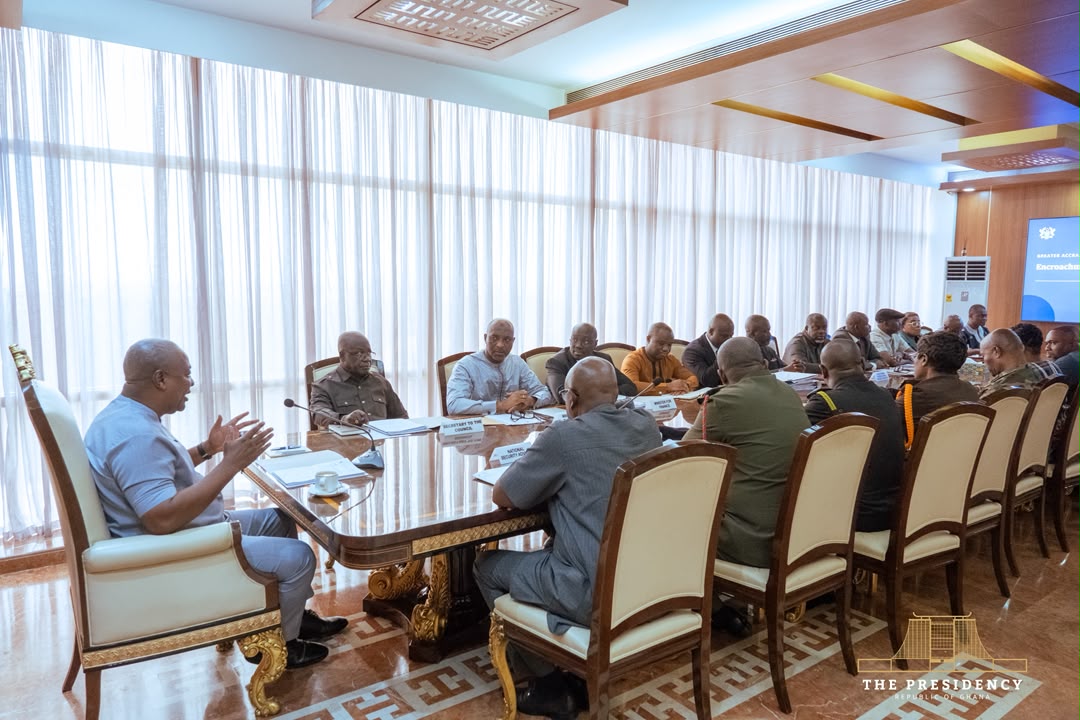
President John Dramani Mahama has convened a National Security meeting to review Ghana’s response to the recent floods that devastated many communities along the country’s southern coastal belt and to strengthen measures aimed at reducing the impact of future disasters.
Speaking after the meeting, President Mahama described the flooding as one of the most severe incidents Ghana has experienced in recent years, noting that the increasing intensity of rainfall due to climate change continues to pose a significant challenge to the country’s disaster preparedness.
He explained that while flooding has become a recurring phenomenon, the latest incident underscored the urgent need to reassess and reinforce existing mitigation strategies.
The President also identified rapid urbanisation as a major contributing factor, particularly in Accra, where growing demand for land has led to widespread encroachment on waterways and flood-prone areas that were originally designated for the natural flow and containment of stormwater.
To strengthen the national response, President Mahama announced that the Ghana Armed Forces have been deployed to support flood mitigation efforts, while the National Disaster Management Organisation (NADMO) and other state agencies continue to provide relief items and emergency assistance to affected communities.
He noted that government is reviewing interventions already undertaken and identifying additional measures to better prepare the country for future extreme weather events.
According to the President, government had established a flood mitigation task force before the disaster struck, which carried out limited dredging of drains and waterways.
However, he acknowledged that the extraordinary volume of rainfall exceeded the capacity of those preventive works.
President Mahama further disclosed that the Minister for Finance has released resources from the Contingency Fund to finance additional flood mitigation projects and other emergency interventions.
While acknowledging that flooding cannot be completely eliminated because it is a natural phenomenon affecting many countries worldwide, the President stressed that government remains committed to reducing its impact through improved planning, infrastructure development and coordinated disaster management.
He observed that several West African countries, including Gabon and Côte d’Ivoire, also experienced severe flooding and loss of lives during the same period, with some recording even greater devastation.
President Mahama expressed optimism that with sustained collaboration among security agencies, emergency responders, government institutions and local communities, Ghana would be better positioned to minimise the effects of future floods and protect lives and property.
“As Christians say, in all things we give thanks,” the President said. “We remain hopeful that through our collective efforts and the measures we are putting in place, we will ease the difficulties faced by affected communities.”
Story: Patrick Asford Boadu