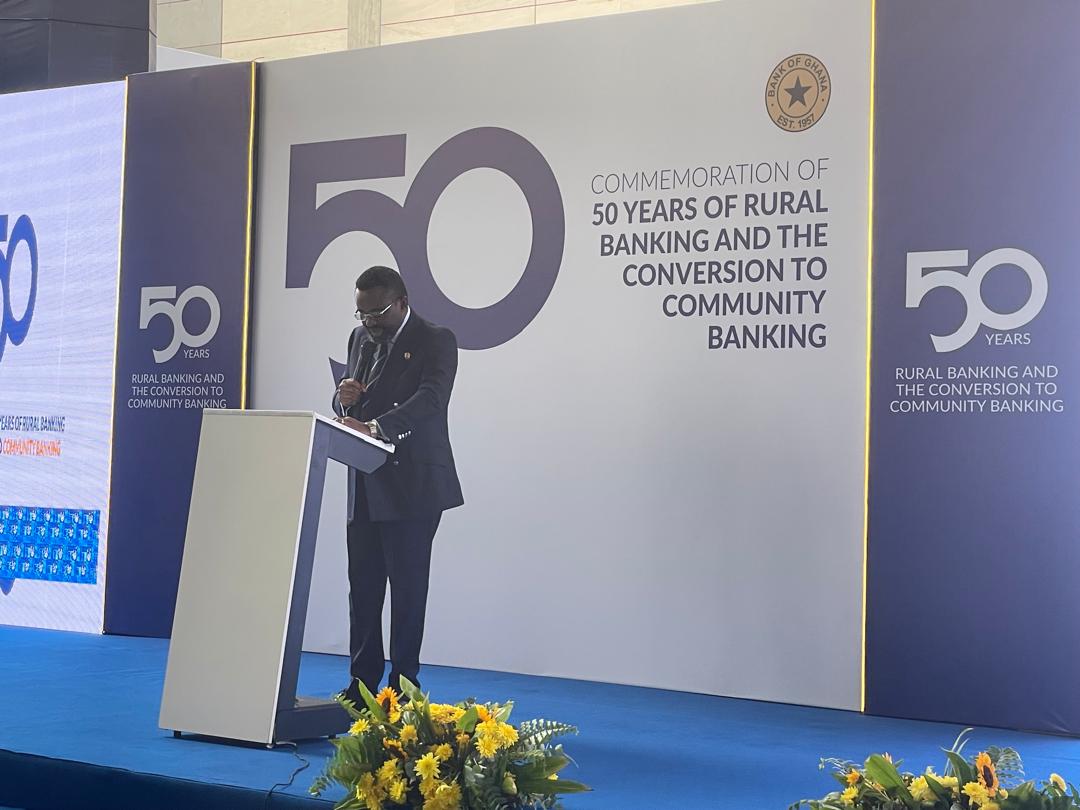
Governor of the Bank of Ghana, Dr Johnson Pandit Asiama, has described rural banking as one of Ghana’s most significant financial inclusion interventions, revealing that the sector has grown from a single community-owned bank in 1976 to 147 licensed institutions serving more than eight million customers.
Speaking at the commemoration of 50 years of rural banking in Ghana, Dr Asiama said the sector now operates about 1,000 branches and had accumulated an asset base of approximately GH¢26 billion as of May 2026.
He said the figures represent more than institutional growth, describing them as evidence that the original vision of bringing banking services to ordinary people has endured for five decades.
The Governor recalled that Ghana’s formal banking system was initially designed to serve the colonial administration and commercial merchants, leaving farmers, traders and rural enterprises largely excluded.
Even after independence brought locally owned commercial and development banks, many communities remained too far from formal banking services.
Dr Asiama said a farmer could produce the crops that generated Ghana’s foreign exchange while living a full day’s journey from the nearest bank, while traders who sustained entire communities remained invisible to the financial system.
The Rural Banking Programme, established through a partnership between the Government of Ghana and the Bank of Ghana, sought to address that exclusion by helping communities establish and own their own banks rather than merely extending branches of existing commercial institutions.
The first Rural Bank was opened in the Central Region in 1976, creating the foundation for a community-based banking model that would later spread across the country.
Within a year, three additional Rural Banks had been licensed at Biriwa, Afosu and Esiama, demonstrating the growing demand for locally owned financial institutions.
Dr Asiama credited the late former Governor of the Bank of Ghana, Dr Seth Amon Nikoi, and former banking supervision head Emmanuel Asiedu-Mante for their leadership and commitment to the development of rural banking.
He said the banks helped communities develop a formal savings culture, financed farms and small businesses, supported the payment of school fees and provided accessible financial services to people who had previously operated outside the banking system.
The institutions also played a crucial role when the Ghana Cocoa Board introduced the Akuafo Cheque System in the 1980s, enabling cocoa farmers to convert their cheques into cash through banking facilities located closer to their communities.
The establishment of the Association of Rural Banks in the early 1980s and the creation of ARB Apex Bank in 2002 further strengthened the sector by providing operational support and linking Rural Banks to the national financial system.
Despite the achievements, Dr Asiama acknowledged that some institutions had failed or been poorly governed during the past 50 years, causing losses that affected the savings and confidence of entire communities.
He said such failures reinforced the need for stronger governance, regulation and supervision as the sector transitions into a new Community Banking framework.
The Governor maintained that financial inclusion must remain central to the Bank of Ghana’s development role, arguing that low inflation, exchange-rate stability and financial-sector stability must ultimately translate into better living conditions.
“Low inflation, high economic growth; so what?” he asked, stressing that economic stability must be accompanied by wider access to finance capable of lifting people out of poverty.
Dr Asiama said the central bank would continue to support innovation, responsible banking, environmental sustainability and financial products that connect underserved Ghanaians, including members of the diaspora, to productive investment opportunities.
He maintained that banking must reach people where they live, where they work and where they build their livelihoods.