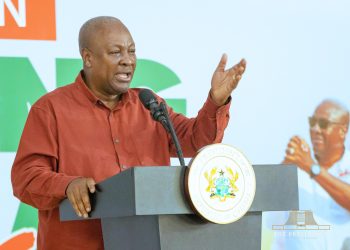
Minister for Communications, Digital Technology and Innovation Samuel Nartey George delivered an impassioned address at Kwame Nkrumah University of Science and Technology (KNUST), highlighting the vital role academia must play in Ghana’s next phase of technological evolution.
Reflecting on his journey from a day student experiencing his first boarding life at Africa’s premier university to stepping back onto campus as a cabinet minister, Sam George expressed profound gratitude for his alma mater. “I’m extremely grateful to KNUST for holding and shaping me to the man that I am today,” he shared. “It’s good to be back home and we’re excited about the partnership that we have from the ministry with KNUST.”
Transitioning from the first two years of heavy policy formulation and structural frameworks, the Minister emphasized that the next two years will center heavily on implementation with universities serving as the primary drivers.
When the ministry initiated its national AI strategy to govern the country’s next decade of deployment, academia was brought directly into the fold. Acknowledging the leadership behind the initiative, the Minister noted, “We decided that if we’re going to write the national AI strategy, it should be done by academia and practitioners”.
A major focus of the Minister’s address centered on the preservation of indigenous African languages in the age of artificial intelligence. Warning that unguided AI deployment risks causing an extinction of local dialects, Sam George stressed that national language models must be built locally with the guidance of traditional authorities and academics.
Recalling his recent participation in the Mate Plan launch in Rome, the Minister explained why foreign tech hubs cannot build these models alone. “When you take, for example, my local dialect of Dangme, the same word written can have multiple meanings,” he illustrated. “So if you take a word like ‘nu’, ‘nu’ can mean man, it can mean water, it can mean drink, depending on the inflection. So if a European was building a national language model with that ‘nu’, they would not know how to place it.”
By partnering with institutions like KNUST and leveraging ties with traditional authorities such as Asantehene, the ministry aims to create voice interfaces in local languages. This innovation will empower rural farmers with precision agriculture tools and enable remote telemedicine via the upcoming nationwide rollout of 5G technology, allowing specialists to treat patients in distant communities.
Upgrading the One Million Coders Program
A cornerstone of the ministry’s visit was the strategic restructuring of the President’s flagship One Million Coders program. Building on insights gathered during a recent crash program at Harvard alongside the Minister for Trade, the administration is refining how youth are equipped for the workforce.
Instead of enrolling students exclusively in their first year, the program is pivoting toward upper-level students to bridge the gap between education and immediate employment. “If a level 100 completes the program today and decides not to do anything between level 200 and 400, by the time they’re leaving the university there is a lack between the training and then the implementation,” the Minister noted.
“If we focus this training on our level 400s and 300s, then we’re beginning to prepare them for the world of work as they graduate.”
To support this expanded scope on campus, the Minister announced a major upgrade to the university’s technical infrastructure. Supplementing the initial 500-laptop allocation, the ministry deployed an additional 2,000 laptops to KNUST, bringing the total to 2,500 devices distributed across 15 learning centers.
Furthermore, a skills gap analysis conducted with experts from Harvard will ensure that the training modules directly match the demands of the global job market.
Concluding his visit with a nod to his university roots, the Minister expressed excitement about exploring potential technical collaborations for campus research facilities, such as the photonics laboratory at the physics department, reinforcing that KNUST remains the ultimate bridge between government policy and real-world national transformation.
Eugenia Ewoenam Osei