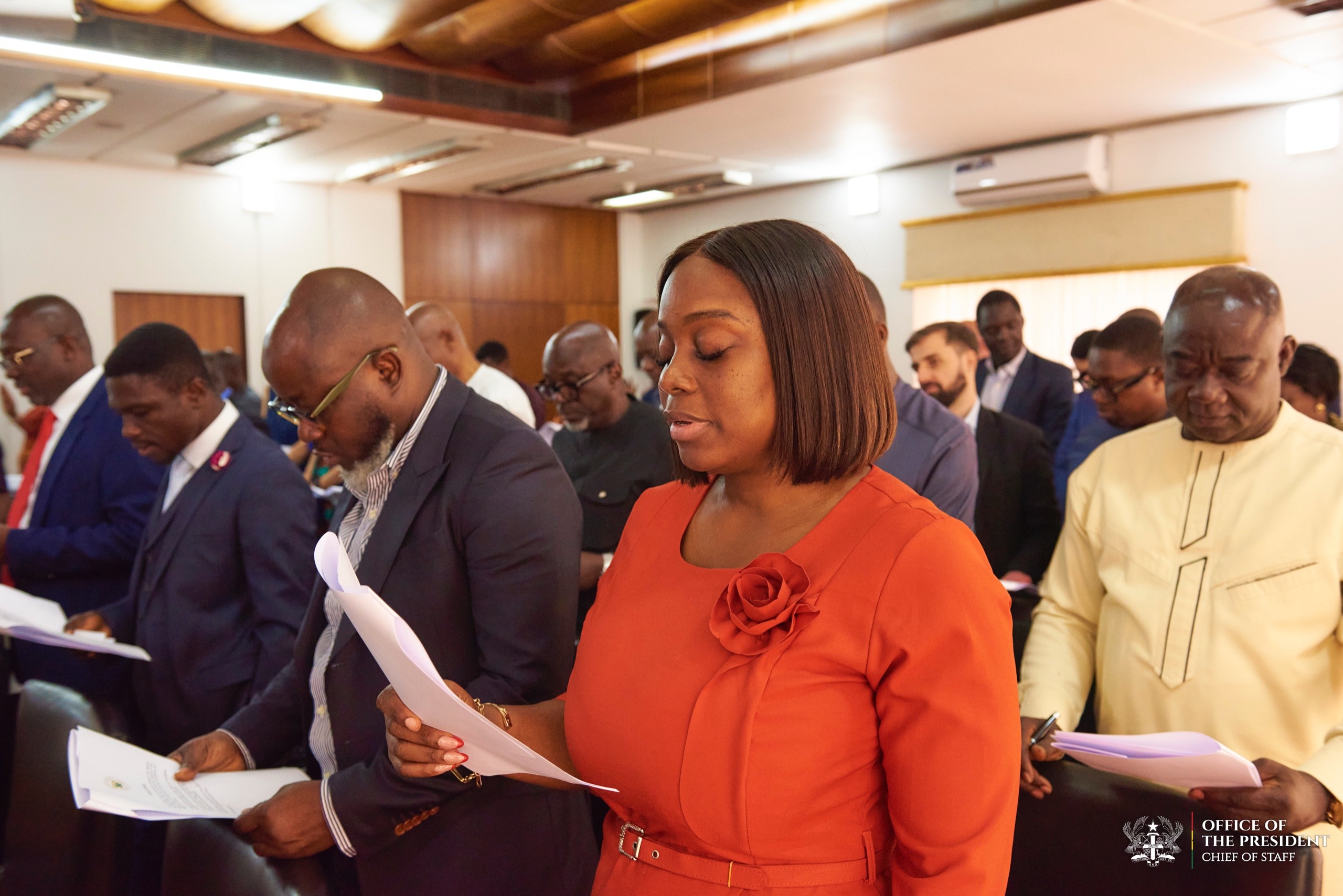
The Government of Ghana has inaugurated a working group to develop a new National Anti-Corruption Strategy, marking the beginning of a renewed national push to tackle corruption through bold, measurable reforms.
At the official ceremony held at the Jubilee House, Chief of Staff Julius Debrah commended the newly appointed members and charged them with the critical responsibility of reversing Ghana’s declining performance in the fight against corruption.
“This next strategy comes at a pivotal moment in our anti-corruption journey under the renewed leadership of President John Dramani Mahama,” Mr. Debrah said. “We must be honest—while awareness has improved, corruption itself has not decreased. The evidence is out there for all Ghanaians to see.”
He noted that the previous National Anti-Corruption Action Plan (NACAP), launched in 2014 during President Mahama’s earlier administration, helped create public awareness, promoted whistleblower protection, and drove digital reforms in public institutions, including ports and financial systems.
Mr. Debrah also highlighted the increased activities of institutions such as CHRAJ, the Office of the Special Prosecutor (OSP), and EOCO, especially in investigations and asset recovery.
However, he acknowledged a concerning decline in Ghana’s Corruption Perception Index (CPI)—from 48% in 2014 to a record low of 42% in 2024, the final year of NACAP’s implementation.
“One could argue that NACAP has not performed too well when it comes to the actual reduction of corruption in our country,” he admitted. “We have to reverse this trend, and I charge this group to ensure that the new strategy does exactly that.”
Mr. Debrah urged the working group to adopt ethics, accountability, and moral integrity as the pillars of the new strategy. He described the new approach as a needed “shock therapy” to reset Ghana’s anti-corruption framework and emphasized the need for a shift away from outdated assumptions.
The strategy, which is expected to be delivered in draft form by August 31, 2025, will be coordinated by the Office of the Presidential Advisor on the National Anti-Corruption Programme (PANACP), in collaboration with the Office of the Chief of Staff, CHRAJ, OSP, and the Attorney General’s Department.
While assuring the group of government’s full backing, Mr. Debrah also stressed the need for prudent and transparent use of resources, particularly in light of Ghana’s current fiscal constraints.
He expressed appreciation to CHRAJ for a decade of leadership in Ghana’s anti-corruption efforts and reaffirmed government’s commitment to continued collaboration to uphold human rights and administrative justice.
“We have confidence in the technical expertise of the team that has been assembled,” he said. “We expect your fullest commitment to the cause.”
The inauguration of the working group represents the second phase in Ghana’s national fight against corruption—this time with a stronger focus on results, technology, and ethical governance.