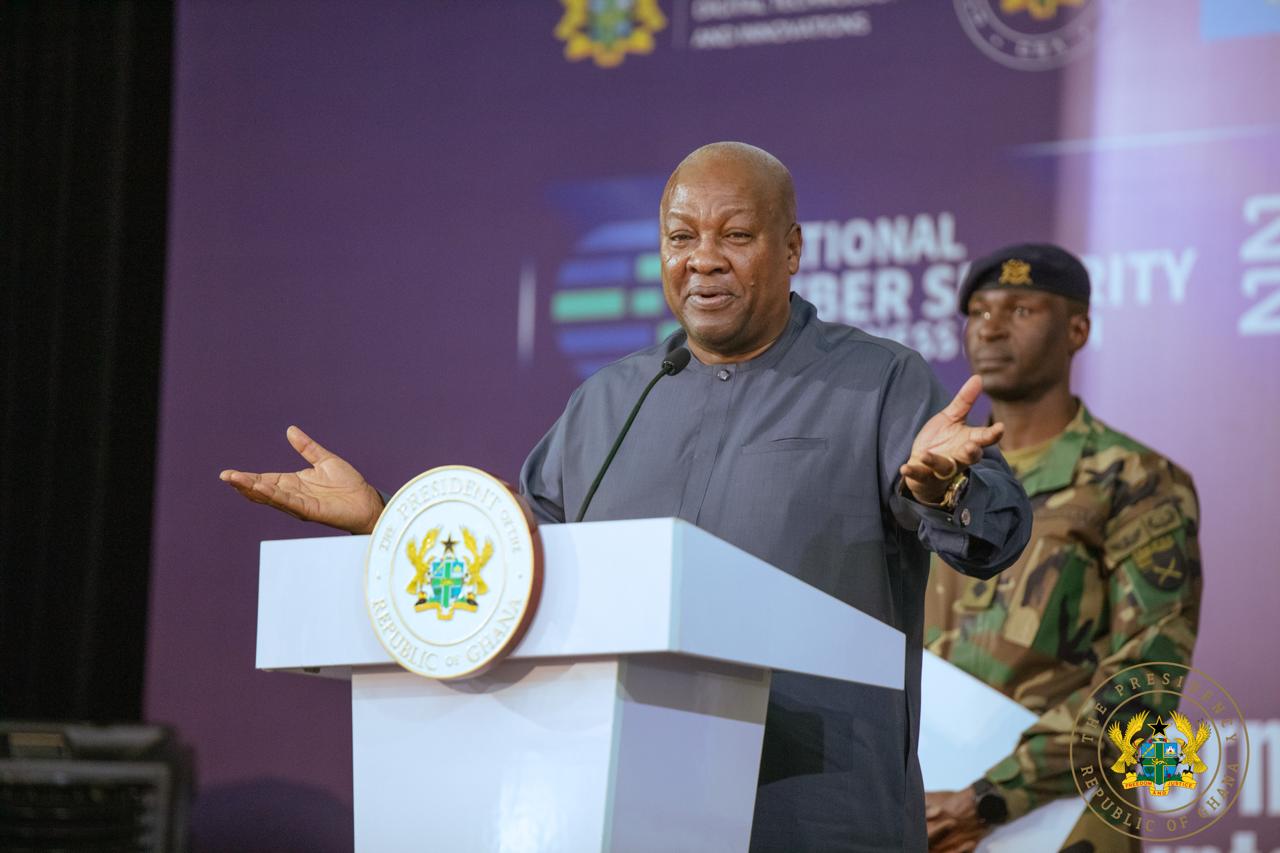
President John Dramani Mahama has launched the 2025 National Cyber Security Awareness Month, calling for a united national effort to safeguard Ghana’s digital future.
The launch, held in Accra under the theme “Building a Safe, Informed and Accountable Digital Space”, also witnessed the inauguration of Ghana’s first Joint Cyber Security Committee (JCC), established under the Cyber Security Act 2020. The JCC brings together security and intelligence agencies to coordinate the country’s defence against rising cyber threats.
“As we transition into a 24-hour economy, our systems must be as resilient as they are innovative. Cyber security is the backbone of trust in the digital age,” President Mahama said.
Digitalisation and Its Double-Edged Sword
The President stressed that while digitalisation was transforming lives and creating opportunities, it also came with risks.
“Digitalisation is not just an abstract idea; it is real. It opens new opportunities for innovation, efficiency and inclusion. But the same technologies that empower us can also be exploited to manipulate information, steal identities or compromise critical infrastructure,” he warned.
He cited an IMF Global Financial Stability Report which revealed that 20% of all cyber incidents worldwide in the last two decades targeted the financial sector, resulting in $12 billion in losses. Since 2020 alone, Africa has lost more than $2.5 billion to cybercrime.
Four Flagship Initiatives
President Mahama outlined four major programmes under his administration’s Reset Ghana Agenda:
One Million Coders Programme – launched in April 2025 to train young Ghanaians in coding, software engineering, data analytics, and cyber security. Pilots are already running in Greater Accra, Ashanti, Bono, and Upper East.
Digital Jobs Initiative – a public-private partnership to create employment through ICT, including the redevelopment of the Dawa ICT Park into a global centre of excellence.
$50 Million Fintech Growth Fund – supporting indigenous startups to drive financial innovation tailored to African realities.
24-Hour Economy – ensuring round-the-clock business operations with robust digital security and constant monitoring.
International Partnerships
The President reaffirmed Ghana’s commitment to global cooperation on cybercrime. Ghana is already a signatory to the Malabo Convention and the Budapest Convention, and will in October ratify the United Nations Convention on Cyber Crime.
“This treaty equips us with new tools to investigate attacks, prosecute cyber criminals and protect critical information infrastructure,” he said, adding that Ghana had led global efforts to include provisions against online child sexual exploitation.
Citizens as the First Line of Defence
President Mahama emphasised that technology alone could not guarantee safety without informed citizens.
“Our citizens are our first line of defence. This Awareness Month is therefore about ensuring every Ghanaian—from the child in school to the trader in the market, understands the risks of the digital world and knows how to stay safe,” he said.
Through school curricula, community training, and public campaigns, the government aims to promote vigilance online and responsible digital behaviour.
Building a Secure Digital Society
The President concluded by framing cyber security as a shared responsibility between government, private sector, civil society, and citizens.
“If we act wisely, decisively and inclusively, Ghana can be a continental leader in secure digital innovation. What we seek to build is not just a digital economy, but a digital society, one that is safe, inclusive, and accountable,” he declared.
He then officially launched the 2025 National Cyber Security Awareness Month.
With flagship initiatives in digital skills, fintech, and cyber resilience, and by inaugurating the Joint Cyber Security Committee, Ghana is positioning itself as a continental leader in secure digital transformation.
Story: Patrick Asford Boadu