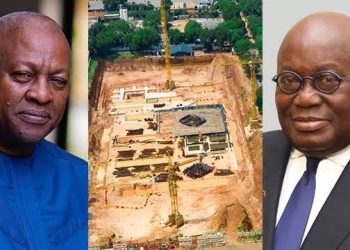
President John Dramani Mahama has announced a groundbreaking initiative that will harness artificial intelligence (AI) and satellite technology to revolutionize Ghana’s fight against illegal mining, known locally as galamsey.
Speaking during a high-level engagement with civil society organisations (CSOs) at the Jubilee House, President Mahama emphasized the urgent need for smarter, more targeted interventions to combat environmental degradation and streamline small-scale mining.
“Today, it’s possible to precisely map out where the mineral prospect is… that’s one of the things Gold Board is going to introduce,” the President revealed.
President Mahama explained that Ghana’s mineral potential remains grossly under-explored due to outdated methods. To address this, the government, through the Ghana Geological Survey Department and its partners, will deploy AI-driven seismic satellite imaging to map mineral-rich zones accurately.
This will prevent haphazard digging by small-scale miners and limit the destruction of land and water bodies. According to Mahama, the current practice—where miners randomly dig in search of gold—has led to extensive environmental damage with little productivity.
“They dig here, don’t find enough gold, and leave it. Then dig there and do the same. By the time they find something, the entire concession is destroyed,” he lamented.
The President announced that the Ghana Gold Board would not only support this mapping initiative but also launch a track-and-trace system to monitor the source of gold exports. This system is key to meeting the London Bullion Market Association (LBMA) standards, which restrict gold exports from unverified and environmentally harmful sources.
“Once the gold is tracked and known to have come from responsible sources, we can export it to LBMA countries and that gives us a much higher price than we currently get,” Mahama stated.
The strategy includes forming Public-Private Partnerships (PPPs) with Ghanaian mining companies to responsibly mine in mapped areas, instead of leaving the field to unregulated miners.
The engagement with CSOs is part of President Mahama’s broader push to build consensus and national commitment around sustainable mining. He stressed that the environmental and economic challenges posed by galamsey can only be addressed with coordinated action from all stakeholders, including civil society, traditional authorities, the private sector, and government agencies.
As the meeting continued behind closed doors, it became clear that Mahama’s administration intends to adopt a science-backed, data-driven, and inclusive approach to what has long been one of Ghana’s most complex governance challenges.