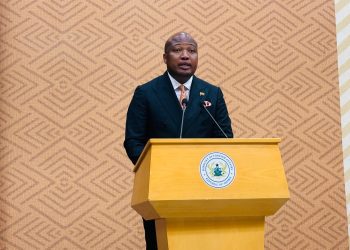
Ghana’s macroeconomic recovery has entered what the Governor of the Bank of Ghana (BoG), Dr. Johnson Asiama, describes as a new phase, one that moves beyond crisis management toward deep structural reform of the banking sector.
Speaking at the 128th Post-Monetary Policy Committee (MPC) Meeting with Heads of Banks in Accra, Dr. Asiama announced that inflation has dropped to its lowest level since Ghana adopted inflation targeting.
According to the Governor, inflation declined sharply from 23.8 percent in December 2024 to 5.4 percent by December 2025, before falling further to 3.8 percent in January 2026.
“This disinflation has been broad-based,” Dr. Asiama stated, attributing the sharp decline to tight monetary policy, fiscal consolidation, and exchange rate appreciation.
Dr. Asiama further revealed that real GDP growth strengthened significantly, with the economy expanding by 6.1 percent in the first three quarters of 2025, driven largely by services and agriculture.
He noted that the Bank’s Composite Index of Economic Activity confirmed sustained momentum across trade, private sector credit, industrial output, and consumption.
Business and consumer confidence, he said, have improved, supported by easing inflation, exchange rate stability, and expectations of lower borrowing costs.
The Governor added that adjusted money market and lending rates have begun to decline, while real private sector credit growth is gradually recovering, indicating that monetary policy transmission to the real economy is taking effect.
On the fiscal front, Dr. Asiama pointed to improvements in public finances, including a lower budget deficit, a strong primary surplus, and a marked decline in public debt.
Externally, he indicated that strong export earnings, private transfers, and prudent demand management have resulted in a balance of payments surplus and an accumulation of foreign reserves.
“These developments provide important buffers for the economy,” the Governor noted, adding that a steadier global growth environment has become more supportive for emerging and frontier economies such as Ghana.
With macroeconomic stability largely restored, Dr. Asiama emphasized that attention must now shift “from resilience to structure.”
A thematic review of banks’ business models conducted by the Bank of Ghana, he disclosed, found the sector to be viable and profitable. However, structural vulnerabilities remain.
Financial intermediation, according to the Governor, is still modest, with loans accounting for less than one-fifth of total industry assets. Asset concentration in sovereign and central bank instruments also remains elevated.
He further noted that approximately 68 percent of industry profitability is driven by net interest income: “There is nothing inherently problematic about net interest income. However, high dependence increases sensitivity to interest rate cycles and sovereign exposure dynamics.”
As interest rates normalize and margins compress, he urged banks to diversify income sources through transactional banking, trade services, payments, treasury operations, and other fee-based activities that are less balance-sheet intensive.
Although non-performing loans (NPLs) have declined, the Governor cautioned that they remain above benchmark levels. He stressed that as credit expansion resumes, underwriting discipline and proper sectoral risk assessment will be critical.
“Stability must not translate into passive intermediation,” Dr. Asiama warned, urging banks to support agriculture, SMEs, and value-adding sectors without reintroducing asset quality pressures.
Dr. Asiama also disclosed that 87 percent of banks evaluated now maintain fully continuous 24/7 Security Operations Centre (SOC) monitoring, describing this as a strong response to rising cyber threats.
However, he noted that a small number of institutions still operate with limited monitoring coverage or incomplete log reporting, which could pose systemic vulnerabilities if not addressed.
On digital finance regulation, the Governor announced that Parliament has passed the Bank of Ghana (Amendment) Act 2025, reinforcing the Bank’s operational independence while strengthening transparency and accountability.
Additionally, the Virtual Asset Service Providers Act has been enacted, formally bringing digital asset activities within Ghana’s regulatory perimeter.
“We are not creating a parallel financial system,” Dr. Asiama clarified. “We are extending the perimeter of the existing one.”
He stated that banks will be expected to build capacity in digital asset risk assessment, transaction monitoring, and compliance, as digital assets increasingly interact with the traditional banking system.
The Governor further announced the inauguration of a Steering and Technical Committee to encourage more banks to list on the Ghana Stock Exchange (GSE).
The committee comprises representatives from the Bank of Ghana, the Securities and Exchange Commission, the Ghana Stock Exchange, the Ministry of Finance, the National Insurance Commission, the Ghana Securities Industry Association, the Central Securities Depository, and the Ghana Association of Banks.
Listing, Dr. Asiama emphasized, goes beyond capital raising. “It broadens ownership, strengthens governance, deepens transparency, and anchors banks more firmly in domestic long-term savings,” he stated.
Concluding his address, Dr. Asiama stressed that while stability has been restored, the next phase requires durability. “Durability requires stronger business models, broader ownership, deeper intermediation, disciplined innovation, and above all, sound governance,” he said.
He assured banks that the Central Bank will remain “firm, fair and forward-looking,” supportive where necessary but clear in its expectations.
The message from the 128th post-MPC engagement was clear. Ghana has moved beyond crisis containment. The next chapter, according to the Governor, is about building a banking system that is not only stable but structurally positioned to support long-term economic transformation.