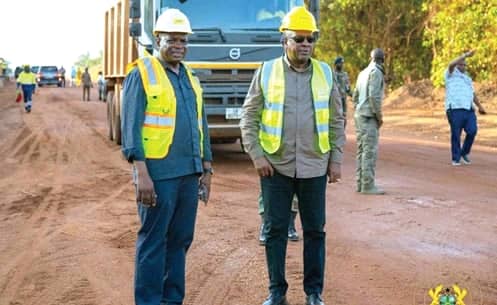
The Minister of Roads and Highways, Governs Kwame Agbodza, has formally dismissed media allegations of widespread procurement irregularities within the “Big Push” infrastructure project, clarifying that less than half of the major contracts under the initiative were awarded via sole sourcing.
Addressing Parliament on Tuesday, March 24, the Minister described recent publications by the Fourth Estate porta as “mischievous” and “deliberate falsehoods” aimed at misinforming the public. He maintained that the government has prioritized transparency and competitive bidding while managing a massive inherited debt and a “deplorable” road network.
The Procurement Rebuttal
The Minister was emphatic in correcting the figures currently circulating in the media. “It is important to note that only 44% of all the major contracts included in the Big Push were awarded by the Ministry under sole sourcing. 44%. So not what has been published by a certain online portal,” Agbodza stated.
He further contrasted this with the government’s broader procurement record, noting that over 400 different contracts have been awarded through open competitive bidding. He argued that this shift is “unprecedented,” claiming that between 2017 and 2024, nearly all ministry projects were procured through sole sourcing.
The Minister defended the use of limited sole sourcing as a “prudent and necessary” measure to ensure the survival of the state, particularly for projects that were “urgent and needed to be done” to alleviate public agitation and food inflation.
An important portion of the Big Push project involves “novating” or absorbing projects started under the previous administration. According to Agbodza, 23 road projects valued at GH₵14.88 billion, which had been abandoned by contractors due to a lack of dedicated funding were integrated into the new program to ensure completion.
These projects include the Design and Construction of the Suame Interchange (Phases 1 and 2), the dualization of the Adenta-Dodowa road, and the rehabilitation of the Ofankor-Nsawam road. The Minister noted that globally, sole sourcing is acceptable when extending the implementation of works that were previously competitively procured to speed up completion.
To safeguard public funds, the Minister revealed that the ministry has moved away from “design-and-build” contracts, which often led to inflated costs. Instead, state agencies now conduct their own surveys, designs, and costings.
“By asking the agencies to actually do our design and costing, we have saved at least 5% of the cost of the project,” he informed the House.
Furthermore, the government has reached an agreement with the Ghana Institution of Surveyors to develop local capacity for independent value-for-money auditors. Agbodza assured Parliament that a stricter monitoring system is now in place, stating, “No contractor will walk away with a Cedi without working for it.”
A Call for Oversight
Concluding his update, the Minister reminded the House that the Big Push remains under continuous parliamentary oversight, with all contractual information publicly available on the Ministry’s website. He urged Members of Parliament and the public to rely on the “House of Records” rather than social media narratives.
“The NDC did not award over 70 billion Cedis worth of work under the Big Push. We said 54 billion of that was for new works,” he clarified. “By the end of 2027, you will see a lot of completed road projects that will enhance our economy and make our roads safer. Let us work together to protect the Big Push.”
Story by Eugenia Ewoenam Osei