The Government of Ghana, through the Ministry of Communications has officially approved the National Artificial Intelligence (AI) Strategy, signaling a major shift toward integrating advanced automation into the country’s socio-economic fabric.
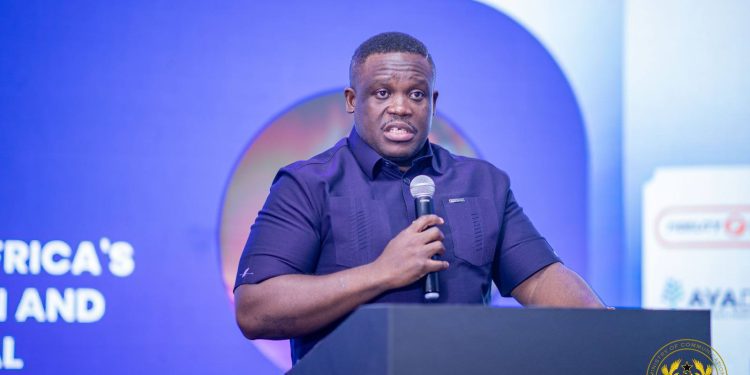
Minister for Communication, Digital Technology, and Innovations, Samuel Nartey George, announced this significant milestone on Tuesday, March 31,during a national stakeholder engagement on Ghana’s AI Readiness Assessment Methodology (RAM) Report. The strategy is expected to be launched imminently by President John Dramani Mahama.
The new policy framework aims to drive AI adoption across critical sectors, including agriculture, healthcare, and financial services. According to the Minister, the strategy is not merely a technical document but a blueprint for delivering innovative solutions to long-standing societal challenges.
”AI will advance public service delivery by helping farmers boost productivity, assisting medical professionals in diagnoses, increasing financial inclusion, and delivering innovative solutions to societal challenges,” George stated.
The Minister emphasized that the RAM report, developed in partnership with UNESCO and the European Union, provides the necessary structured and comprehensive framework to evaluate the nation’s infrastructure, ethical safeguards, and economic readiness.
Addressing the audience at the Best Western Premier Hotel, Sam George highlighted that Ghana is not starting from zero, noting that the country already boasts a mobile penetration rate exceeding 110% with over 38 million active subscriptions.
However, he was candid about the hurdles that remain. To transition from a consumer of technology to a creator, the Minister outlined critical pillars for urgent action, including the strengthening of data governance systems to protect privacy and national interests.
He further emphasized the need for strategic investment in AI research and computing infrastructure so that local researchers can develop solutions rather than relying solely on external technologies.
Also, the Minister stressed the importance of expanding AI education and digital skills development to ensure young people become creators of technology. He noted that ethical considerations must remain central to AI deployment so that the technology works for the benefit of society without reinforcing inequality or exclusion.
Continental Leadership
With the African Continental Free Trade Area (AfCFTA) Secretariat headquartered in Accra, the Minister positioned Ghana’s AI ambitions as a catalyst for broader continental growth. He noted that AI will be the engine of the emerging Digital Trade Ecosystem across Africa.
In a call to action for the private sector, academia, and civil society, Sam George stressed that the government cannot build this future in isolation.
”Government cannot build Ghana’s AI future alone. We need the ingenuity of researchers, creativity of startups, investments from the private sector, and wisdom from civil society,” he remarked. “The decisions and commitments we make today will have far-reaching implications and will shape Ghana’s technological future for decades to come.”
The forum concluded with a charge to stakeholders to propose bold and actionable ideas to inform the implementation plans of the National AI Strategy, as Ghana seeks to cement its status as a leading hub for responsible innovation in Africa.
Story By: Eugenia Ewoenam Osei