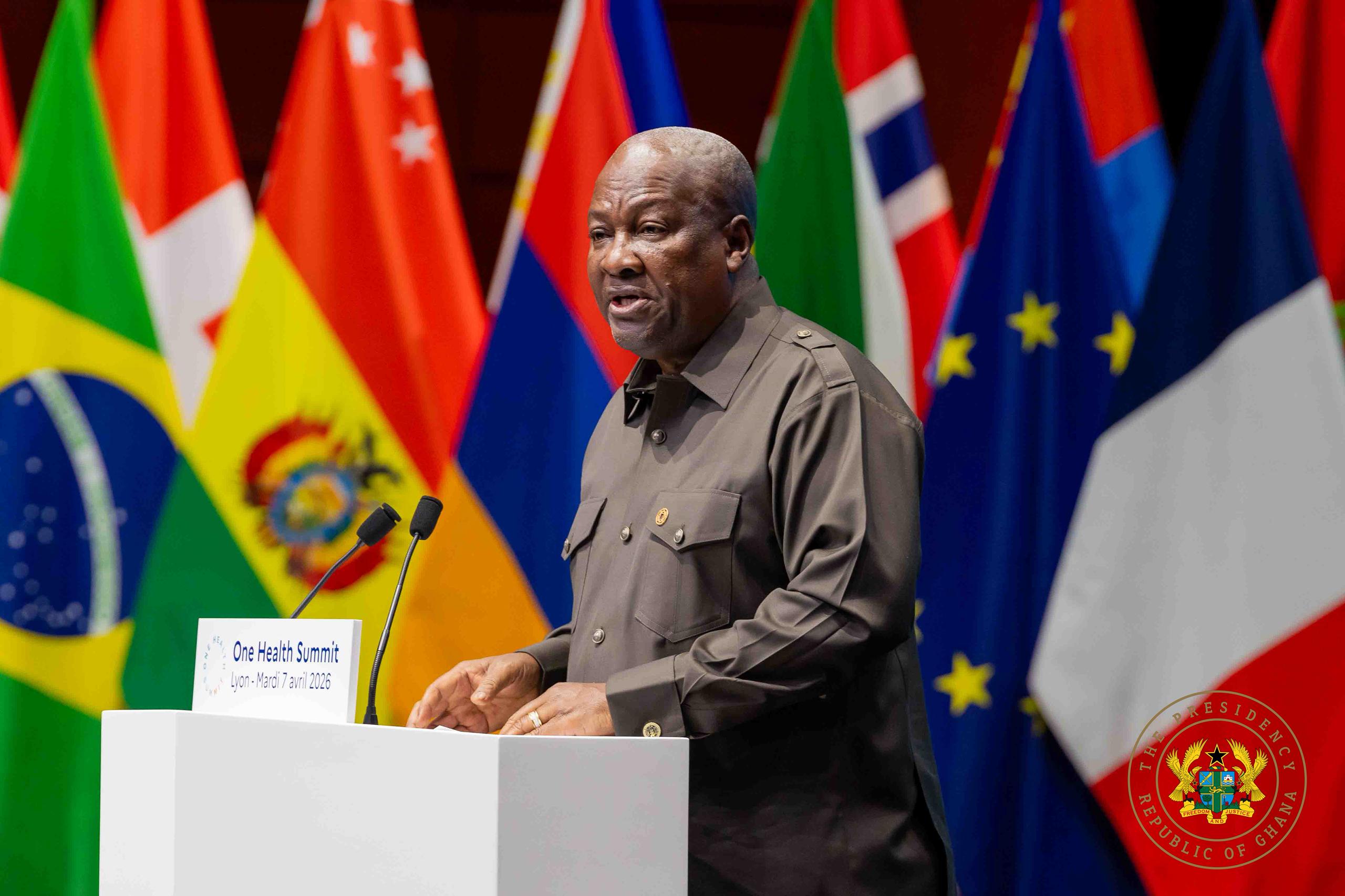
President John Dramani Mahama has called for decisive global action to address the growing intersection of climate change, environmental degradation, and public health threats, warning that the world is facing an unprecedented convergence of crises.
Delivering the keynote address at the One Health Summit in Lyon, which he co-chaired with French President Emmanuel Macron, President Mahama expressed gratitude to the Government of France and international partners for convening the high-level gathering.
“I wish to thank the Government of France for convening this important summit in Lyon and the Quadripartite organisations for their continued leadership in advancing the One Health agenda globally,” he said. “I am grateful for the honour of co-chairing this summit.”
The President noted that the world is undergoing profound shifts, with long-held assumptions increasingly being challenged.
“We are living in truly interesting times, and much of what we previously took for granted is now being questioned, while our old answers have become new questions,” he observed.
President Mahama emphasised that global health has become the focal point of these pressures, citing a surge in cross-border threats affecting humans, animals, and plant life.
“Health, and global health in particular, is where these pressures have come to a head, as around the world we face an overwhelming surge of cross-border health threats,” he stated.
He highlighted the visible impact of environmental degradation, pointing to rising sea levels, desertification, and deforestation as clear indicators of a deepening crisis.
“The environmental catastrophe confronting us is visible in the waves of the sea, the melting glaciers, the rainforests, and the desert storms,” he said.
Drawing on Ghana’s experience, President Mahama revealed that climate-related challenges are already affecting key sectors of the economy.
“In Ghana, diseases and pests are affecting smallholder cocoa farmers and threatening millions of livelihoods, while illegal gold mining continues to degrade forests and pollute water bodies,” he noted.
He identified climate change as the underlying driver linking multiple global threats, from infectious diseases to food insecurity.
“At the foundation of all these crises is climate change, which underscores the reality that everything is interconnected,” he said.
President Mahama stressed that Africa’s long-standing relationship with nature aligns closely with the One Health concept.
“The One Health approach is not theoretical for us in Africa, as we have traditionally lived in close harmony with nature,” he explained, adding that “more than 50 percent of our population relies on herbs and natural forest resources for medicine.”
Referencing Africa’s historical legacy, he underscored the continent’s long tradition of integrated health systems.
“From Songhai to Great Zimbabwe, from Timbuktu to Aksum and ancient Egypt, knowledge systems have existed for diagnosing and treating diseases, managing pests, and sustaining agriculture,” he said.
The President also reflected on recent global health crises, including COVID-19, Mpox, Lassa fever, and Marburg, noting that these experiences reinforce the importance of prevention.
“These experiences have taught us that prevention is more effective and far more cost-efficient than cure,” he said, citing Ghana’s efforts to strengthen primary healthcare and establish the Ghana Medical Trust Fund.
He further warned of a growing burden of non-communicable diseases across Africa, alongside evolving infectious disease patterns.
“The drivers of today’s health threats are interconnected and mutually reinforcing, with plastic pollution posing an additional global challenge,” he added.
President Mahama expressed concern over global inequities, noting that countries most vulnerable to health risks often lack the resources to respond effectively.
“It is regrettable that countries most at risk often have the least resources to respond, and this inequity must be addressed,” he stressed.
He called for equitable access to financing, technology, and innovation, urging global leaders to move beyond rhetoric.
“We must ensure fair access to financing, technology, data, innovation, and research,” he said.
Despite ongoing discussions, the President lamented the slow pace of progress and urged renewed political commitment.
“We must now muster the political will to integrate fragmented systems and ensure that this summit in Lyon becomes a turning point,” he declared.
Concluding his address, President Mahama issued a strong call to action for tangible outcomes.
“Let us move from commitments to action by integrating One Health into national and global frameworks ensuring that the decisions we take here lead to tangible, measurable outcomes that protect both people and the planet,” he said.
Story: Patrick Asford Boadu