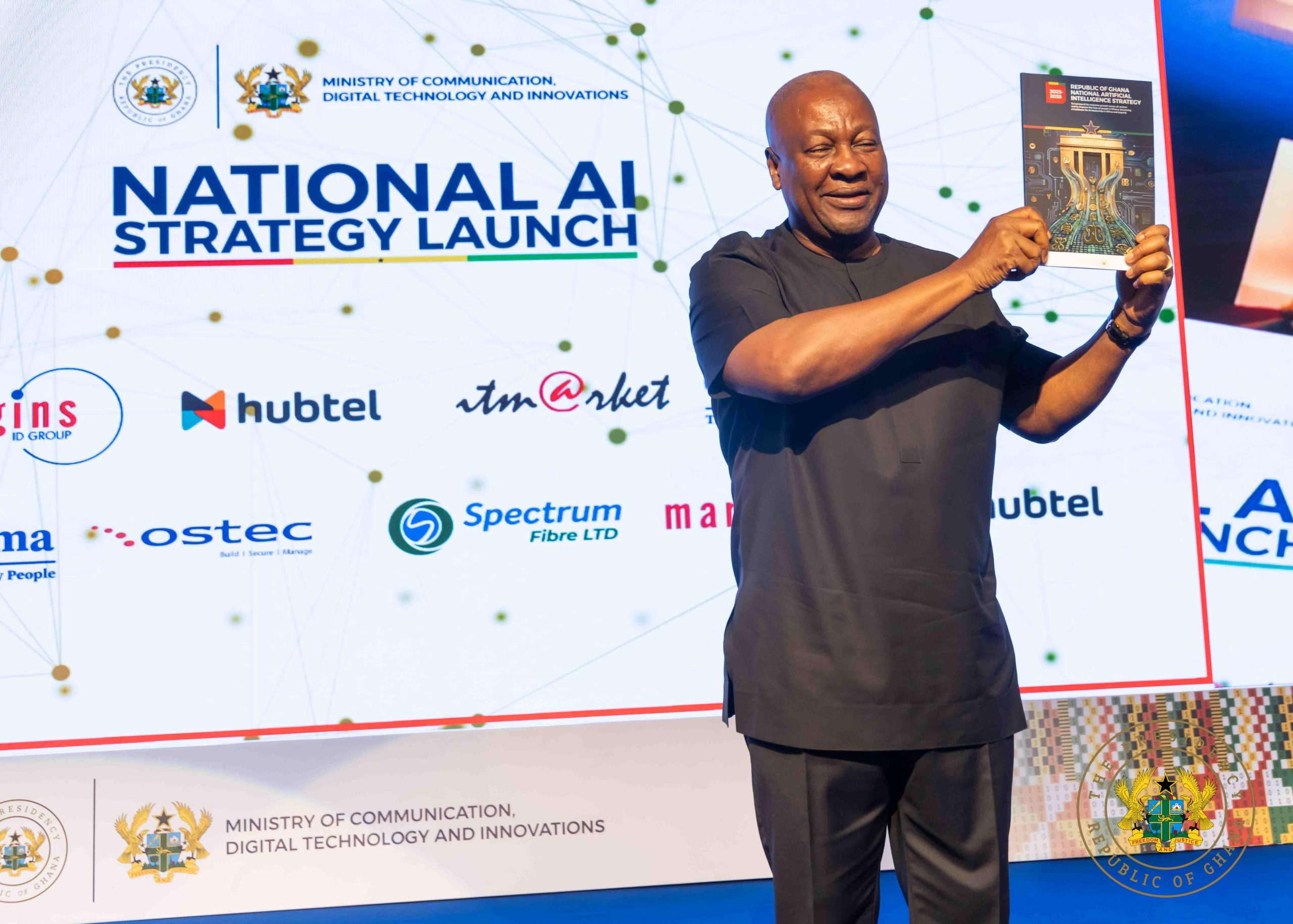
President John Dramani Mahama has officially launched Ghana’s National Artificial Intelligence (AI) Strategy (2025–2035), outlining an ambitious roadmap to position the country as a leading AI hub in West Africa.
Speaking at the launch, the President described the strategy as a defining moment in Ghana’s digital transformation journey.
“This is a significant milestone in our national journey towards a digitally empowered, innovation-driven and globally competitive Ghana,” he said.
He stressed that Ghana intends to move beyond being a passive consumer of technology to becoming an active player in shaping the future of AI.
“Ghana will not be just a passive consumer of technologies shaping the future. We are going to be active participants in designing, governing and deploying them for national transformation.”
President Mahama noted that global perceptions of artificial intelligence have shifted from fear to opportunity, with countries increasingly adopting AI for development.
“Technology is not destiny. Human choices, public policy and responsible leadership determine whether innovation will serve the common good.”
He highlighted the transformative impact of AI across sectors, including healthcare, agriculture, education, security and public service delivery.
“AI is no longer a speculative technology of the future. It is already a strategic development tool of our present.”
Addressing concerns about job displacement, the President assured that government’s approach would prioritize people. “AI must enhance human capabilities and not diminish human dignity,” he emphasized.
He announced plans to invest in skills development and workforce readiness to ensure Ghanaians are equipped for the evolving digital economy.
“We do not intend to surrender our people to technological disruptions. We intend to prepare them to lead in it.”
As part of this effort, he referenced the government’s “One Million Coders” programme, aimed at training young Ghanaians in digital and AI-related skills at scale.
“These are more than just numbers. They represent opportunity, employability and national preparedness.”
The President also underscored the need to develop AI systems that reflect Ghanaian realities, warning against over-reliance on foreign-trained models.
“We must not only use AI, we must localize AI,” he said, adding that indigenous languages and local data must be integrated into AI development.
To support implementation, President Mahama announced major financial commitments, including $250 million for a world-class AI computing centre and an additional $20 million for short- to medium-term execution of the strategy. “These investments are bold but necessary,” he noted.
He explained that the proposed AI computing centre would serve as a hub for research, innovation and enterprise, enabling Ghanaian talent to develop solutions for both local and continental challenges.
The President further revealed plans to integrate AI into Ghana’s education system, including the introduction of coding, robotics and electronics at the basic school level.
“We must equip our people not only to use AI tools, but also to build, govern and improve them.”
He also announced the establishment of a Responsible AI Office to oversee implementation and ensure accountability.
President Mahama emphasized that successful execution of the strategy would depend on collaboration between government, academia, the private sector and international partners.
“This strategy is a national call to action. It calls on all of us to work together to ensure that AI becomes a force for inclusion, productivity and national progress.”
He concluded by formally declaring the strategy launched, expressing confidence in Ghana’s ability to lead in the emerging digital era.
“Let us build an AI future that is not imported, but shaped by our own values Ghana must lead with vision, purpose and responsibility.”
Story: Patrick Asford Boadu