
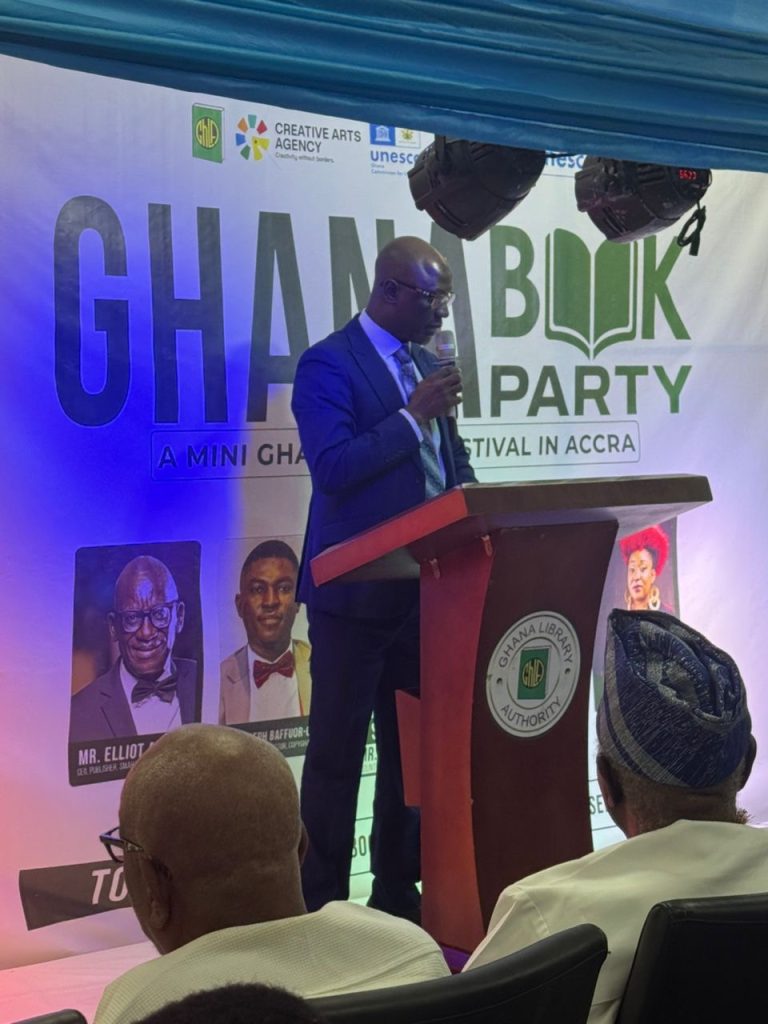
Calls are mounting on government to prioritise investment in Ghana’s library infrastructure and creative industry, as stakeholders used this year’s World Book and Copyright Day to highlight gaps in access to knowledge and policy direction.
The Executive Director of the Ghana Library Authority, Alhassan Ziblim, delivered a strong message at a national event in Accra, stressing that while some progress has been made, the pace of development remains inadequate to meet the country’s literacy and educational needs.
Speaking under the theme “From Our Roots to the World: Reading Ghana, Writing the Future,” Mr. Ziblim revealed that although over 140 libraries have been established nationwide, more than 150 districts are still without library services — a situation he implied requires urgent government intervention.
“Building communities where access remains limited must be a priority,” he said, in what observers describe as a direct appeal for increased public funding and policy attention to the sector.
The programme, organised in partnership with the Ghana Commission for UNESCO, the Creative Arts Agency and the Ghana Publishing Company, also exposed broader structural challenges within Ghana’s literary ecosystem from infrastructure deficits to limited access in rural communities.
Mr. Ziblim further called on the UNESCO and development partners to support Ghana’s digital transition in library services, but maintained that sustained local investment and political will are critical to expanding access.
He also stressed the need for stronger enforcement of copyright laws, warning that weak protection of intellectual property continues to undermine authors and the publishing industry.
In a complementary but equally pointed address, UNESCO’s Country Representative, Edmond Moukala, framed Ghana’s book industry as a strategic national asset that has yet to receive the level of coordinated policy backing required to compete globally.
Tracing Ghana’s literary journey from oral traditions to modern publishing, Mr. Moukala cautioned that failure to invest in local content production and protect creative rights could sideline Ghana in the global knowledge economy.
“A nation that does not write its own stories risks being written out of history,” he warned a statement widely interpreted as a call for deliberate state policy to support indigenous content creation.
He highlighted ongoing challenges including high production costs, weak distribution networks and piracy, urging policymakers to address these systemic issues through reforms and targeted investment.
Mr. Moukala also pushed for a forward-looking education policy that integrates digital skills, coding and storytelling, as well as the adoption of emerging technologies such as augmented reality to modernise learning.
He commended institutions such as the Ghana Library Authority, the Creative Arts Agency and the Ghana National Commission for UNESCO, but stressed that institutional efforts alone are not enough without strong government backing and policy alignment.
The Secretary General, Ghana Commission for Unesco made a strong call for Ghanaians to cultivate a reading culture at home, in schools and within communities, as he emphasised that building a knowledge-driven society begins with access to books and the promotion of local stories.
As part of the event, four literary icons Kofi Anyidoho, Martin Owusu, Lade Wosornu and Mawuli Adjei were honoured, but the recognition also served as a reminder of the need to invest in the next generation of writers.
The event ultimately evolved into a broader policy conversation, with stakeholders insisting that Ghana’s ambition to build a knowledge-based economy will remain unattainable unless government places libraries, reading culture and the creative industry at the centre of national development planning.
Story by Osman Issah Abadoo


