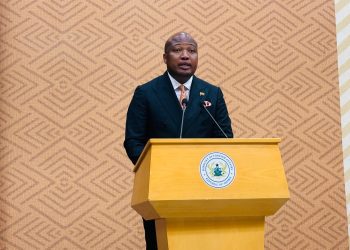
The Public Relations Officer of the Ghana Education Service, Daniel Fenyi, has intensified calls for tertiary institutions across Ghana to replace the “Women Commissioner” portfolio in Students’ Representative Councils (SRCs) with the title “Gender Commissioner.”
In a detailed statement, Fenyi argued that the proposed change reflects a more modern, inclusive, and comprehensive understanding of gender advocacy and representation within student governance structures.
According to him, the “Women Commissioner” role emerged during a period when institutional spaces were heavily male-dominated and women’s voices required deliberate amplification. While acknowledging the historical importance of the position, he maintained that gender-related challenges have evolved beyond issues affecting women alone.
“A ‘Gender Commissioner’ better captures this inclusivity,” Fenyi stated, explaining that many challenges affecting women are often shaped by broader social dynamics involving both men and women.
He noted that a gender-focused office would not only advocate for women’s welfare but also educate and engage men on issues such as sexual harassment, gender-based violence, exploitation, mental health, and inclusivity.
Fenyi further pointed to Ghana’s own policy direction as justification for the proposed shift, citing the transition from the former Ministry of Women and Children Affairs to the current Ministry of Gender, Children and Social Protection.
According to him, the change in ministerial nomenclature reflected a deliberate effort to address women’s issues within a broader gender framework that considers social relations, systemic inequalities, and power structures.
“It is inconsistent for tertiary institutions, which are centres of intellectual leadership and progressive thought, to lag behind in adopting this framework,” he argued.
The GES PRO dismissed concerns that changing the portfolio name could weaken attention on women’s issues, insisting that a broader gender-focused approach would instead strengthen advocacy efforts.
He explained that challenges such as sex-for-grades, unequal opportunities, harassment, and underrepresentation could be tackled more effectively through a framework that recognises the wider ecosystem in which they occur.
Fenyi also stressed the symbolic importance of the proposed change, noting that governance titles communicate institutional values and priorities.
“Retaining ‘Women Commissioner’ may unintentionally signal a limited or outdated understanding of gender advocacy, whereas adopting ‘Gender Commissioner’ reflects awareness and alignment with contemporary discourse,” he stated.
He concluded by describing the proposed transition as both a practical and ideological step forward that aligns SRC governance structures with current academic thinking, national policy trends, and global conversations on inclusion and representation.
Story By: Eric Boateng