
The government has positioned Ghana at the center of global cocoa sector reforms following the announcement that the country will host the 2027 World Cocoa Foundation (WCF) Partnership Meeting in Accra, in a move aimed at driving farmer welfare, climate resilience, disease control and long-term value addition in one of Ghana’s most strategic economic sectors.
Announcing the development in Accra, Deputy Minister of Finance, Thomas Nyarko Ampem, described Ghana’s selection as host as a major international endorsement of the country’s leadership in cocoa production and government’s commitment to resetting the sector for greater sustainability, competitiveness and improved returns for farmers.
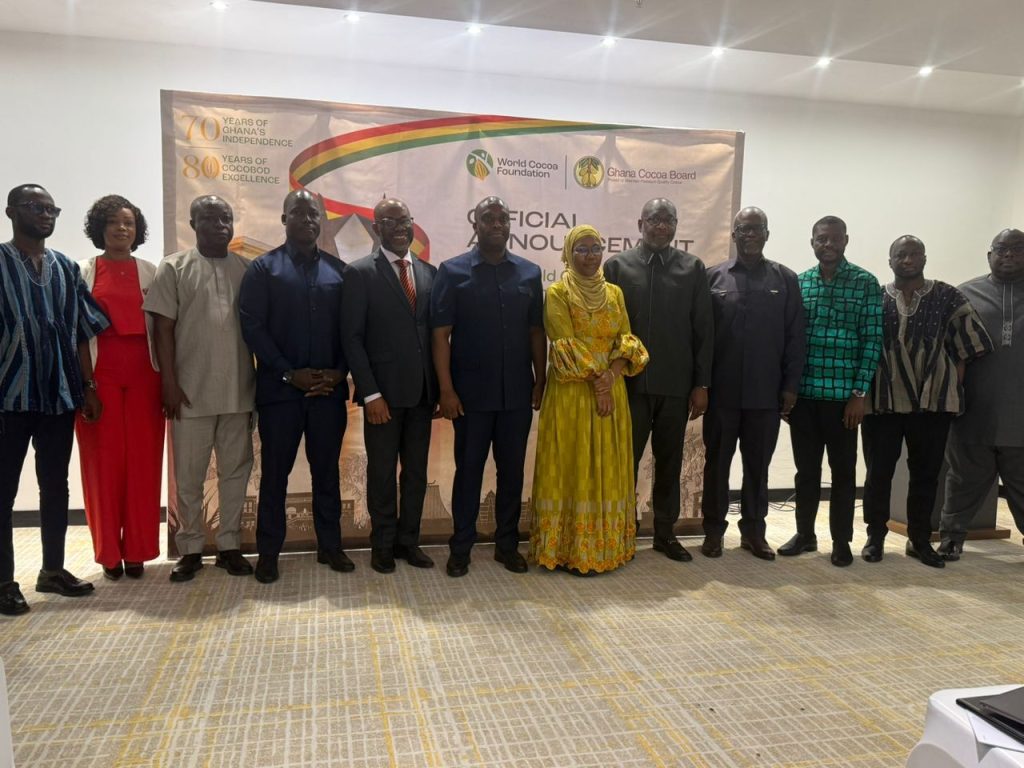
The global summit, scheduled for March 16 to 19, 2027, will bring together world cocoa industry leaders, governments, farmer organizations, financial institutions, civil society groups, development partners and policymakers to deliberate on critical issues affecting the future of cocoa production.
Mr. Ampem said government is determined to move Ghana beyond the traditional export of raw cocoa beans by promoting local processing, value addition and stronger domestic competitiveness to ensure cocoa-producing countries retain more value from the global supply chain.

He noted that Ghana’s cocoa sector continues to face significant pressures, including climate change, environmental degradation, volatile international prices and disease outbreaks such as cocoa swollen shoot virus disease, stressing that government’s ongoing “cocoa reset” agenda is designed to restore financial discipline, improve governance, support farmers, strengthen productivity and expand processing capacity.

Chief Executive Officer of the Ghana Cocoa Board, Randy Abbey, also called for urgent international collaboration to improve farmer incomes, strengthen disease response and build climate resilience ahead of the 2027 summit.
According to Dr. Abbey, farmer welfare must remain central to global cocoa sector discussions, warning that the future of cocoa production depends on whether farmers — especially younger generations — see cocoa farming as a viable and profitable long-term enterprise.

He identified cocoa swollen shoot virus disease as one of the biggest threats to productivity and called for scaled-up investments, rapid rehabilitation efforts and coordinated interventions to protect farms and safeguard supply security.
Dr. Abbey also advocated stronger climate-smart agriculture policies, forest restoration and public-private partnerships to ensure the cocoa sector remains resilient in the face of growing environmental and economic pressures.
Adding the international industry perspective, Country Director of the World Cocoa Foundation for Ghana and Nigeria, Mawuli Coffie, said Ghana’s hosting of the summit sends a powerful signal that the future of cocoa must be shaped closer to the farmers and communities at the heart of production.
Dr. Coffie stressed that resilient cocoa supply chains can only be built on resilient farmers, calling for urgent global attention to farmer incomes, access to finance, productivity improvement, disease control and climate adaptation.
He warned that sustainability efforts would fail if farm-level economics do not improve, noting that farmer wellbeing is central to the future competitiveness and security of the global cocoa industry.

Under the theme “From Origin to Global Resilience,” the 2027 World Cocoa Foundation Partnership Meeting is expected to attract more than 500 delegates from about 38 countries, with discussions focusing on farmer livelihoods, climate resilience, disease control, supply security and long-term sustainability.
The international gathering will coincide with COCOBOD’s 80th anniversary and Ghana’s 70th independence anniversary, a development government officials say presents a strategic opportunity to showcase Ghana’s leadership in the global cocoa sector and build stronger international partnerships for sector transformation.
Government says the summit forms part of broader efforts to reposition Ghana’s cocoa industry through stronger reforms, value addition, climate adaptation and farmer-centered policies aimed at securing the future of cocoa production and protecting the livelihoods of millions who depend on the sector.
Story by Osman Issah Abadoo